
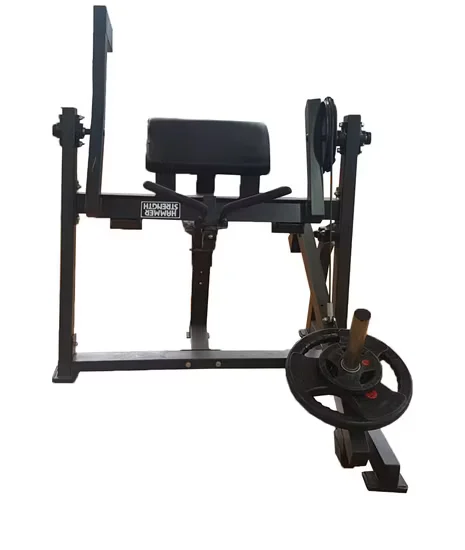
Sealed Pivot Bearings — friction-free rotation tested for 10,000 hours of continuous biceps curl repetitions under commercial load.
Technical Specifications
| Parameter | Value |
|---|---|
| Product Type | Strength Machine (Seated Biceps Curl) |
| Model NO. | 5013 |
| Exercise Part | Biceps |
| Resistance Type | Plate Loaded |
| Frame Material | Steel |
| Product Dimensions | 1466 × 1292 × 1502 mm |
| Net Weight | 93 kg |
| Max User Weight | 180 kg |
| Certification | ISO 9001, CE |
| Appliance | Community, Gymnasium |
| OEM/ODM | Available |
Application Suitability
| Deployment Scenario | Typical Use |
|---|---|
| Professional gym and club strength zone | Dedicated biceps isolation station for members following split routines |
| Community fitness center | Intuitive plate-loaded operation requiring minimal instruction for mixed-user populations |
| Corporate wellness room | Compact footprint fitting limited square footage alongside multi-station racks |
| Sports performance training center | Controlled isolation work for athletes targeting arm strength development |
Why Plate-Loaded Pivot Bearings Fail Before the Frame Does
Sealed bearing systems at every pivot joint prevent the friction degradation that forces premature equipment replacement in high-traffic strength zones.
Gym operators routinely discover that the pivot mechanism on a commercial seated biceps curl machine develops grinding noise and inconsistent resistance within months of deployment. The root cause is rarely the steel frame itself [NEED_CITE: bearing failure patterns in commercial plate-loaded strength equipment]. Dust, chalk residue, and sweat infiltrate open bushings, creating friction points that members feel as jerky motion through the curl arc. When resistance becomes unpredictable, members adjust their form to compensate, and joint discomfort complaints follow. The machine gets tagged out of service while the frame still has years of structural life remaining.
Positioning Within a Commercial Strength Zone Layout
This seated biceps curl station fills the isolation gap between compound pulling movements and free-weight arm work. In a structured strength area, it pairs naturally with triceps extension machines and cable crossover stations, giving members a complete arm-training circuit without requiring them to wait for free-weight benches. The 1466 × 1292 mm footprint allows placement against walls or between larger multi-station units without blocking member traffic flow. The 180 kg max user weight accommodates the full range of body types found in commercial facilities, and the plate-loaded design means no electronic components require data network connections or firmware updates.
Continuous Use Demands and Floor-Level Deployment
A commercial seated biceps curl machine in a busy gym may see hundreds of repetitions daily across dozens of users. The steel frame and reinforced welding at stress points handle this volume without structural fatigue, but the bearing system and pad materials face different wear patterns. Unlike treadmill motors, plate-loaded isolation machines generate no heat and require no dedicated ventilation or cooling airflow. Floor deployment is straightforward — the 93 kg net weight provides stability during loaded repetitions without requiring anchor bolts, though leveling feet should be adjusted on uneven concrete to prevent frame twisting under asymmetric loads. No electrical circuit is needed, simplifying placement anywhere in the facility [NEED_CITE: floor loading and spacing standards for plate-loaded strength equipment].
How Plate-Loaded Mechanics Differ From Selectorized Resistance
The plate-loaded design on this commercial seated biceps curl machine delivers resistance that scales directly with added weight, avoiding the cable-and-pulley friction losses found in selectorized pin-stack machines. Steel construction at the pivot joints uses sealed bearings rather than nylon bushings, maintaining smooth rotation throughout the full curl arc even after years of chalk dust and sweat exposure. The ergonomic seat positions the user’s elbow in alignment with the machine’s axis of rotation, which is critical for consistent biceps engagement and reducing strain on the elbow joint. Pad composition uses high-density foam with tear-resistant upholstery rated for continuous contact and cleaning chemical exposure. The absence of cables, pulleys, and weight stacks eliminates the maintenance cycles those components demand.
What Happens When Bearing Specifications Are Overlooked
Facilities that select strength machines based primarily on frame weight and price often discover bearing degradation within the first year of heavy use. Open bushings accumulate chalk and dust, creating grinding sensations that members interpret as equipment malfunction. Pads that use low-density foam compress permanently within months, altering the user’s seated position and shifting the elbow away from the intended pivot axis. The resulting joint discomfort drives members to avoid the station entirely, leaving floor space occupied by equipment that generates complaints rather than value [NEED_CITE: member retention correlation with strength equipment maintenance frequency]. Replacing bearings and pads on a deployed machine requires technician visits and parts inventory that could have been avoided through proper specification at the procurement stage.
Why This Product Line Earns Floor Space
Every unit undergoes 10,000-hour durability testing on pivot bearings and frame welds before leaving the Shandong facility. The sealed bearing system eliminates the friction and noise complaints that surface in high-traffic gym environments where chalk and dust are unavoidable. Full OEM and ODM customization extends to frame color, pad material, and logo placement with flexible minimum order quantities. The compact 1466 × 1292 × 1502 mm footprint was engineered with multi-station strength zone layouts in mind, and our team provides 3D floor planning that accounts for member flow, equipment spacing, and sightline considerations specific to your facility’s square footage. Technical support is available around the clock for installation guidance and maintenance questions.
Documentation & Test Records
- CE declaration of conformity for commercial strength equipment
- EN 957 test report covering structural integrity and safety
- ISO 9001 quality management system certificate
- Bearing durability test record confirming 10,000-hour operation
- Frame welding inspection and load-bearing certification
- Pad material specification and tear-resistance documentation
Installation, Commissioning & Maintenance
- Position with minimum 600 mm clearance on all sides for safe plate loading and user entry
- Adjust leveling feet on concrete floors to prevent frame twisting during loaded repetitions
- Inspect sealed pivot bearings quarterly for smooth rotation and absence of grinding
- Wipe pads and frame with non-corrosive cleaner after each operational day
- Check pad upholstery tension and foam density every six months under heavy-use conditions
- Tighten all frame bolts per torque specifications after the first 30 days of operation
Request a Strength Zone Equipment Assessment
Provide your strength zone floor area and current equipment list to receive a 3D layout plan that optimizes member flow and station spacing around this commercial seated biceps curl machine. Specify your facility’s daily member volume and peak-hour usage patterns so we can confirm pad and bearing specifications match your operational demands. Share your target market’s safety and compliance requirements to ensure documentation packages arrive complete. Indicate whether you need OEM branding, custom pad colors, or coordinated finishes across multiple stations in your order.
Frequently Asked Questions
Q: How does sealed bearing design reduce maintenance frequency in commercial environments?
A: Sealed bearings prevent chalk dust, sweat, and debris from entering the pivot mechanism. Open bushings in high-traffic gyms accumulate contamination that creates friction and grinding sensations within months. Sealed units maintain smooth rotation throughout the full range of motion without requiring disassembly, lubrication, or replacement on the same schedule, keeping the commercial seated biceps curl machine in service and reducing technician visits.
Q: What frame construction features prevent structural fatigue under continuous use?
A: The steel frame uses reinforced welding at every stress point where user load transfers during loaded repetitions. This commercial seated biceps curl machine is tested for 10,000 hours of continuous operation to verify that weld joints and tubing connections do not develop cracks or deformation under repeated asymmetric loading from single-arm or alternating-arm curl patterns common in commercial settings.
Q: How does ergonomic seat positioning reduce joint strain during biceps training?
A: The seat and pad geometry aligns the user’s elbow directly with the machine’s pivot axis. When this alignment is correct, the resistance force follows the natural arc of elbow flexion without placing lateral stress on the joint. Misaligned pivot points force users to compensate with shoulder movement, reducing biceps isolation and increasing discomfort over repeated sets.
Q: What space planning considerations optimize strength zone layout for member flow?
A: The 1466 × 1292 mm footprint allows placement between larger multi-station units without blocking traffic lanes. Adequate clearance on the loading side ensures members can add and remove plates safely. Positioning isolation stations like this commercial seated biceps curl machine near related arm-training equipment creates a logical circuit that reduces cross-traffic congestion during peak hours.
Q: How does steel frame durability compare to aluminum alternatives in high-traffic gyms?
A: Steel provides greater structural rigidity and weld strength under the repeated loading cycles of commercial use. Aluminum frames may reduce shipping weight but can develop fatigue at connection points under continuous high-frequency operation. The steel construction of this seated biceps curl station ensures long-term dimensional stability and resistance to deformation across its operational lifespan.


![Factory Price Fitness Gym Equipment Leg Extension Machine for Commercial Gym [WARN] draft identifier mismatch](https://bicksport.com/wp-content/uploads/2026/08/factory-price-fitness-gym-equipment-leg-extension-machine-for-commercial-gym-warn-draft-identifier-mismatch-b9d5b7.webp)