
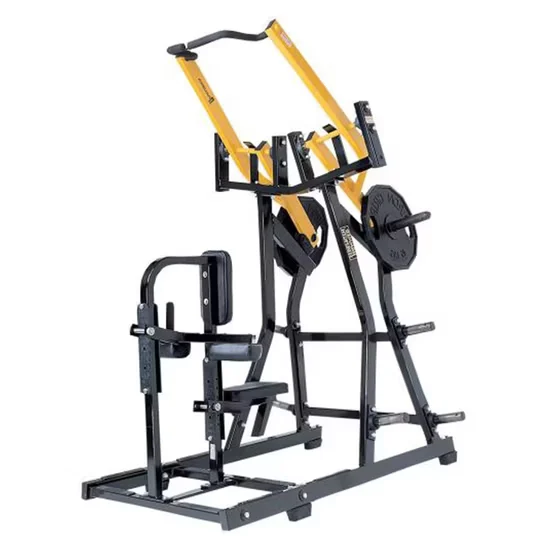
10,000-Hour Durability Validated — plate loaded front lat pulldown engineered for continuous commercial back training with sealed pulley bearings and reinforced steel frame integrity.
Technical Specifications
| Parameter | Value |
|---|---|
| Product Type | Plate Loaded Lat Pulldown |
| Model NO. | 5015 |
| Exercise Part | Back |
| Gender | Unisex |
| Material | Steel |
| Product Dimensions | 1650x1100x2050mm |
| Net Weight | 145kg |
| Target Audience | Adult |
| Application | Gymnasium, Commercial Gym |
| Certification | ISO 9001, CE |
Application Suitability
| Deployment Scenario | Typical Use |
|---|---|
| hotel fitness center on guest room floors | 24-hour self-service back training with minimal noise transfer |
| chain gym cardio and strength zone | high-repetition lat work between peak-hour class rotations |
| corporate wellness room | mid-day back activation for desk workers with limited rest intervals |
| high-end residential home gym | daily heavy-load pulldown sessions without pulley wear concerns |
| sports performance training center | athlete-grade lat engagement for overhead strength programming |
Why Cable Wear Decides Whether a Plate Loaded Front Lat Pulldown Stays on the Floor or Gets Tagged Out of Service
Sealed bearings and smooth cable routing prevent the fraying that takes machines offline.
When pulleys spin thousands of cycles daily, open bearings collect chalk dust and sweat residue, grinding the cable sheath until strands separate mid-set. A frayed cable on a plate loaded front lat pulldown commercial gym equipment unit does not just feel rough — it snaps under load, creating a safety incident that shuts the entire strength row down for inspection. [NEED_CITE: cable fatigue failure modes in commercial plate loaded equipment] Facilities replacing cables every few months are not maintaining equipment; they are subsidizing underspecified components.
Where This Plate Loaded Front Lat Pulldown Commercial Gym Equipment Fits in a Strength Zone Layout
The plate loaded front lat pulldown commercial gym equipment anchors the vertical-pull station, covering wide-grip and close-grip lat activation across beginner to advanced load ranges. It pairs with a seated row for horizontal pulling balance and a chest-supported T-bar for mid-back density work. Positioned along a wall or partition, its 1650x1100mm footprint leaves clear passage for plate loading without blocking adjacent equipment traffic. The 145kg steel frame stays stable under uneven plate loads, accommodating users across a wide body-mass spectrum without lateral shift.
Continuous Operation and the Environment Around the Machine
Commercial strength floors run twelve to sixteen hours daily, meaning pulleys cycle through tens of thousands of repetitions per week [NEED_CITE: duty cycle expectations for commercial plate loaded strength equipment]. Sealed bearings keep chalk, dust, and humidity from reaching the inner race, which is where most pulley failures originate. The reinforced steel frame transfers load directly to the floor without flex, so leveling feet must sit on a solid surface — rubber mats alone introduce lateral sway under heavy plate stacks. No electrical circuit is required, which eliminates voltage mismatch concerns entirely and allows placement anywhere the floor load rating permits.
Reading the Pulley and Frame Specifications That Actually Matter
The 145kg net weight reflects a steel frame thick enough to resist torsional flex when a user loads one side heavier than the other during unilateral pulldowns. Precision-machined pulleys with sealed bearings reduce rotational friction so the cable travels smoothly from the top anchor to the lat bar without the stuttering feel that signals worn bushings. Smooth cable routing keeps the wire rope aligned through each guide point, preventing the edge-wear that causes individual strands to separate and whip outward under tension. The 1650x2050mm vertical profile provides sufficient overhead clearance for full-arm extension even for taller users, ensuring the lat reaches full stretch before the plates contact the guide rods. Ergonomic seat and pad positioning keeps the thoracic spine aligned so the load travels through the lats rather than shifting into the lower back. [NEED_CITE: biomechanical alignment standards for seated lat pulldown machines]
The Hidden Cost of Specifying Below Commercial Grade
Light-duty pulleys with unsealed bushings feel acceptable for the first few hundred sets, then develop lateral play that causes the cable to track off-center and chew through its own sheath. Frames built from thinner-gauge tubing deflect under eccentric loading, producing a rocking sensation that users interpret as instability and report to management as a safety concern. [NEED_CITE: frame deflection thresholds in commercial strength equipment safety standards] When the cable snaps, the plates drop uncontrolled — an event that triggers incident documentation, liability review, and often a decision to replace the entire unit rather than risk recurrence. The machines that survive five years in a high-traffic gym are the ones that were overbuilt from the pulley bearing up.
Why This Product Line Covers the Decision Points That Matter
Sub-35dB whisper-quiet operation across the cardio family means this plate loaded unit deploys beside treadmill rows without adding noise complaints from adjacent spaces. Components tested for 10,000 hours of continuous operation carry the same durability philosophy into the strength range — sealed bearings and reinforced welds instead of consumable bushings. Full OEM and ODM capability extends to frame color, pad upholstery, and logo placement so the unit matches existing facility branding. A free 3D layout covers the footprint and clearance this 1650x1100mm machine requires, including plate-loading swing radius and member flow paths. The 24/7 technical support response means a pulley alignment question gets answered before it becomes a cable replacement.
Documentation & Test Records
- CE declaration of conformity covering structural and mechanical safety requirements
- EN 957 test report validating load capacity and durability under repeated use
- ISO 9001 certificate confirming manufacturing quality management compliance
- Noise level test record documenting operational sound during loaded cycles
- Durability test log tracking pulley bearing and cable wear over extended operation
- Spare parts list with cable, pulley, and pad replacement part numbers
Installation, Commissioning & Maintenance
- Verify 1650x1100mm footprint clearance plus plate-loading swing radius on all sides
- Level frame on solid flooring; rubber mats alone introduce lateral sway under load
- Inspect cable routing through every pulley guide before first loaded set
- Check sealed pulley bearings for smooth rotation and replace if lateral play is detected
- Wipe cable and guide rods after each operating shift to remove chalk and sweat residue
- Inspect pad upholstery and foam density monthly for compression or tearing
Requesting the Right Configuration for Your Facility
Provide your strength zone square footage and adjacent equipment list to receive a 3D layout showing plate-loading clearance and member flow around this unit. Specify daily operating hours so pulley bearing specifications match your actual cycle count. Confirm floor load rating at the intended placement point for the 145kg frame plus maximum plate stack. State whether pad upholstery color and frame finish need to match an existing facility palette.
Frequently Asked Questions
Q: What steel grade and frame thickness ensure commercial durability in a plate loaded lat pulldown?
A: Commercial-grade frames use high-tensile steel tubing with wall thickness sufficient to resist torsional flex under uneven plate loading. The 145kg net weight of this unit reflects material density chosen for long-term structural integrity rather than shipping cost savings. Weld penetration depth and joint reinforcement at the pulley anchor point are where frame failures originate, so inspecting weld quality matters more than comparing overall weight figures.
Q: How do sealed bearings reduce pulley maintenance frequency under high-repetition use?
A: Sealed bearings prevent chalk dust, sweat residue, and ambient humidity from entering the inner race where they accelerate wear. Open bushings require regular lubrication and eventually develop lateral play that causes cable misalignment. Sealed units run maintenance-free through thousands of cycles, keeping the cable tracking centered and eliminating the stuttering feel that signals bearing degradation on a busy gym floor.
Q: What cable specification prevents fraying under high-repetition lat pulldown use?
A: Wire rope rated for commercial load cycles uses a strand count and core construction that resist individual strand separation under repeated tension release. Smooth cable routing through precision-machined pulleys keeps the rope aligned so it does not rub against guide edges. When routing geometry is correct, the cable wears evenly across its surface rather than developing a weak point at a single contact area.
Q: How does seat positioning affect lat engagement and user comfort during pulldowns?
A: Proper seat height and pad angle keep the thoracic spine in neutral alignment so the load travels through the latissimus dorsi rather than shifting into the lumbar region. Ergonomic pad positioning also stabilizes the thighs under heavy plate loads, preventing the user from lifting off the seat during the concentric phase. Incorrect positioning forces compensatory movement patterns that reduce training effectiveness and increase lower-back fatigue.


![Commercial Plate Loaded Hip Adductor Machine Senrui Fitness Equipment [WARN] draft identifier mismatch](https://bicksport.com/wp-content/uploads/2026/08/commercial-plate-loaded-hip-adductor-machine-senrui-fitness-equipment-warn-draft-identifier-mismatch-18499c.webp)