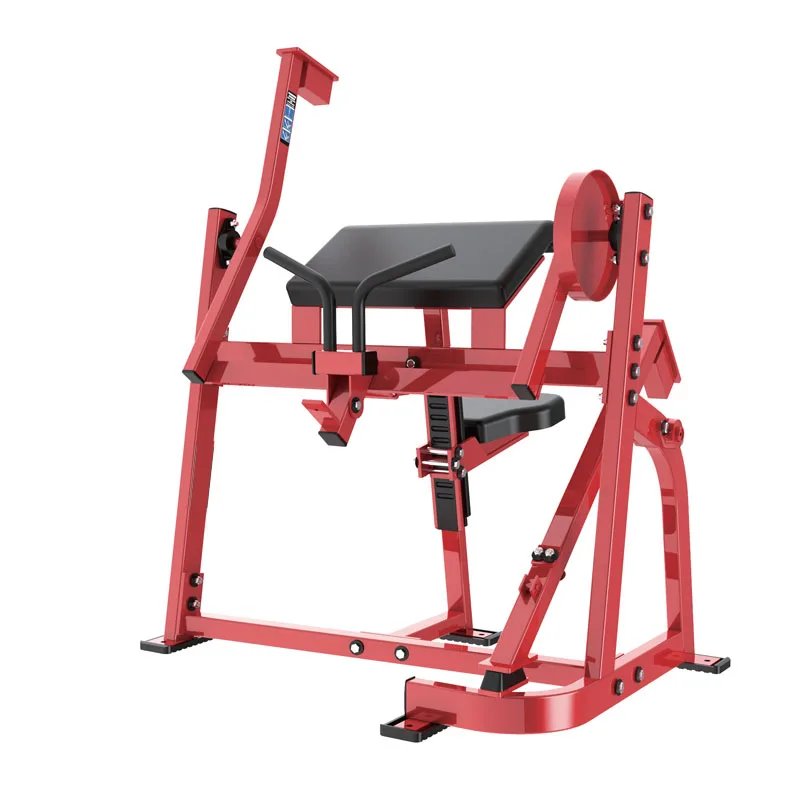
Zero Downtime Assurance — Manual plate-loaded resistance eliminates motors and electronics, the two most frequent failure points in commercial strength equipment.
Technical Specifications
| Parameter | Value |
|---|---|
| Designation | OS-H5014 |
| Product Type | Seated Dip Station |
| Resistance Type | Manual Plate-Loaded |
| Power Source | Manual |
| Material | Steel |
| Product Dimensions | 1833 x 1492 x 1110 mm |
| Net Weight | 163 kg |
| Max User Weight | 180 kg |
| Foldable | Unfolded |
| Frame Color | Customizable |
| Cushion Color | Customizable |
| Certification | ISO 9001, CE |
Application Suitability
| Deployment Scenario | Typical Use |
|---|---|
| Professional gym and club strength zones | High-frequency dip and core training for general membership |
| Community fitness centers | Low-maintenance upper body training with simple plate loading |
| Hotel fitness centers | Aesthetically customizable equipment for compact 24/7 access facilities |
| Corporate wellness rooms | Reliable manual training for employees with no electronic downtime |
| High-end residential home gyms | Heavy-duty training for dedicated strength enthusiasts |
Why Maintenance Tickets Accumulate in 24/7 Strength Zones
The absence of electronic components is the ultimate reliability feature.
In facilities operating around the clock, motorized selectorized machines are magnets for service calls. Consoles freeze, sensors drift, and drive belts snap under the stress of hundreds of daily repetitions. The commercial seated dip station plate loaded model OS-H5014 bypasses these issues entirely by relying on gravity and steel. With no circuit boards to fry and no firmware to update, the maintenance required drops significantly, keeping the station in constant rotation. [NEED_CITE: failure rates of electronic vs manual strength equipment in high-traffic facilities]
The Role of Manual Resistance in Modern Training Zones
This station focuses on the specific mechanics of the dip and abdominal engagement, offering a stable alternative to free-weight variations. In a busy gym layout, it sits naturally between the squat racks and the functional training rigs, providing a dedicated spot for triceps and chest isolation. The 180 kg max user weight and 163 kg unit weight ensure stability during aggressive sets. It accommodates a wide range of body types, allowing users to load exact increments without the "jumping" effect common in pin-loaded stacks.
Operational Endurance in Shared Spaces
Because this equipment requires no power, facility managers can place it anywhere—against a window, in a corridor, or in a basement gym—without worrying about cable management or outlet proximity. The 163 kg steel footprint provides the necessary grounding for heavy loads without the need for specialized floor anchoring in most concrete-based commercial facilities. [NEED_CITE: floor load and spatial requirements for heavy plate-loaded stations]
The Mechanics of Seated Dip Ergonomics
The 1833 x 1492 x 1110 mm footprint is designed to allow full range of motion while keeping the user centered. Seated dips reduce the stabilizer demand on the core compared to standing variations, allowing users to focus entirely on the triceps and pectorals. The manual loading system allows for micro-adjustments; users can add small fractional plates, a feature often missing in selectorized machines that jump in 10-kg increments. The pivot bearings are sealed to withstand the dust and chalk typical of high-volume training environments.
The Cost of Downtime in Membership Retention
When a selectorized machine goes "Out of Order," it stays that way until a technician arrives, sometimes for weeks. In a competitive gym environment, members notice which machines are consistently unavailable. A plate-loaded station like this one is rarely out of commission; if a cable frays or a bolt loosens, it is a five-minute fix by on-site staff rather than a specialized service call. [NEED_CITE: member attrition rates related to equipment availability]
Why We Build Around Steel and Gravity
Our engineering philosophy prioritizes "install and forget" reliability. The OS-H5014 is built from reinforced steel designed to withstand the lateral forces of heavy dip movements. We utilize full OEM/ODM customization to ensure the frame and cushion colors match the specific interior design of hotel or club environments. Furthermore, our 3D layout planning ensures this station is positioned with sufficient clearance for plate loading, preventing traffic bottlenecks in the strength zone.
Documentation & Test Records
- CE declaration of conformity for strength equipment
- EN 957 test report covering stability and loading safety
- ISO 9001 certificate for manufacturing consistency
- Durability test record for pivot bearings and steel frame
- Installation guide and spare parts list for manual stations
Installation, Commissioning & Maintenance
- Ensure a 1.5-meter clearance on all sides for safe plate loading and user entry.
- Place on a level surface with rubber matting to protect flooring from dropped plates.
- Inspect pivot bearings and frame bolts every 90 days for tightening and lubrication.
- Clean steel frames weekly to prevent chalk and sweat corrosion on the finish.
Sourcing for High-Traffic Environments
When planning a strength zone, provide the total square footage and equipment list to receive a 3D layout that optimizes member flow around plate-loading stations. Specify the daily traffic volume to ensure the selected bearing specifications match the facility’s intensity. Mention any specific branding or color requirements for the frame and upholstery to align with your design standards.
Frequently Asked Questions
Q: How does manual plate-loading compare to selectorized machines for maintenance?
A: Manual plate-loaded stations like the OS-H5014 eliminate the need for complex cable routing, weight stack pins, and electronic consoles. This reduces the number of moving parts that can fail, making them ideal for facilities with limited maintenance staff or those operating 24/7 where downtime is costly.
Q: What are the space requirements for this specific unit?
A: At 1833 x 1492 mm, the station requires a dedicated footprint plus additional clearance for plate storage and user movement. We recommend a minimum of 1.5 meters of clearance on the loading side to allow users to move plates safely without interfering with adjacent training zones.
Q: Can the frame and cushion colors be customized for my facility?
A: Yes, full OEM and ODM customization is available. We can match the main frame color and cushion color to your facility’s interior design standards, ensuring visual consistency across hotel fitness centers or branded gym chains.
Q: How does the seated design benefit users compared to standing dips?
A: The seated design provides a stable base, isolating the triceps and chest muscles by removing the need for core stabilization and balance. This allows users to safely handle heavier loads and focus on muscle contraction without the risk of swaying or losing form during high-intensity sets.
Q: What type of flooring is recommended for installation?
A: Heavy-duty rubber matting or specialized gym flooring is recommended to protect the subfloor from impact and reduce noise when plates are loaded or unloaded. The unit’s 163 kg weight requires a solid, level surface to ensure stability during vigorous use.
![Commercial Weight Tree Machine for Gym & Fitness Centers | OEM [WARN] draft identifier mismatch](https://bicksport.com/wp-content/uploads/2026/08/commercial-weight-tree-machine-for-gym-fitness-centers-oem-warn-draft-identifier-mismatch-9492e9.webp)
![2019 Hammer Strength ISO-Lateral Wide Chest 19 Commercial Gym Equipment [WARN] draft identifier mismatch](https://bicksport.com/wp-content/uploads/2026/08/2019-hammer-strength-iso-lateral-wide-chest-19-commercial-gym-equipment-warn-draft-identifier-mismatch-c85a21.webp)
![Commercial Adjustable Utility Bench Gym Equipment [WARN] draft identifier mismatch](https://bicksport.com/wp-content/uploads/2026/08/commercial-adjustable-utility-bench-gym-equipment-warn-draft-identifier-mismatch-af4b76.webp)