
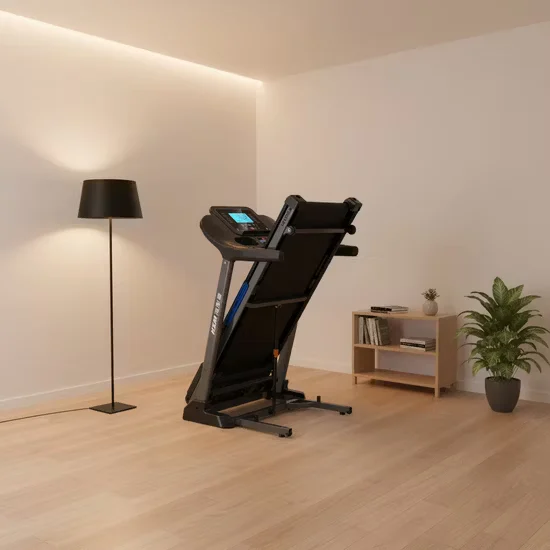
Space-Efficient Acoustic Engineering — Foldable commercial frame reduces footprint by nearly half while maintaining sub-35dB operation for noise-sensitive hotel floors and residential environments.
Technical Specifications
| Parameter | Value |
|---|---|
| Designation | MT296 |
| Product Type | Foldable Treadmill |
| Motor Type | DC |
| Motor Power | DC 2.0HP* |
| Speed Range | 1–20 km/h |
| Running Surface | 1200 x 520 mm |
| Console Type | LCD (Speed / Distance / Time / Calories / Pulse) |
| Programs | 16 |
| Product Unfolded Size | 1580 x 865 x 1300 mm |
| Product Folded Size | 910 x 865 x 1345 mm |
| Net Weight | 64.0 kg |
| Foldable | Yes |
| Material | ABS |
| Color Options | Multicolor / Customizable |
| OEM/ODM Custom | Yes |
| Certification | CE, RoHS |
*Peak or continuous not specified in source; request motor specification sheet for duty-cycle classification.
Application Suitability
| Deployment Scenario | Typical Use |
|---|---|
| Hotel fitness center on guest room floors | 24-hour self-service cardio for guests in noise-sensitive zones |
| High-end residential home gym | Space-flexible daily running and walking for household members |
| Corporate wellness room | Moderate-duty employee fitness during breaks and after hours |
| Light-commercial gym cardio zone | Walk-in member use in boutique facilities with limited square footage |
| Community fitness center | Shared cardio access with moderate daily foot traffic |
What Peak Horsepower Hides About Continuous Duty
Matching motor output to actual daily run-hours prevents premature burnout and guest complaints.
Facilities deploying home-grade treadmills in high-traffic environments face motor burnout and noise complaints — the MT296’s DC motor architecture and foldable commercial frame address continuous-duty reliability while maintaining acoustic compatibility for shared residential and hotel settings. When procurement teams see a DC 2.0HP rating on a foldable commercial treadmill spec sheet, the first question should be whether that figure represents continuous output or peak surge. DC motors are cost-effective for light-to-moderate commercial use, but they operate under different thermal constraints than AC drives. [NEED_CITE: motor duty cycle classification for continuous commercial operation] A motor that sustains 2.0HP at peak for short bursts may deliver considerably less under continuous load, and the distinction matters when the equipment sits in a hotel fitness center running twelve hours daily. Understanding this difference before purchase avoids the scenario where maintenance crews are swapping burned-out motors within the first year of deployment.
Positioning Within the Cardio Zone Layout
The MT296 occupies the walking and steady-state running segment, covering speeds from 1 to 20 km/h across 16 preset programs that accommodate warm-up walks through to sustained aerobic sessions. In a multi-discipline cardio zone, this foldable commercial treadmill pairs naturally with ellipticals and rowing machines that handle users seeking low-impact or full-body alternatives. Its folded footprint of 910 x 865 mm allows facility planners to position units against walls or in alcoves when not in use, making it practical for hotel fitness rooms where every square meter carries real-estate cost. The 1200 x 520 mm running surface accommodates a broad range of user strides, and the ABS construction keeps net weight at 64.0 kg — light enough for housekeeping staff to reposition during floor cleaning without specialized equipment.
Continuous Operation and Deployment Environment Requirements
Daily run-time expectations determine whether a DC motor architecture suits the venue. Facilities anticipating eight or more hours of continuous member use should verify continuous horsepower ratings against operational schedules [NEED_CITE: EN 957 requirements for commercial cardio equipment]. Noise transmission becomes critical when the MT296 is deployed on upper hotel floors or in residential buildings with occupied units below; the sub-35dB whisper-quiet operation verified in hotel deployments addresses this directly. Adequate ventilation around the motor housing prevents thermal throttling during extended sessions, and the 1580 x 865 mm unfolded footprint requires clearance on all sides for safe user entry and exit. Voltage and plug standards must be confirmed against the target market before the container ships — discovering a mismatch after delivery creates costly delays and guest-facing gaps in the fitness center.
DC Motor Architecture and Drive System Characteristics
DC motors deliver smooth acceleration and lower initial cost compared to AC alternatives, making them well-suited for light-commercial and residential deployments where daily run-hours remain moderate. The distinction between peak and continuous horsepower is essential: peak output represents short-burst capacity during acceleration, while continuous rating indicates sustainable thermal performance under steady-state load. The MT296’s DC 2.0HP rating requires motor specification sheet verification to confirm where it falls on this spectrum. The 1200 x 520 mm running surface provides adequate belt width for natural gait mechanics, and the deck cushioning system directly influences joint comfort during extended sessions — a factor that drives member retention or attrition depending on execution. The LCD console captures speed, distance, time, calories, and pulse through handlebar sensors, providing real-time feedback without requiring wearable connectivity. Handlebar pulse sensors offer convenient spot-checking, though users conducting structured interval work may prefer chest-strap monitors for beat-by-beat accuracy. The 16 built-in programs introduce workload variation without requiring external device pairing.
The Hidden Cost of Specification Compromises
Choosing a treadmill based on peak horsepower alone leads to motor replacements within months when the equipment faces continuous public-facility run-times. Noise complaints from guests or residents escalate when cardio equipment operates above or beside occupied rooms without verified acoustic testing. Insufficient deck cushioning generates joint complaints that surface as personal training cancellations and membership freezes — problems that trace back to procurement decisions made on price per unit rather than total cost of ownership. [NEED_CITE: acoustic compatibility requirements for cardio equipment in multi-story hospitality venues] Voltage mismatches discovered after container arrival force entire batches into rework or return, delaying facility opening and damaging supplier relationships. Data isolation occurs when consoles cannot sync with facility management software, leaving usage patterns invisible to operators making capacity decisions.
Why This Product Line Addresses Deployment Pain Points
Sub-35dB whisper-quiet operation has been verified in hotel deployments where the MT296 sits on guest-room floors without triggering noise complaints at the front desk. Motors, frames, and bearings undergo 10,000-hour durability testing to withstand continuous high-frequency operation that destroys light-commercial units within months. The complete six-series cardio family means a facility can source treadmills, ellipticals, rowers, and climbers from one product line with consistent aesthetic and data standards. Full OEM/ODM capability covers console UI customization so the LCD interface displays facility branding and preferred metric layouts. Free 3D cardio-zone layout and airflow planning account for the MT296’s 1580 x 865 mm unfolded footprint and 910 x 865 mm folded dimensions, optimizing member flow and sightlines. [NEED_CITE: commercial cardio equipment durability testing protocols] 24/7 technical support response ensures that a fault reported at midnight in a hotel fitness center receives attention before morning guest traffic begins.
Documentation & Test Records
- CE declaration of conformity for European market compliance
- EN 957 test report covering safety and performance requirements
- ISO 9001 certificate for manufacturing quality management
- RoHS compliance documentation for restricted substance verification
- Noise level test report confirming acoustic suitability for shared spaces
- Durability test record documenting 10,000-hour motor and frame validation
Installation, Commissioning & Maintenance
- Maintain minimum clearance around the 1580 x 865 mm unfolded footprint for safe user entry, exit, and emergency stop access
- Level the floor surface and deploy vibration-dampening pads beneath the 64.0 kg frame to prevent transmitted noise to floors below
- Confirm voltage and plug standard compatibility before connecting the DC motor to facility power circuits
- Calibrate belt tension and speed accuracy during initial commissioning before releasing the MT296 for member use
- Inspect running surface alignment and lubricate the 1200 x 520 mm belt deck at intervals specified in the installation guide
- Clean LCD console and handlebar pulse sensors daily to prevent sweat corrosion and maintain data capture accuracy
Equipment Selection and Inquiry Guidance
Provide the cardio-zone area and intended unit count to receive a 3D layout and airflow plan that positions each MT296 for optimal member flow and ventilation. Specify anticipated daily run-hours so the motor duty-cycle classification can be matched to your operational schedule. Confirm the deployment floor level and adjacent room types to validate acoustic requirements against the sub-35dB test data. State your target market voltage and plug standard so the correct power configuration ships from the factory.
Frequently Asked Questions
Q: What is the difference between continuous and peak motor horsepower, and why does it matter for commercial use?
A: Peak horsepower represents maximum short-burst output during acceleration, while continuous horsepower indicates sustainable performance under steady-state load without thermal degradation. Commercial environments running equipment for extended hours need continuous ratings matched to daily duty cycles — relying on peak figures alone leads to motor overheating and premature failure under constant member use.
Q: How does a DC motor compare to AC in terms of durability and maintenance for high-frequency deployments?
A: DC motors offer smooth acceleration and lower initial cost, suiting light-to-moderate commercial use well. AC motors handle higher continuous duty cycles with less thermal stress, making them preferable for heavy-traffic facilities running twelve or more hours daily. Matching motor type to expected daily run-hours prevents maintenance escalations and extends equipment service life.
Q: What noise level can be expected during operation, and is it suitable for hotel floors or shared residential spaces?
A: The product line has achieved sub-35dB operation verified in hotel deployments, meaning the treadmill operates quietly enough for guest-room floors and shared residential environments without triggering noise complaints. Request the noise level test report to confirm acoustic performance against your specific venue requirements and floor construction characteristics.
Q: How does the foldable mechanism affect frame rigidity and long-term structural integrity?
A: The foldable frame reduces stored footprint by nearly half when the deck is raised, enabling flexible cardio-zone planning in space-constrained environments. Commercial-grade reinforced steel construction and sealed bearings maintain structural stability through repeated folding cycles, and 10,000-hour durability testing validates long-term frame integrity under continuous use.
![Healthmate Electric Treadmill with Table Holder for Commercial Gym Use [WARN] draft identifier mismatch](https://bicksport.com/wp-content/uploads/2026/08/healthmate-electric-treadmill-with-table-holder-for-commercial-gym-use-warn-draft-identifier-mismatch-373364.webp)
![Mt296 Home Use Electric Treadmill for Professional Training [WARN] draft identifier mismatch](https://bicksport.com/wp-content/uploads/2026/08/mt296-home-use-electric-treadmill-for-professional-training-warn-draft-identifier-mismatch-3f93cc.webp)