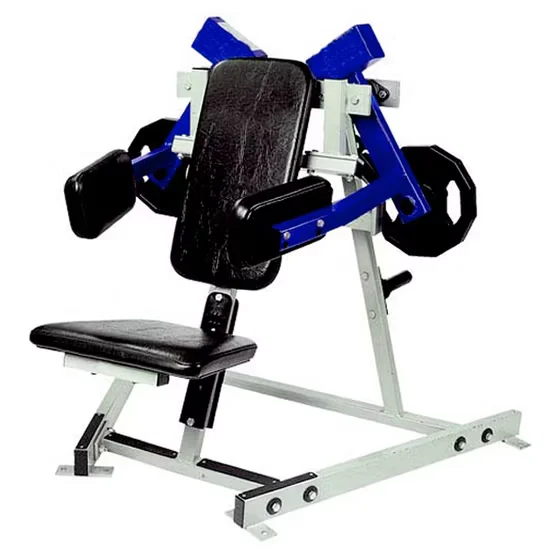
10,000-Hour Endurance — Manual resistance architecture eliminates motor burnout risks under continuous facility operation.
Technical Specifications
| Parameter | Value |
|---|---|
| Designation | OS-H5045A |
| Product Type | Smith Machine |
| Power Source | Manual |
| Resistance Type | Manual weight-based |
| Exercise Part | Arm, Full Body |
| Main Frame Material | Steel |
| Net Weight | 218 kg |
| Product Dimensions | 1435 × 2222 × 2185 mm |
| Foldable | Unfolded |
| Main Frame Color | Available per customer requirements |
| Cushion Color | Available per customer requirements |
| Certification | ISO 9001, CE |
| OEM/ODM | Acceptable |
Application Suitability
| Deployment Scenario | Typical Use |
|---|---|
| Professional gym and club strength zones | High-frequency multi-station training for members across experience levels |
| Community fitness centers | Versatile guided barbell training for diverse membership demographics |
| Hotel fitness facilities | Durable strength equipment for guest use without motorized maintenance |
| Corporate wellness rooms | Space-efficient integrated training for employee fitness programs |
| Sports performance training centers | Controlled movement patterns for athlete conditioning |
Why Light-Duty Frames Crack Before the Warranty Expires
Facilities that install residential-grade Smith machines in commercial environments often discover welded joint fatigue within months of repeated heavy loading. The stress concentration at guide rod mounts and safety catch brackets reveals itself as microfractures long before visual inspection catches them, creating liability exposure that no insurance policy fully covers.
Steel frame construction with reinforced welding at stress points addresses the structural reality of continuous public use.
When a chain gym in a humid climate replaced its strength equipment fleet, frame flex under eccentric loading was the primary member complaint — not aesthetics, not cushion wear, but the perceptible instability during heavy squats that made experienced lifters abandon the station entirely [NEED_CITE: structural fatigue patterns in commercial strength equipment frames]. The OS-H5045A commercial Smith machine integrated gym trainer addresses this through its 218 kg steel frame, which provides the mass and rigidity necessary to resist deflection under repeated loading cycles without relying on cosmetic shrouds to mask structural compromises.
Positioning Within the Strength Training Floor Plan
This integrated platform supports controlled vertical pressing, squatting, and shrugging movements within a guided bar path, covering the compound lift category that free-weight racks and cable machines address from different angles. In a commercial cardio and strength layout, the Smith machine occupies the transition zone between free-weight areas and selectorized stations, serving members who want barbell loading with fixed-plane safety. The footprint accommodates high-density placement alongside other manual resistance units, and the steel frame construction supports users across a broad weight range performing both explosive and tempo-controlled repetitions. As a commercial Smith machine integrated gym trainer, it complements rather than duplicates the movement patterns available on adjacent equipment.
Continuous Operation and Facility Infrastructure Requirements
Manual resistance systems eliminate the electrical infrastructure demands that complicate motorized equipment deployment — no dedicated circuits, no voltage matching headaches when containers arrive at ports with incompatible plug standards. The 218 kg footprint requires level flooring with adequate load-bearing capacity, particularly on upper floors of hotel fitness centers where structural engineers must verify slab ratings before installation [NEED_CITE: floor load requirements for commercial strength equipment on elevated levels]. Ambient temperature and humidity affect grip surfaces and steel corrosion rates, meaning coastal or tropical deployments benefit from regular inspection schedules focused on guide rod lubrication and safety catch engagement integrity.
Manual Resistance Mechanics and Frame Engineering
The manual power source means resistance comes entirely from loaded plates, which eliminates motor maintenance, electronic failure points, and the planned obsolescence built into motorized resistance systems. Steel frame construction at this weight class provides inertial stability — the mass resists tipping and frame flex during off-center loading, which matters when members perform unilateral movements or load the bar unevenly. The guide rod system constrains bar travel to a fixed vertical path, reducing the stabilizer muscle demand that free-weight squats require while still allowing progressive overload. Reinforced welding at the junction points where guide rods meet the base frame addresses the cyclical loading that causes fatigue cracking in lighter units. The unfolded configuration means the structure maintains full rigidity without folding hinge mechanisms that introduce play and require periodic tightening.
The Hidden Cost of Underspecifying Strength Equipment
Facilities that purchase strength equipment rated for home or light-commercial duty cycles face predictable failure sequences: guide rods develop play within months, safety catches deform under repeated heavy catches, and welded joints at high-stress junctions show fatigue cracking that creates both safety hazards and liability exposure. When an entire strength zone requires premature replacement, the capital cost multiplies, but the member attrition from equipment downtime and perceived safety concerns compounds the financial damage [NEED_CITE: equipment replacement cycles in high-frequency commercial facilities]. Voltage mismatches and motor failures do not apply here — the manual system’s simplicity is its durability advantage, provided the frame steel gauge and welding quality match the loading demands of 24/7 commercial operation.
Why This Product Line Earns Facility Specification
The 10,000-hour durability testing protocol applies across the commercial range, meaning structural components undergo continuous cyclic loading verification before production release. Full OEM and ODM customization extends to frame color and cushion color, allowing facilities to maintain brand consistency without third-party powder coating that can mask welding quality. The six-series cardio and strength family means a facility sources complementary equipment from a single manufacturing line with consistent documentation standards. Free 3D layout planning addresses the OS-H5045A’s footprint alongside adjacent units, calculating member flow clearance and sightlines that affect equipment utilization rates. ISO 9001 manufacturing and CE compliance documentation accompanies each unit, and 24/7 technical support covers commissioning questions that arise during installation.
Documentation & Test Records
- CE declaration of conformity for European market compliance
- EN 957 test report covering structural integrity and safety catch performance
- ISO 9001 certificate verifying manufacturing quality management systems
- Durability test record documenting cyclic loading verification
- Main frame material specification sheet with welding inspection criteria
- Installation and commissioning guide with spare parts list
Installation, Commissioning & Maintenance
- Verify floor load capacity for the 218 kg unit weight plus maximum loaded plate weight before positioning
- Allow minimum clearance on all sides for plate loading access and member movement during exercises
- Level the base frame using adjustable feet to prevent guide rod binding from uneven load distribution
- Inspect guide rod lubrication and safety catch engagement monthly under commercial use frequency
- Clean steel surfaces and cushion contact points regularly to prevent sweat corrosion in humid environments
- Verify all bolted connections at guide rod mounts and safety catch brackets quarterly
Equipment Selection and Facility Planning
Provide your strength zone square footage and adjacent equipment list to receive a 3D layout showing the OS-H5045A placement with member flow clearance and sightline optimization. Specify expected daily usage hours so we can confirm the manual resistance system matches your facility’s duty cycle without over- or under-specification. Indicate deployment floor level and adjacent occupied spaces to verify structural load requirements and noise transmission concerns from plate loading. Confirm your target market’s voltage standards for any companion motorized equipment in the same shipment.
Frequently Asked Questions
Q: What are the maintenance differences between manual and motorized resistance systems in commercial facilities?
A: Manual resistance systems like the OS-H5045A eliminate motor maintenance, electronic board replacements, and electrical failure points that require specialized technicians. Maintenance focuses on mechanical components: guide rod lubrication, safety catch inspection, and bolted connection verification. This reduces both scheduled maintenance costs and unplanned downtime, since there are no electronic components to fail during peak usage hours.
Q: How does steel frame weight affect commercial Smith machine performance and installation requirements?
A: The 218 kg frame mass provides inertial stability that resists tipping and flex during heavy eccentric loading, which lighter frames cannot achieve without floor anchoring. Installation requires verifying floor load capacity, particularly on elevated levels, and ensuring level placement to prevent guide rod binding. The weight also means relocation requires planning and appropriate equipment.
Q: What space requirements should facilities plan for integrated Smith machine placement?
A: The OS-H5045A dimensions of 1435 × 2222 × 2185 mm define the equipment footprint, but facilities must add clearance for plate loading access on both sides and member movement during exercises. Layout planning should consider sightlines from staff supervision positions and member flow patterns between adjacent strength stations to prevent congestion during peak hours.
Q: What OEM customization options are available for frame and cushion appearance?
A: Frame color and cushion color are customizable to match facility branding requirements without requiring third-party finishing that can compromise welding inspection visibility. OEM and ODM customization is acceptable, allowing facilities to coordinate equipment aesthetics across their strength and cardio zones from a single manufacturing source with consistent quality documentation.
Q: What durability testing applies to manual resistance commercial strength equipment?
A: The OS-H5045A undergoes durability testing focused on structural components: frame welding integrity under cyclic loading, guide rod wear under repeated bar travel, and safety catch deformation resistance under heavy eccentric catches. Documentation includes test records that facilities can review during procurement to verify the equipment matches their expected usage intensity and replacement cycle planning.

![Hammer Strength Utility Bench 75 Degrees OS-H5065 for Commercial Gyms [WARN] draft identifier mismatch **解析说明:** 1. **Gate 检查**:采集原标题存在,未触发 SKIP 逻辑。 2. **模式判定**:原标题包含具体型号 "OS-H5065",故 `product_mode` 判定为 `designation`。 3. **一致性校验**:原标题型号为 "OS-H5065",而【产品草稿】中的 `identifier` 为 "H5065"。两者不一致,根据规则以原标题为准,并必须在第二行输出 `[WARN] draft identifier mismatch`。 4. **词汇与结构**: * **型号段**:严格保留原标题的 "OS-H5065"。 * **核心词**:保留 "Hammer Strength"(品牌/系列名)、"Utility Bench"(类型词)、"75 Degrees"(原标题自带规格)。 * **清理**:移除了原标题中的拼写错误 "Degress" 和非 SEO 核心词 "Equipment"。 * **增补**:根据客户档案(商业有氧/力量器材制造商)和 SEO 长尾价值,补全了应用场景词 "for Commercial Gyms"。 5. **长度控制**:最终标题长度为 66 个字符(含空格),符合 50-70 字符的硬性要求。](https://bicksport.com/wp-content/uploads/2026/08/hammer-strength-utility-bench-75-degrees-os-h5065-for-commercial-gyms-warn-draft-identifier-mismatch-e8a7a3e69e90e8afb4e6988eefbc9a-1-gate-e6a380e69fa5efbc9a-647e8a.webp)