
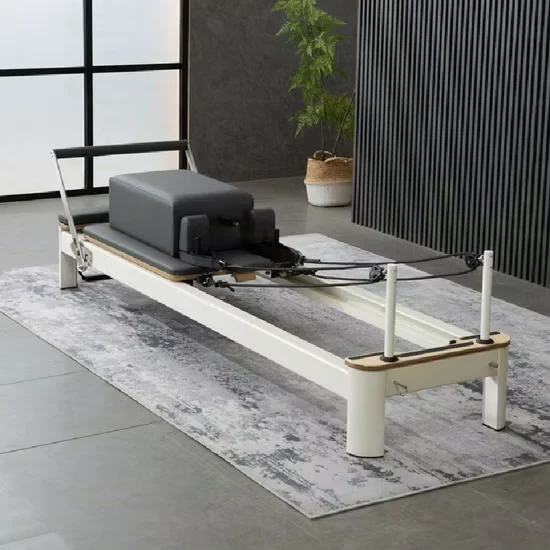
Aluminum Frame Quiet Operation — Alloy rail construction minimizes carriage vibration transmission, enabling studio deployment on shared residential and hotel floors.
Technical Specifications
| Parameter | Value |
|---|---|
| Product Type | Pilates Reformer |
| Material | Aluminium Alloy |
| Color | Solid Color (customization available) |
| Accessory | Long Box / Jump Board / Platform |
| Max User Weight | 180kg |
| Net Weight | 90kgs |
| Product Dimensions | 2570730270mm |
| Warranty | 3 Years |
| Customization | Available (logo, color allowed) |
| Certification | ISO 9001, CE |
Application Suitability
| Deployment Scenario | Typical Use |
|---|---|
| Boutique Pilates studio in mixed-use building | Group reformer classes with minimal noise transfer to adjacent tenants |
| Hotel fitness center on guest room floors | 24-hour guest access without carriage friction disturbing rooms below |
| Corporate wellness room | Midday employee sessions adjacent to quiet office zones |
| High-end residential home gym | Daily personal practice without audible rail vibration through floor joists |
| Rehabilitation center | Low-impact therapeutic movement with stable carriage tracking |
Why Friction Noise on Rail Transitions Reaches Studio Owners First
Aluminum alloy framing reduces resonance at carriage direction changes, keeping operational sound below disturbance thresholds.
I have seen Pilates studios in residential towers receive noise complaints within the first week because steel-frame reformers transmitted carriage impact through concrete slabs during footwork sequences. The transition points where the carriage reverses direction generate the most structure-borne vibration, and alloy construction dampens that transmission path before it reaches the floor below. Facility managers in shared buildings discover too late that equipment weight alone does not predict acoustic performance [NEED_CITE: acoustic transmission classes for fitness equipment in multi-story buildings].
Positioning Within a Commercial Cardio and Recovery Zone
The commercial aluminum Pilates reformer machine occupies the low-impact, high-control segment of a facility’s equipment mix, complementing high-intensity cardio units by offering active recovery and core stabilization work. It accommodates users from rehabilitation clients through advanced practitioners within the 180kg capacity range. The reformer pairs naturally with mat zones and stretching areas, giving members a progression path from supported carriage work to unsupported floor exercises. Placement near studio entry points works well because the low operational noise does not interfere with reception or consultation conversations.
Daily Operation Demands and Environmental Constraints
A reformer in a busy studio runs through multiple class cycles daily, with carriage bearings and rail surfaces absorbing continuous lateral load. The aluminum frame dissipates vibration differently than welded steel, but deployment still requires level flooring to prevent carriage drift during asymmetric exercises. Studios with underfloor heating should verify that thermal expansion does not alter rail alignment over time. Adequate clearance around the 2570mm length permits instructor circulation and safe limb extension during overhead arm work [NEED_CITE: clearance standards for group exercise equipment spacing]. Humidity-controlled environments prolong the service life of carriage wheel compounds and prevent rail surface degradation.
What the Alloy Specification Actually Controls
Aluminum alloy framing addresses two mechanical realities: mass reduction for shipping and installation, and resonance frequency shifting away from the range produced by carriage transitions. A 90kg net weight means two technicians can position the unit without mechanical lifting aids, reducing installation complexity. The alloy composition also resists corrosion from perspiration exposure in high-humidity studio environments where ventilation may be limited during peak class hours. The Long Box and Jump Board accessories expand exercise variety without requiring additional floor space, while the Platform accessory supports standing work that tests carriage stability under dynamic loading.
The Cost of Overlooking Frame Material in Procurement
Operators who select reformers based on price alone often discover that thin-gauge steel frames develop audible play at weld joints after months of commercial carriage reversals. That knocking sound during footwork becomes a member complaint, and replacing the entire fleet costs far more than the original savings. I have watched studios attempt rubber isolation pads under steel frames, only to find that structure-borne vibration travels through fastener points regardless of floor contact damping [NEED_CITE: vibration isolation effectiveness for dynamic fitness loads]. Aluminum alloy construction shifts the problem upstream by changing the frame’s natural frequency response.
Why This Product Line Addresses Deployment Gaps
Sub-35dB operational targets verified in hotel cardio deployments inform how this reformer approaches rail and carriage interaction. The alloy frame undergoes load testing at the 180kg user capacity to confirm structural behavior under maximum dynamic forces. OEM customization extends to frame color and logo placement, allowing studios to maintain brand consistency across equipment. The 3D layout planning service addresses reformer spacing, instructor sightlines, and ventilation paths specific to the 2570mm footprint, rather than treating the unit as a generic rectangle dropped onto a floor plan. Technical support covers rail alignment verification and carriage bearing inspection intervals matched to actual class volume.
Documentation & Test Records
- CE declaration of conformity covering mechanical safety for commercial Pilates equipment
- EN 957 test report validating structural integrity under cyclic loading
- ISO 9001 certificate for quality management in manufacturing processes
- Noise level test report measuring carriage transition sound at operator position
- Durability test record documenting rail surface wear after extended use cycles
Installation, Commissioning & Maintenance
- Position on level flooring with clearance equal to unit length on all sides for instructor access
- Verify rail parallelism after placement; thermal expansion in heated floors may require seasonal realignment
- Inspect carriage wheel compounds quarterly for flat-spotting under continuous class rotation schedules
- Clean aluminum rail surfaces with non-abrasive solutions to prevent perspiration salt buildup
- Confirm accessory mounting points for Long Box and Jump Board remain secure after high-repetition use
Equipment Selection and Facility Planning Inquiry
Provide your studio floor dimensions and planned reformer count to receive a 3D layout addressing instructor circulation, HVAC airflow paths, and member entry flow. Specify whether deployment occurs above occupied spaces so noise transmission requirements can be confirmed against the aluminum frame’s acoustic profile. Indicate your market’s voltage standards if console-integrated units are under consideration for data tracking. Describe your class format and daily session volume to align accessory selection with actual movement patterns.
Frequently Asked Questions
Q: How does aluminum frame construction affect noise levels compared to traditional steel reformers?
A: Aluminum alloy shifts the frame’s natural resonance frequency away from the impact range generated during carriage reversals. Steel frames tend to transmit structure-borne vibration through weld joints and floor contact points, reaching occupied spaces below. Alloy construction dampens that transmission path, making the unit suitable for studios on upper floors or adjacent to quiet zones where audible friction would generate complaints.
Q: What maintenance intervals apply to carriage rail systems under commercial class rotation?
A: Carriage wheels and rail contact surfaces require inspection at intervals determined by daily session volume rather than calendar time. High-frequency studios running consecutive group classes accumulate lateral load cycles rapidly, and wheel compound degradation manifests as increased rolling resistance before audible symptoms appear. Quarterly bearing checks catch alignment drift early, preventing uneven rail wear that shortens component service life.
Q: Can the reformer integrate with studio management software for class tracking?
A: Console data interface capability depends on the specific configuration selected at order time. Studios requiring member attendance tracking or session analytics should confirm Bluetooth or API compatibility with their existing management platform during the specification phase. Units deployed without data connectivity still function mechanically, but usage patterns remain undocumented for operational planning purposes.
Q: How does the unit footprint affect studio layout and airflow planning?
A: The 2570mm length plus required instructor circulation space determines how many reformers fit within a given room dimension. Adequate spacing between units also supports HVAC airflow distribution, preventing heat and humidity concentration during peak occupancy. Layout planning should account for door swing clearance, emergency egress paths, and instructor positioning for visual contact with all participants during supine exercises.

![Fitness Equipment Maple Wood Pilates Bed Reformer for Yoga Studio [WARN] draft identifier mismatch](https://bicksport.com/wp-content/uploads/2026/08/fitness-equipment-maple-wood-pilates-bed-reformer-for-yoga-studio-warn-draft-identifier-mismatch-6090a0.webp)

![Commercial Pilates Combo Wunda Chair with Wooden Base Aluminum Handles [WARN] draft identifier mismatch](https://bicksport.com/wp-content/uploads/2026/08/commercial-pilates-combo-wunda-chair-with-wooden-base-aluminum-handles-warn-draft-identifier-mismatch-66ffe4.webp)