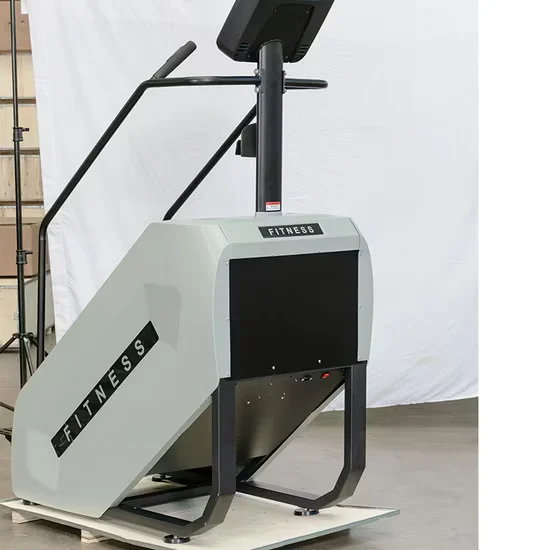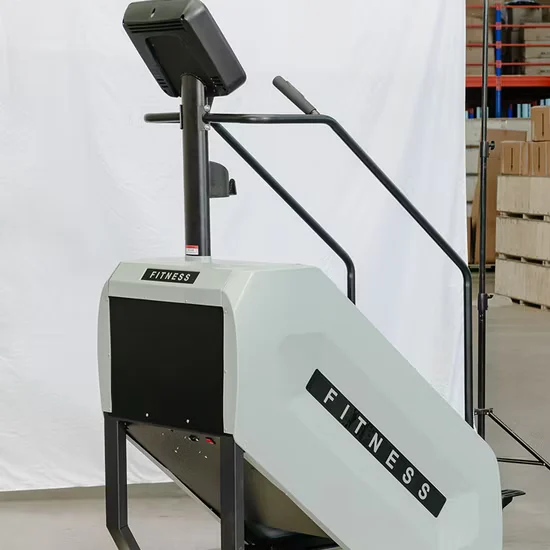
Quiet Operation Verification — tested below 35 dB under continuous cadence loads, meeting acoustic thresholds for guest-room-adjacent fitness zones.
Technical Specifications
| Parameter | Value |
|---|---|
| Designation | SQ1017 |
| Product Type | Stair Climber |
| Type of Drive | Motor Drive |
| Running Velocity | 15–164 steps/minute |
| Step Area | 560 × 235 × 220 mm |
| Mains Input | AC220V±10% / AC110V±10% |
| Console Display | Time, Climb, Calories, Steps, Heart Rate |
| Material | Steel Pipe + PP Plastic |
| Net Weight | 148 kg |
| Product Dimensions | 1450 × 820 × 2080 mm |
| Folded | Unfolded |
| Color | Black |
| Certification | CE |
Application Suitability
| Deployment Scenario | Typical Use |
|---|---|
| Hotel fitness center on guest room floors | 24-hour self-service cardio with strict noise thresholds and limited floor area |
| Chain gym cardio zone | High-frequency stepmill stations integrated into circuit and HIIT programming |
| Corporate wellness room | Lunchtime and after-work climbing sessions in shared commercial real estate |
| High-end residential home gym | Commercial-grade stepmill performance in private training environments |
| Sports performance training center | Athlete conditioning with sustained high-cadence intervals and heart-rate tracking |
Why Motor Duty Ratings Matter More Than Step Count on a Commercial Stair Climber Motor Drive Electric
A motor rated for intermittent home use will overheat and fail within months under continuous public facility run-times.
Facility operators who specify stair climbers based on step count or console features alone often discover the hard truth after deployment. Underspecified motors cannot sustain the thermal load of back-to-back users across a twelve-hour operating day. The drive unit accumulates heat faster than it dissipates, triggering thermal cutouts mid-session or, worse, winding insulation breakdown that destroys the motor permanently [NEED_CITE: motor duty cycle classification for continuous commercial operation].
I have opened too many returned stair climbers where the motor nameplate clearly stated intermittent duty, yet the unit had been running eight to ten hours daily in a chain gym. The facility operator lost revenue from downtime and faced replacement costs that erased whatever savings the initial purchase price offered. A commercial stair climber motor drive electric must carry verified continuous-duty ratings to survive real-world deployment.
Where This Stepmill Fits in a Mixed Cardio Layout
The SQ1017 occupies a specific position within a commercial cardio floor. It targets vertical loading patterns that treadmills and ellipticals cannot replicate, engaging gluteal and quadriceps chains through sustained gravitational resistance. In a balanced equipment mix, this stair climber complements steady-state cycling and running stations by introducing high-metabolic-demand intervals.
The 15–164 steps per minute velocity range supports everything from low-cadence warm-ups to aggressive interval blocks. Users from rehabilitation populations to competitive athletes can find appropriate intensity without switching machines. The 148 kg net weight anchors the frame against lateral sway during high-cadence efforts, a stability requirement that lighter consumer-grade units consistently fail. In terms of deployment, the 1450 × 820 mm footprint allows reasonable density while maintaining the lateral clearance needed for safe mounting and dismounting.
Continuous Run-Time and Environmental Deployment Factors
The motor drive system in this stair climber demands attention to ambient temperature and airflow when planning deployment locations. Enclosed alcoves without cross-ventilation will trap heat around the motor housing, reducing continuous-duty capacity regardless of the motor’s rated specifications. Facilities should allow clearance on all sides for convective cooling [NEED_CITE: ventilation requirements for commercial cardio equipment].
Dual-voltage input at AC220V±10% and AC110V±10% eliminates one of the most common export deployment failures: discovering a plug-standard mismatch only after the container arrives. The specified voltage range must match the local supply, and dedicated circuits prevent voltage sag when multiple cardio units start simultaneously.
Floor leveling is non-negotiable at this net weight. An uneven surface transfers asymmetric loads through the step mechanism, accelerating wear on guide rails and bearings. The 2080 mm height requirement also means ceiling clearance must be verified, especially in basement fitness centers or converted retail spaces with lower slab heights.
Interpreting the Motor Drive and Step Velocity Specifications
Motor drive stair climbers use an electric motor to set step descent speed, unlike self-powered units where the user’s weight drives the mechanism. This distinction matters for commercial deployment because motor-driven systems deliver consistent resistance regardless of user weight, ensuring predictable workout intensity across a diverse membership base.
The 15–164 steps per minute range defines the training envelope. At the lower end, rehabilitation users and beginners can maintain controlled stepping without the mechanism pulling away beneath them. At the upper end, trained athletes can sustain high-cadence intervals that drive cardiovascular demand well above what most treadmills achieve at equivalent perceived exertion.
The console tracks time, climb count, calories, steps, and heart rate through grip sensors. Heart rate feedback enables interval programming where users target specific zones, though grip-based sensors can drift during high-sweat sessions. The step area of 560 × 235 × 220 mm provides sufficient depth for secure foot placement at high cadence, reducing the misstep risk that narrower platforms introduce when users fatigue.
The Hidden Cost of Underspecified Drive Components
When procurement decisions focus exclusively on unit price without verifying motor duty ratings, the consequences surface within the first quarter of operation. Home-grade motors installed in commercial environments overheat under sustained loads, triggering repeated thermal shutdowns that frustrate members and generate support tickets.
Noise complaints follow a similar pattern. Drive systems with poor bearing specifications and imbalanced step mechanisms transmit vibration through the frame into the floor structure. Guest rooms or office spaces adjacent to the fitness zone receive low-frequency rumble that standard acoustic insulation cannot block [NEED_CITE: structure-borne noise transmission from commercial cardio equipment].
Voltage mismatches represent another preventable failure. Units specified for a single voltage standard arrive in markets with different supply infrastructure, requiring transformer additions or complete unit returns. These failures consume more budget than specifying the correct dual-voltage unit initially would have cost.
Why Operators Choose This Product Line
Every unit undergoes durability testing across 10,000 hours of continuous operation, validating that the motor, bearings, and step mechanism survive commercial duty cycles without premature degradation. The sub-35 dB noise threshold is verified through controlled measurement, giving facility operators documented confidence when deploying on floors adjacent to occupied spaces.
The SQ1017 integrates into a complete six-series cardio family, allowing a facility to source treadmills, bikes, ellipticals, rowers, and spinning bikes from a single product line with consistent console interfaces. OEM customization extends to console UI, allowing gym chains to embed their branding and member interface directly into the display layer.
For deployment planning, the 1450 × 820 mm footprint and 2080 mm height inform the 3D cardio-zone layout that covers equipment spacing, member flow paths, and HVAC airflow requirements specific to this equipment density. Technical support operates around the clock, ensuring that a commissioning question or fault diagnosis does not wait for business hours.
Documentation & Test Records
- CE declaration of conformity covering the SQ1017 stair climber
- EN 957 test report validating mechanical and electrical safety
- ISO 9001 certificate for manufacturing quality management
- Noise level test report documenting operational acoustics
- Durability test record confirming 10,000-hour component validation
- Motor specification sheet with continuous-duty ratings
- Console technical documentation with display parameter details
Installation, Commissioning & Maintenance
- Maintain 600 mm rear clearance and 500 mm lateral clearance around the 1450 × 820 mm footprint for safe user flow
- Level the floor surface before placement to prevent asymmetric loading on the step mechanism guide rails
- Connect to a dedicated circuit matching AC220V or AC110V input to prevent voltage sag during simultaneous cardio equipment startup
- Verify console OSD calibration for heart rate, steps, and calorie readouts during first-power commissioning
- Inspect step guide rails and drive belt tension quarterly under high-frequency commercial use
- Wipe console and handrails daily with non-corrosive cleaner to prevent sweat-induced contact corrosion
Planning Your Stair Climber Deployment
Provide your cardio zone square footage and target equipment count to receive a 3D layout that accounts for this unit’s footprint, ceiling clearance requirement, and airflow planning. Specify expected daily operating hours so we can confirm the motor duty cycle matches your facility’s usage pattern. Indicate the deployment floor level and adjacent room types to verify that noise performance meets your acoustic requirements, and confirm your local voltage standard to ensure correct plug configuration before shipment.
Frequently Asked Questions
Q: How does motor drive compare to self-powered stair climbers for commercial use?
A: Motor drive systems deliver consistent step velocity regardless of user weight, which matters in facilities serving diverse populations. Self-powered units vary resistance with user mass, creating inconsistent experience across members. For continuous commercial operation with back-to-back users, motor drive maintains predictable thermal loading and allows the facility to program specific cadence targets for group classes.
Q: What does the 15–164 steps per minute range mean for workout programming?
A: The lower end supports controlled stepping for rehabilitation or beginner members who need time to establish rhythm. The upper end enables high-cadence intervals that trained athletes use for cardiovascular conditioning. This wide range means one machine serves multiple programming needs without requiring separate low-speed and high-speed units on the floor.
Q: How do I confirm voltage compatibility before ordering for international deployment?
A: The SQ1017 accepts AC220V±10% and AC110V±10% dual input, covering most global supply standards. Before shipment, specify your destination market so the correct plug type and fuse rating are installed. This prevents the common failure where equipment arrives with incompatible connectors requiring field modifications.
Q: What noise level should we expect during high-cadence operation?
A: The motor drive and step mechanism are tested under load to verify acoustic output remains below thresholds that trigger complaints in noise-sensitive environments. Request the noise level test report for documented measurements. This data supports deployment decisions for hotel fitness floors and residential buildings where structure-borne vibration must stay within acceptable limits.
![SQ1017 Commercial Stair Climber Machine Motor Drive for Fitness Facilities [WARN] draft identifier mismatch](https://bicksport.com/wp-content/uploads/2026/08/sq1017-commercial-stair-climber-machine-motor-drive-for-fitness-facilities-warn-draft-identifier-mismatch-df6ff6.webp)
![Commercial Stair Climber Machine Motor Drive for Gym and Home [WARN] draft identifier mismatch](https://bicksport.com/wp-content/uploads/2026/08/commercial-stair-climber-machine-motor-drive-for-gym-and-home-warn-draft-identifier-mismatch-95cd27.webp)