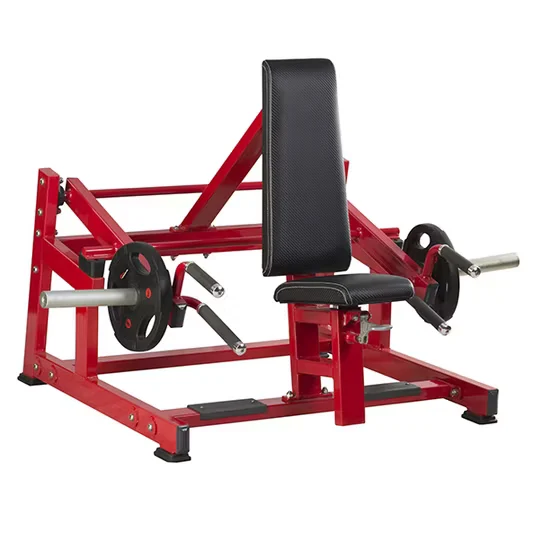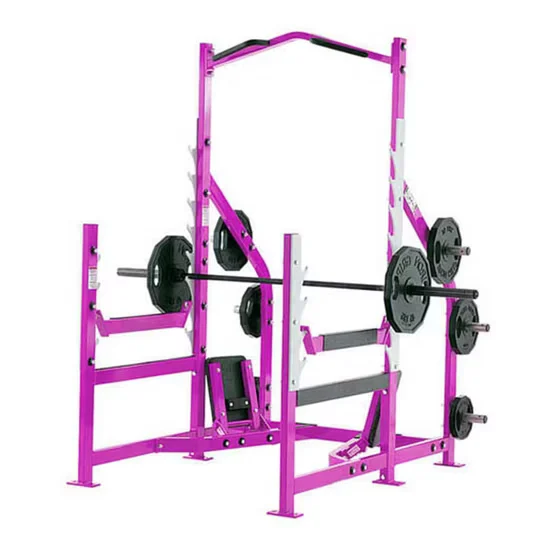
Steel Frame Rigidity — 165kg net weight and full steel construction eliminate frame resonance during heavy compound lifts in high-traffic gym environments.
Technical Specifications
| Parameter | Value |
|---|---|
| Product Type | Integrated Gym Trainer (Strength Equipment) |
| Product Dimensions | 1785×1365×2235mm |
| Net Weight | 165kg |
| Material | Steel |
| Main Frame Color | Available per customer requirements |
| Cushion Color | Available per customer requirements |
| Exercise Part | Leg |
| Folded | Unfolded |
| Power Source | Manual |
| Age Group | Adult |
| Gender | Unisex |
| Max User Weight | 180kg |
| OEM/ODM | Acceptable |
| Fit Area | Professional Gym and Club |
| Certification | ISO 9001, CE |
Application Suitability
| Deployment Scenario | Typical Use |
|---|---|
| Professional gym and club strength zone | Compound lifts, pull-ups, and accessory work during peak hours |
| Community fitness center | Multi-user functional training with high daily throughput |
| Corporate wellness room | Space-efficient strength training for employee fitness programs |
| Sports performance training center | Athlete testing and progressive overload programming |
| High-end residential home gym | Dedicated power training in private garage or basement installations |
Why Frame Oscillation Drives Member Attrition Before Anyone Notices
A 165kg steel frame holds its ground when plates load past triple digits.
I used to watch gym owners swap out strength stations every eighteen months because the frames were flexing under repeated heavy loads. Welds develop hairline cracks, uprights begin to sway during rack pulls, and members quietly migrate to facilities where the equipment feels planted. With this commercial power rack pull up station integrated gym trainer, the full steel construction and substantial net weight create a platform that does not walk across the floor during aggressive sets. The problem is rarely catastrophic failure — it is the slow erosion of member confidence when equipment feels uncertain under load [NEED_CITE: structural fatigue testing standards for commercial strength equipment].
Positioning Within the Strength Zone Layout
This integrated gym trainer occupies a specific role in facility planning: it consolidates a power rack and pull-up station into a single footprint, freeing floor area that would otherwise host two separate units. In a commercial gym strength zone, it pairs naturally with free-weight benches, cable machines, and plate-loaded sleds to cover the full spectrum of resistance training intensity. The 1785×1365mm footprint suits medium-to-high density deployments where member throughput demands efficient spacing without sacrificing clearance for loading and unloading. Users across a wide range of body sizes can perform squats, presses, pull-ups, and leg work with full range of motion. The equipment supports manual resistance progression, meaning members self-regulate loading without console interfaces or electronic governors.
Continuous Throughput and Floor Loading Considerations
In a busy professional gym, a power rack of this class sees rotation throughout operating hours, often with minimal downtime between users. The steel frame must handle repeated racking of heavy loads without accumulating stress deformation over months of continuous use. Floor loading calculations should account for the 165kg net weight plus maximum live load from users and plates, requiring level concrete subfloors with adequate compressive strength. Vibration transmission to adjacent spaces matters in multi-story deployments — a ground-floor installation avoids structural transfer concerns that arise on suspended slabs. Ventilation requirements are minimal since the unit is manually powered, but surrounding clearance must allow airflow for user comfort during high-exertion sets [NEED_CITE: commercial gym floor load capacity guidelines for heavy strength equipment]. Electrical requirements are limited to any optional accessory lighting or integrated display mounts.
Steel Gauge, Weld Integrity, and Load Path Engineering
The 165kg net weight signals substantial steel gauge selection throughout the main frame, uprights, and cross-members. Heavier gauge tubing resists bending moments generated during off-center loading, such as when a user performs unilateral movements or loads plates unevenly. Weld penetration depth and joint geometry determine whether stress concentrates at connection points or distributes along the full member length — poorly executed welds create fatigue initiation sites that propagate under cyclic loading. The manual power source eliminates motor-related failure modes entirely, focusing maintenance attention on mechanical fasteners, bushings, and any moving contact surfaces. Frame color customization allows facility operators to match existing equipment palettes or corporate visual identity without compromising structural specification. The unfolded configuration means the unit occupies its full footprint permanently, which simplifies installation but demands accurate placement during initial commissioning.
The Hidden Cost of Underspecifying Strength Stations
Facilities that install light-commercial power racks in high-traffic professional gyms often discover the gap within the first year. Frame sway becomes noticeable during heavy compound lifts, prompting members to reduce working weights or avoid the station altogether. Weld failures at high-stress joints can occur without warning, creating liability exposure and forcing emergency equipment removal. When a single underspecified unit fails, operators frequently replace an entire row to maintain visual and functional consistency — a cost multiplier that was invisible at the procurement stage. Noise from rattling components and frame vibration also degrades the training environment, particularly in facilities where strength zones share walls with group exercise studios or recovery areas [NEED_CITE: commercial strength equipment lifecycle cost analysis].
Why This Product Line Addresses the Gap
The sub-35dB whisper-quiet engineering philosophy from our cardio division translates to strength equipment through precision-machined contact surfaces that eliminate rattle and resonance. Every unit undergoes 10,000-hour durability testing protocols adapted for cyclic load application rather than continuous motor operation. The integrated power rack and pull-up design reduces sourcing complexity — one SKU covers two major training modalities. OEM and ODM capabilities extend to frame color, cushion color, logo application, and specification adjustments with flexible minimum order quantities. Our 3D layout service models the 1785×1365mm footprint within your specific floor plan, calculating member flow corridors and equipment spacing to prevent congestion during peak hours. Round-the-clock technical support covers installation queries and commissioning adjustments for international deployments.
Documentation & Test Records
- CE declaration of conformity covering structural and mechanical safety requirements
- EN 957 test report validating load capacity and stability under maximum rated weight
- ISO 9001 certificate confirming manufacturing quality management systems
- Noise level test record documenting vibration and acoustic output under load
- Durability test record showing cyclic load performance over extended testing periods
- Installation and commissioning guide with floor preparation and anchoring specifications
Installation, Commissioning & Maintenance
- Maintain minimum clearance around the 1785×1365mm footprint for safe plate loading and user movement
- Verify concrete subfloor levelness before anchoring the 165kg steel frame to prevent racking stress
- Confirm ceiling height exceeds 2235mm plus overhead clearance for pull-up and overhead press movements
- Inspect all mechanical fasteners after the first month of use and retorque to specification
- Apply protective coating to steel contact surfaces to prevent corrosion from sweat and cleaning agents
- Establish a monthly inspection schedule for weld integrity at high-stress frame junctions
Equipment Selection and Facility Planning Inquiry
Provide your strength zone square footage and planned unit count to receive a 3D layout mapping equipment spacing and member flow corridors around this commercial power rack pull up station integrated gym trainer. Specify average daily member throughput so we can confirm frame durability alignment with your usage profile. Indicate deployment floor level and adjacent room types to evaluate vibration transmission requirements. State your target market voltage standards if any powered accessories are planned. Confirm whether OEM branding or console integration with existing facility management systems is required.
Frequently Asked Questions
Q: How is the power rack frame load capacity verified during testing?
A: Each frame undergoes static and dynamic load testing per EN 957 standards, with incremental weight applied to simulate maximum user load plus plate loading. Deflection measurements confirm the steel structure returns to baseline geometry without permanent deformation. Weld joints are inspected for crack initiation after repeated cyclic loading sequences that represent years of commercial use.
Q: What are the minimum order requirements for custom frame and cushion colors?
A: Our OEM and ODM program offers flexible minimum order quantities that vary based on color specification complexity and customization scope. Standard palette selections typically require lower thresholds, while bespoke color matching to corporate visual identity systems may adjust minimums accordingly. Contact our team with your specific color codes for a detailed quotation and timeline.
Q: Can additional attachments be mounted to the power rack frame?
A: The steel frame design accommodates aftermarket accessories such as gymnastics ring anchors, resistance band attachment points, and landmine bases, provided mounting hardware matches the frame’s bolt pattern and gauge thickness. We recommend confirming attachment compatibility before procurement so that any required adapter plates or reinforced mounting points can be incorporated during manufacturing rather than field-modified.
Q: How should the strength zone layout account for this equipment’s footprint?
A: The 1785×1365mm footprint requires surrounding clearance for safe plate loading, user approach, and emergency egress. Our 3D layout service models member flow patterns during peak occupancy, positioning racks to minimize cross-traffic interference while maintaining sightlines for floor staff supervision. Ceiling height must accommodate the 2235mm frame plus overhead movement clearance for pull-ups and pressing exercises.