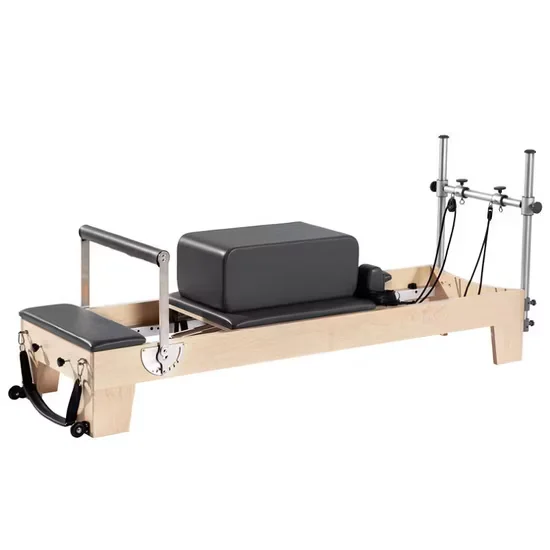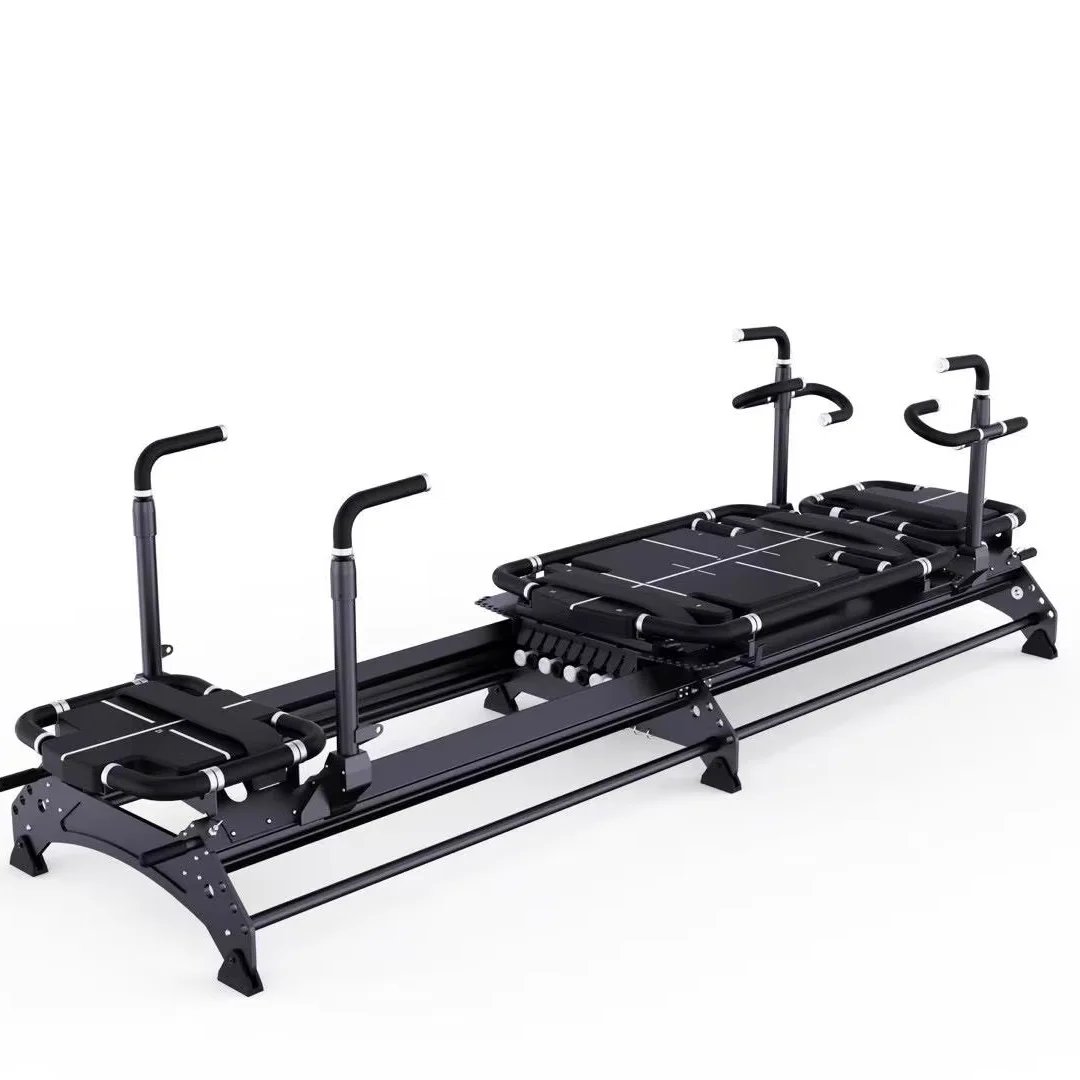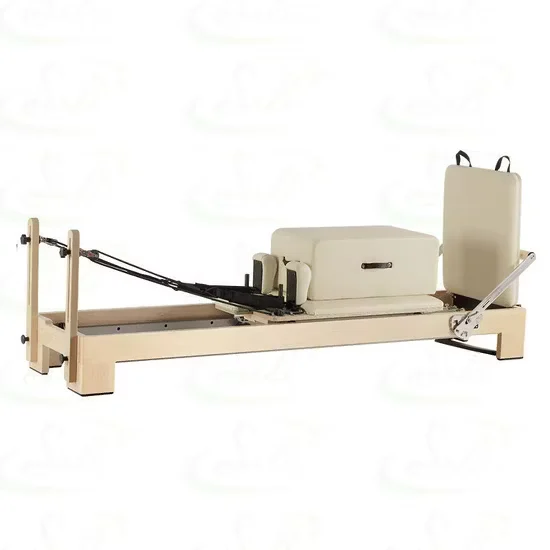
Quiet Studio Deployment — Solid maple construction with smooth carriage glide and noise-damped spring housing keeps shared wellness spaces free from mechanical disruption.
Technical Specifications
| Parameter | Value |
|---|---|
| Designation | SRY-02 |
| Product Dimensions | 2460 × 730 × 680 mm |
| Net Weight | 100 kg |
| Accessory Suite | Long Box / Jump Board / Platform |
| Finish | Solid Color (White Maple) |
| Age Group | Adult |
| Gender | Unisex |
| Logo | Customized Is Allowed |
| Production Capacity | 80 Pieces/Month |
| Warranty | 3 Years |
Application Suitability
| Deployment Scenario | Typical Use |
|---|---|
| Commercial Pilates studio | Multi-class daily scheduling with consistent spring tension across full-length carriage travel |
| Rehabilitation and physiotherapy clinic | Controlled low-impact resistance protocols for post-injury recovery and mobility restoration |
| High-end residential wellness room | Aesthetic integration with premium interior finishes for private core training sessions |
| Boutique fitness and wellness center | Group reformer classes requiring uniform equipment behavior across multiple units |
Why Squeaking Rails and Worn Pulleys Drive Members Away Before Instructors Notice
A reformer that drifts out of tolerance under continuous class scheduling quietly erodes studio retention long before mechanical failure becomes visible.
In Pilates studios running back-to-back group sessions, carriage rails accumulate micro-wear that introduces lateral play and audible friction. Clients feel the inconsistency before they articulate it — they simply stop rebooking. Spring housings that lack proper damping transmit metallic resonance through solid flooring, reaching adjacent treatment rooms and quiet zones [NEED_CITE: acoustic transmission through structural flooring in wellness facilities]. A commercial Pilates reformer core training bed must maintain glide tolerance and spring consistency through thousands of cycles, not just the first hundred. Facility operators who sourced light-duty units report replacing carriage wheels and spring anchors within months of heavy deployment.
Placement Within a Mixed-Modal Studio Floor Plan
This full-length reformer occupies a defined footprint that anchors the Pilates zone, complementing mat-work areas and Cadillac stations. The 2460 mm length accommodates full-range carriage travel for tall users while the 730 mm width maintains adequate lateral spacing between adjacent units for instructor circulation. The accessory suite — Long Box, Jump Board, and Platform — allows a single unit to cover supine, prone, seated, and plyometric progressions without requiring dedicated secondary machines. This commercial Pilates reformer core training bed fits studios scheduling mixed-level classes where exercise variety must come from one platform rather than a room full of specialized apparatus.
Continuous Scheduling Demands and Environmental Considerations
Studios running four or more group classes daily subject carriage rails and spring assemblies to sustained cyclic loading that exceeds home-use duty profiles by a wide margin. The solid maple frame and reinforced carriage track must resist deflection under repeated jump board impacts and long-box sliding loads. Floor-mounted units transmit vibration through structural slabs, so deployment on upper floors of mixed-use buildings requires isolation pads beneath each foot [NEED_CITE: vibration isolation standards for fitness equipment on suspended floors]. Ambient humidity in studio environments affects wood dimensional stability, making climate-controlled rooms essential for maintaining rail straightness and carriage fit over seasonal cycles. Adequate clearance on all four sides supports both user safety and technician access for spring and pulley maintenance.
Spring Resistance Architecture and Carriage Glide Mechanics
The spring resistance system delivers progressive load through calibrated coil springs, where each spring’s wire gauge and coil count define its force curve across the full extension range. Multiple springs engaged in parallel create compound resistance that scales smoothly from rehabilitation-level loads to advanced athletic training. Pulley routing geometry determines whether cable tension remains linear through the full carriage stroke or introduces friction peaks at travel extremes. Carriage wheel material and rail surface finish together define the glide coefficient — harder wheels on polished rails reduce rolling friction but may amplify vibration transmission, while softer compounds damp noise at the cost of higher replacement frequency [NEED_CITE: material pairing standards for carriage rail systems in commercial Pilates equipment]. The solid maple frame provides dimensional rigidity that prevents rail misalignment under asymmetric loading, a common failure mode in frames built from softer composites.
The Hidden Cost of Underspecified Components
Studios that procured reformers with light-duty springs report inconsistent resistance feel within months, as coil sets lose calibration under daily cycling. Carriage wheels molded from low-grade polymers develop flat spots, converting smooth glide into rhythmic bumping that clients immediately notice. Pulley assemblies without sealed bearings accumulate chalk dust and sweat residue, increasing cable friction and creating uneven resistance through the stroke [NEED_CITE: maintenance intervals for pulley assemblies in high-frequency studio environments]. When spring housings lack proper acoustic damping, metallic ringing propagates through the frame into the floor, reaching adjacent spaces and generating complaints from neighboring tenants. Facilities forced to replace entire units after a year of commercial use absorb costs far exceeding the initial price difference between light-duty and studio-grade equipment.
Why This Line Holds Up Under Daily Studio Load
The SRY-02 frame undergoes load testing that simulates continuous class scheduling, verifying structural integrity through extended cyclic loading. Carriage rail alignment is validated under asymmetric weight distribution to confirm glide consistency across the full stroke. The accessory mounting system — Long Box, Jump Board, and Platform — uses standardized attachment points that remain secure through repeated changeovers between class formats. Customization options including logo placement and finish color allow studio chains to maintain brand consistency across multiple locations. Deployment planning addresses unit spacing, instructor sightlines, and ventilation requirements specific to Pilates environments [NEED_CITE: spatial planning guidelines for group Pilates studio layouts]. Technical documentation covers spring replacement intervals and carriage wheel inspection schedules calibrated for commercial duty cycles.
Documentation & Test Records
- Frame load-bearing certification covering continuous commercial cyclic testing
- Spring grade specification sheets with force-curve data per coil assembly
- Carriage rail material and surface finish documentation
- Accessory compatibility and interchangeability verification records
- Installation and commissioning guide with floor anchoring specifications
- Spare parts catalog covering springs, wheels, cables, and pulleys
Installation, Commissioning & Maintenance
- Allow minimum 900 mm clearance on all sides of the 2460 × 730 mm footprint for safe user entry and instructor access
- Install vibration isolation pads beneath each foot to prevent structural transmission to adjacent rooms
- Level the solid maple frame on delivery and re-check after 30 days of loading settlement
- Inspect carriage wheels for flat spots and rail surfaces for scoring every 500 operating hours
- Replace spring sets according to documented cycle counts rather than waiting for visible sag
- Lubricate pulley bearings and check cable tension quarterly in high-humidity studio environments
Equipment Selection and Deployment Planning
Provide your studio floor area and planned unit count to receive a detailed layout covering spacing, sightlines, and member flow paths. Specify daily class scheduling volume so spring and carriage duty ratings match your operational intensity. Identify deployment floor level and adjacent space usage to confirm whether vibration isolation measures are required. State your target market and any branding requirements for coordinated finish and logo application across multiple units.
Frequently Asked Questions
Q: What determines carriage glide smoothness and long-term wear on a Pilates reformer?
A: Carriage wheel material, rail surface finish, and frame rigidity together define glide quality. Harder wheel compounds reduce rolling friction but may transmit more vibration, while softer materials damp noise at the cost of faster wear. A rigid frame prevents rail misalignment under asymmetric loads, which is the primary cause of uneven glide in commercial settings. Regular inspection intervals catch flat-spotting before clients notice.
Q: How does spring resistance configuration affect exercise versatility and client progression?
A: Calibrated coil springs deliver progressive load that increases with extension length, matching the strength curve of most movement patterns. Engaging multiple springs in parallel scales resistance for different client levels without hardware changes. Consistent spring calibration across all units in a studio ensures that instructors can program classes with predictable load expectations, which matters when clients rotate between machines during group sessions.
Q: What maintenance is required for pulley systems and carriage rails in high-frequency studio use?
A: Pulley bearings require periodic lubrication and inspection for chalk dust accumulation that increases cable friction. Carriage rails should be cleaned of sweat residue and checked for surface scoring that degrades glide smoothness. Cable tension needs verification after spring replacements to maintain linear resistance through the full stroke. Documented maintenance schedules tied to operating hours prevent reactive repairs that disrupt class scheduling.
Q: Can the reformer accommodate multiple accessory types for diverse class programming?
A: The SRY-02 accepts Long Box, Jump Board, and Platform accessories through standardized mounting points designed for quick changeovers between class segments. This allows a single unit to cover supine pressing, seated rowing, standing balance work, and plyometric jumping without requiring separate dedicated machines. Confirming accessory interchangeability across all units in a studio ensures any machine can host any class format.
Q: What frame construction standards ensure commercial-grade durability under continuous daily operation?
A: Solid maple framing provides the dimensional stability needed to maintain carriage rail alignment under repeated asymmetric loading. Frame joints must withstand both static user weight and dynamic jump board impacts without deflection. Load-bearing certification should cover cyclic testing that simulates years of daily class scheduling rather than static weight limits alone. Frame rigidity directly affects carriage glide consistency, making it the foundation of long-term equipment performance.