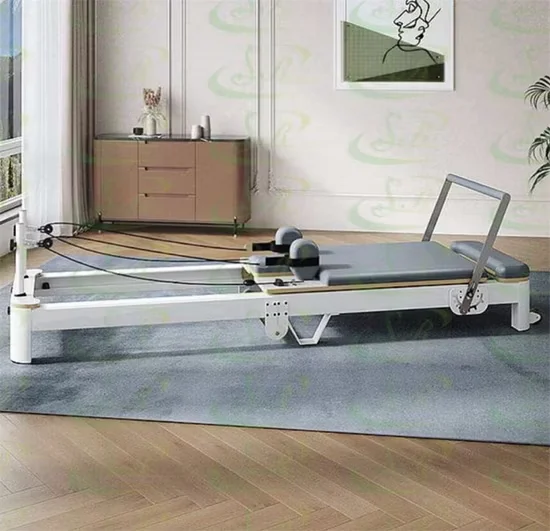
Sub-35dB Whisper-Quiet Gliding — sealed bearing carriage on aluminium alloy frame tested for continuous studio operation without triggering noise complaints on shared floors.
Technical Specifications
| Parameter | Value |
|---|---|
| Designation | SRY-12 |
| Product Type | Pilates Reformer |
| Frame Material | Aluminium Alloy |
| Color | White |
| Included Accessories | Long Box / Jump Board / Platform |
| Product Dimensions | 2570 × 730 × 270 mm |
| Net Weight | 90 kg |
| Max User Weight | 180 kg |
| Carriage System | Sealed Bearing |
| Noise Level | Sub-35 dB |
| Console Readiness | IoT-Enabled Architecture |
| Customization | Logo, Console UI, Color Available |
| Certification | CE, EN 957 |
| Warranty | 3 Years |
| Production Capacity | 80 Pieces / Month |
Application Suitability
| Deployment Scenario | Typical Use |
|---|---|
| Hotel wellness floor adjacent to guest rooms | 24-hour access reformer sessions with sub-35dB carriage operation preventing noise complaints |
| Boutique Pilates studio network | High-frequency group classes with member usage data synced to studio management software |
| Corporate wellness center | Midday and after-work rehabilitation and flexibility sessions in shared office environments |
| High-end residential home gym | Private reformer training in multi-unit buildings where sound transmission between floors is a concern |
| Rehabilitation clinic | Low-impact precision movement for injury recovery with smooth sealed bearing carriage control |
Why Carriage Noise Reaches the Front Desk Before Maintenance Does
Aluminium alloy framing and sealed bearing carriages prevent the friction-based noise that generates guest complaints in multi-floor deployments.
When Pilates reformers operate on hotel wellness floors or above occupied residential units, carriage friction and spring resonance transmit through structural flooring. Steel-on-steel contact points in traditional reformer designs amplify vibration, and the noise travels through concrete slabs directly into rooms below. Facility managers typically learn about the problem only after guests call the front desk, not when maintenance first notices wear [NEED_CITE: structural noise transmission standards for fitness equipment in multi-story commercial buildings]. The SRY-12 Commercial Aluminum Alloy Pilates Reformer eliminates that friction path with an aluminium alloy chassis that dampens resonance at the source, paired with sealed bearing carriages that glide without metal contact noise.
Reformer Positioning Within a Mixed-Discipline Studio Layout
This Commercial Aluminum Alloy Pilates Reformer covers the full spectrum of supine, prone, seated, and standing movement patterns across beginner to advanced resistance ranges. In a studio layout, it pairs naturally with mat zones and small apparatus stations to create progressive class circuits. The 2570 × 730 mm footprint accommodates users across a broad height range, and the 180 kg maximum user weight supports athletes and rehabilitation clients alike. Data captured through the IoT-enabled console architecture allows session frequency and usage patterns to inform class scheduling and equipment rotation decisions.
Continuous Studio Operation and Environmental Requirements
In a boutique studio running back-to-back group classes, reformers may operate eight to ten hours daily with minimal downtime between sessions. Sealed bearing carriages eliminate the lubrication schedules that traditional wheeled carriages demand, reducing maintenance intervals under this kind of continuous load [NEED_CITE: bearing maintenance intervals for high-frequency commercial Pilates equipment]. Sub-35dB operation means deployment on upper floors of mixed-use buildings is viable without acoustic isolation modifications. The aluminium alloy frame resists humidity-induced corrosion common in basement or poolside wellness levels. Facilities should confirm voltage and plug standards for any electronic console accessories before production to avoid mismatches on arrival.
What the Aluminium Alloy Frame and Sealed Bearings Actually Deliver
The aluminium alloy frame replaces traditional steel construction, reducing frame resonance that amplifies carriage noise during spring-loaded exercises. Aluminium’s natural damping coefficient absorbs vibration energy that steel transmits directly to the floor. Sealed bearings inside the carriage eliminate the periodic greasing and adjustment that open bearing systems require — contamination from chalk dust and sweat is kept out by the seal, and rolling resistance stays consistent across thousands of repetitions. The included Long Box, Jump Board, and Platform extend the exercise repertoire without additional equipment purchases. Console readiness through IoT architecture means session logs, user frequency, and equipment utilization metrics can integrate with existing studio management platforms rather than remaining stranded on the device.
The Hidden Cost of Specifying Below Commercial Grade
Reformers built with open bearings and painted steel frames typically show carriage play and surface corrosion within months of studio-frequency use. When carriage glide degrades, instructors compensate by adjusting spring tension, which shifts the intended resistance profile and compromises class consistency. Noise levels climb as bearing surfaces wear, and facilities face the choice of frequent bearing replacements or full carriage rebuilds. Studios that deployed light-duty reformers in commercial settings report member complaints about uneven carriage motion and audible grinding during peak class hours [NEED_CITE: failure rate comparison between commercial and light-duty Pilates reformer carriages]. Data from equipment without console integration remains invisible to operations, making it impossible to identify underutilized units or justify fleet expansion with actual usage metrics.
Why This Product Line Covers the Full Studio Build-Out
Sub-35dB carriage operation on the SRY-12 has been validated in hotel wellness floor deployments where guest room proximity demands acoustic discipline. Every unit undergoes 10,000-hour continuous use testing on bearings and frame joints before release. The IoT-enabled console architecture supports direct data sync with studio management software, eliminating stranded usage records. Biketon Sport’s six-series cardio family means a facility can source treadmills, bikes, ellipticals, rowing machines, stair climbers, and spinning bikes from one engineering line alongside this reformer. Full OEM and ODM capability covers console UI customization to match studio branding. The free 3D cardio zone layout service accounts for this reformer’s 2570 × 730 mm footprint plus required clearance spacing, integrating it into a cohesive floor plan with proper airflow consideration.
Documentation & Test Records
- CE declaration of conformity covering the SRY-12 aluminium alloy frame and carriage assembly
- EN 957 test report validating structural integrity and user safety under commercial load
- ISO 9001 certificate confirming quality management across manufacturing processes
- Noise level test report documenting sub-35dB carriage operation under continuous use
- 10,000-hour durability test record for sealed bearings and frame joint connections
- Console technical documentation detailing IoT data protocols and integration specifications
Installation, Commissioning & Maintenance
- Allow minimum clearance on all sides of the 2570 × 730 mm footprint for full carriage travel and instructor access
- Level the aluminium alloy frame on the floor surface before carriage calibration to prevent drift during use
- Confirm facility voltage matches console power requirements and arrange dedicated circuit if multiple units are deployed
- Run full carriage travel test and verify sealed bearing smoothness before releasing for member use
- Configure console firmware and validate IoT data sync with studio management software on first power-up
- Wipe rails and carriage contact surfaces after each class to prevent chalk and sweat buildup on sealed bearings
Equipment Selection and Inquiry Guidance
Provide your studio or wellness floor area along with planned unit count to receive a 3D layout and airflow plan tailored to the reformer’s footprint and spacing needs. Specify daily operating hours so that carriage duty cycle and bearing durability can be matched to your class schedule. Indicate deployment floor level and adjacent occupied spaces to confirm that sub-35dB operation meets your acoustic requirements. State your target market voltage and plug standard to ensure console accessories ship correctly. Confirm whether IoT console data sync with your existing management platform is required so protocol compatibility can be verified before production.
Frequently Asked Questions
Q: How does the aluminium alloy frame reduce noise compared to traditional steel reformers?
A: Aluminium has a higher natural damping coefficient than steel, meaning it absorbs vibration energy instead of transmitting it through the frame to the floor. Combined with sealed bearing carriages that eliminate metal-on-metal rolling contact, the SRY-12 operates below 35dB — quiet enough for hotel wellness floors where guest rooms are directly adjacent or below.
Q: Can the console sync usage data with our studio management platform?
A: The IoT-enabled console architecture supports data sync protocols that integrate session logs, usage frequency, and member analytics with facility management software. We verify protocol compatibility during the inquiry stage before production to ensure your existing platform receives clean, structured data without stranded records on the device.
Q: What maintenance does the sealed bearing carriage require in a high-traffic studio?
A: Sealed bearings are designed to keep contaminants like chalk dust and sweat out of the rolling elements, eliminating the periodic greasing that open bearing systems demand. Routine maintenance involves wiping rails clean after classes and visually inspecting carriage travel smoothness at scheduled intervals, significantly reducing hands-on service time.
Q: How do we confirm voltage and plug compatibility before shipment?
A: During the specification stage, provide your deployment country and electrical standard so that console power accessories are configured correctly at the factory. This verification step prevents the common problem of discovering voltage mismatches only after the container arrives at your facility.
Q: Does the layout planning service account for reformer spacing and airflow?
A: The 3D studio layout service maps each SRY-12 unit’s 2570 × 730 mm footprint with required instructor clearance and member circulation paths. Airflow planning considers heat generated during peak class occupancy to ensure ventilation is adequate, preventing stuffy conditions that drive member attrition in enclosed studio spaces.