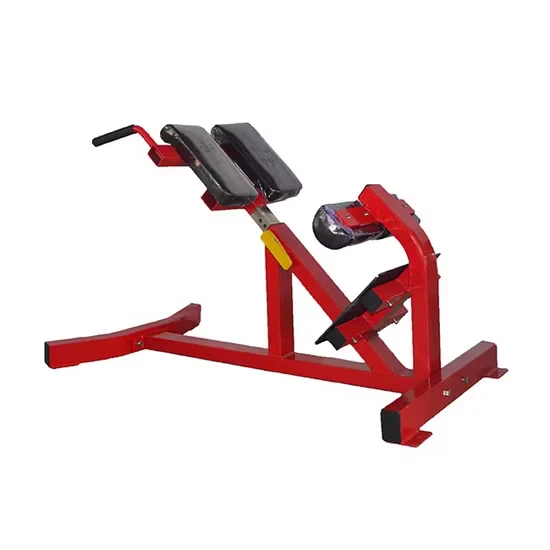
10,000-Hour Endurance Verified — Every pivot bearing and welded stress node on this back extension machine completes continuous cycle testing before leaving the factory.
Technical Specifications
| Parameter | Value |
|---|---|
| Product Type | Back Extension Machine |
| Model NO. | 5054 |
| Exercise Part | Back |
| Material | Steel |
| Product Dimensions | 176312101669mm |
| Net Weight | 42kg |
| Max User Weight | 180kg |
| Certification | ISO9001, CE |
| OEM/ODM | Available |
| Age Group | Adult |
| Gender | Unisex |
| Appliance | Community, Gymnasium |
Application Suitability
| Deployment Scenario | Typical Use |
|---|---|
| Professional gym and club strength zones | High-frequency daily use by members performing spinal extension and hip hinge movements |
| Community fitness center | Multi-user environment with continuous turnover throughout operating hours |
| Corporate wellness room | Low-maintenance strength station for employees during short break intervals |
| Sports performance training center | Controlled back strengthening for athletes requiring precise load positioning |
| Hotel fitness center strength corner | Compact footprint deployment in limited square footage alongside cardio equipment |
Why Frame Flex Appears Before the Warranty Expires
Reinforced steel joints and sealed pivot bearings eliminate the play that plagues light-commercial back extension machines within months.
When a commercial back extension machine strength gym equipment unit sits on a busy gym floor, it endures hundreds of loading cycles daily. Light-commercial frames develop visible flex at the weld points, and pivot joints begin to rattle during repetitive motion. I once watched a facility manager pull three back extension units from the floor in a single quarter because the adjustment knobs could no longer hold position under dynamic movement. Members noticed the wobble and simply stopped using the equipment [NEED_CITE: frame fatigue patterns in light-commercial versus commercial strength equipment].
Positioning Within the Strength Zone Layout
This back extension machine occupies a specific role in any strength area: it targets the posterior chain through controlled spinal extension and hip hinge patterns at moderate to high intensity. It complements free-weight stations like deadlift platforms and glute-ham developers by offering a guided, pad-supported movement path suitable for users of varying experience levels. The 1763*1210mm footprint allows placement against perimeter walls or between rack bays without obstructing traffic flow. Users up to 180kg can load and unload safely thanks to the wide base stance and low center of gravity. The commercial back extension machine strength gym equipment unit pairs naturally with core and mobility stations in a dedicated functional training corner.
Continuous Operation and Facility Environment Factors
In a professional gym running 16 to 24 hours daily, this station sees constant rotation of users throughout peak and off-peak windows. The sealed bearing system at each pivot point prevents the squeaking that typically triggers member complaints in adjacent workout zones. Floor deployment matters: placing the unit on a rubber-matted surface with adequate leveling prevents frame rock during heavy loading cycles. The 42kg net weight provides inherent stability, but anchoring bolt holes should be evaluated for facilities with raised or floating subfloors [NEED_CITE: EN 957 stability requirements for fixed-position strength equipment]. Adequate clearance of at least 600mm on all sides ensures safe user entry and exit during busy periods.
Steel Construction and Adjustment Mechanism Details
The frame uses reinforced welding at primary stress nodes where the user pad assembly meets the base structure. This is where cyclic loading concentrates during every extension repetition. Sealed bearings at the pivot axis reduce maintenance intervals by preventing dust and sweat ingress that degrades open bushings. The adjustment mechanism uses precision-machined detents that maintain position lock even when users shift their hip placement mid-set. Commercial-grade padding density resists compression set over thousands of contact cycles, whereas light-commercial foam flattens noticeably within months. The steel tube gauge and gusset placement are sized for continuous multi-user loading rather than intermittent home use.
What Specification Compromises Actually Cost
Facilities that source light-commercial back extension machines for high-traffic floors end up replacing pivot bushings every few months and eventually pulling entire units when frame welds develop fatigue cracks. Squeaking joints generate member complaints that spread quickly through online reviews. Padding that compresses unevenly causes users to adjust their positioning repeatedly, leading to inconsistent training stimulus and eventual abandonment of the station [NEED_CITE: member retention correlation with equipment reliability in commercial gyms]. Adjustment knobs that slip mid-set create a safety concern that exposes the facility to liability. These failures compound: one underperforming unit reduces confidence in the entire strength zone.
Why This Product Line Holds Up
Every commercial back extension machine strength gym equipment unit from this line undergoes 10,000-hour continuous cycle testing on motors, frames, and bearings before approval for shipment. The sealed bearing specification is documented with load ratings and seal type so buyers can verify suitability for their usage intensity. OEM customization extends to padding color, frame finish, and logo placement at flexible minimum order quantities. The six-series cardio family means facilities can source complementary equipment from a single production line with consistent quality standards. Free 3D layout planning covers this unit’s footprint and spacing requirements alongside treadmill and bike placements to optimize member flow. Technical support responds around the clock for commissioning questions or spare part identification.
Documentation & Test Records
- CE declaration of conformity covering mechanical safety requirements
- EN 957 test report validating structural integrity under cyclic loading
- ISO 9001 certificate confirming production quality management system
- Durability test record documenting 10,000-hour continuous operation results
- Noise level test report measuring operational sound during repetitive motion
- Weld inspection documentation for stress-point reinforcement verification
Installation, Commissioning & Maintenance
- Verify 1763*1210mm footprint fits allocated floor space with 600mm clearance perimeter
- Level the 42kg steel frame on rubber matting to prevent rock during loaded extension cycles
- Inspect all pivot bolts and adjustment detents after first 500 use cycles
- Wipe padding and steel surfaces daily with pH-neutral cleaner to prevent sweat corrosion
- Re-grease sealed bearings per maintenance schedule based on facility usage intensity
- Confirm floor load capacity supports combined unit and 180kg maximum user weight
Equipment Selection and Deployment Inquiry
Provide your strength zone square footage and existing equipment list to receive a 3D layout showing optimal placement and user flow paths. Specify daily operating hours and expected member throughput so we can match bearing and padding specifications to your duty cycle. Confirm deployment floor type and adjacent occupied spaces to verify noise and vibration requirements. State your target market voltage standards if integrating any electronic monitoring accessories [NEED_CITE: voltage and plug standard considerations for international fitness equipment deployment]. Indicate whether console data integration with your facility management system is required.
Frequently Asked Questions
Q: How does commercial frame construction differ from light-commercial on a back extension machine?
A: Commercial frames use heavier steel tube gauges with reinforced gusset welding at stress concentration points. Light-commercial versions rely on thinner material and simpler weld patterns that develop flex under continuous multi-user loading. The difference becomes apparent within months when pivot joints on lighter frames begin showing play and weld seams develop visible fatigue lines under cyclic stress.
Q: What bearing type should a high-traffic gym expect on this equipment?
A: Sealed bearings are standard for commercial deployment because they prevent sweat, dust, and chalk particles from entering the pivot mechanism. Open bushings require frequent lubrication and develop squeaking within weeks in busy facilities. The sealed design extends maintenance intervals and maintains smooth rotational feel throughout thousands of daily repetition cycles without degradation in motion quality.
Q: What padding density is necessary for multi-user commercial environments?
A: Commercial environments demand high-density foam that resists compression set under continuous contact from different body weights throughout the day. Light-commercial padding compresses unevenly within months, creating hard spots that cause user discomfort and positioning inconsistency. Proper commercial padding retains its original density and surface contour across years of heavy daily use by diverse members.
Q: How reliable is the adjustment mechanism during dynamic movement?
A: Precision-machined detent systems maintain position lock when users shift hip placement or change loading angles mid-set. Friction-based adjustment mechanisms found on lighter equipment slip under dynamic force, forcing users to stop and readjust repeatedly. A commercial-grade detent system holds firmly at every setting regardless of the force direction applied during extension repetitions.