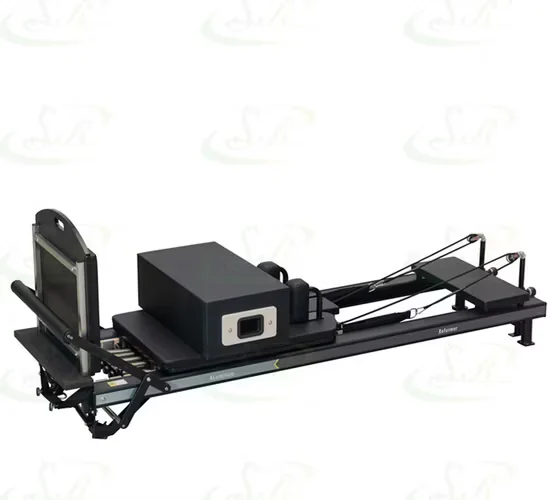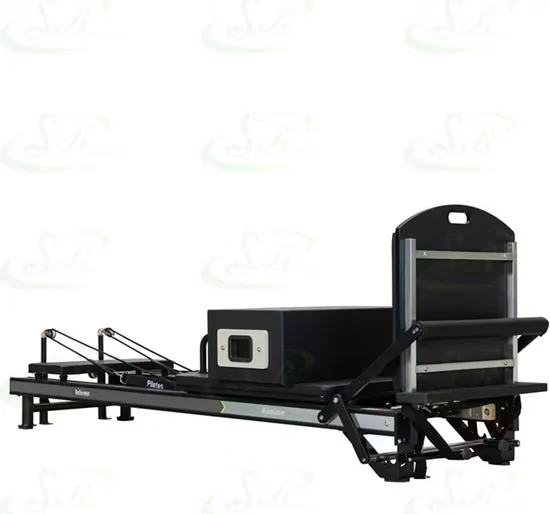
Whisper-Quiet Carriage Glide — Aluminum frame and precision pulley system engineered to maintain sub-35dB operation beside occupied hotel rooms and residential spaces.
Technical Specifications
| Parameter | Value |
|---|---|
| Designation | SRY-27 |
| Product Type | Pilates Reformer |
| Frame Material | Aluminum Alloy |
| Color | Black |
| Accessory Options | Long Box / Jump Board / Platform |
| Product Dimensions | 2570 × 730 × 890 mm |
| Net Weight | 90 kg |
| Age Group | Adult |
| Gender | Unisex |
| Logo | Customized Is Allowed |
| Production Capacity | 80 Pieces / Month |
| HS Code | 9506911900 |
| Certification | ISO 9001, CE |
| Warranty | 3 Years |
Application Suitability
| Deployment Scenario | Typical Use |
|---|---|
| Hotel fitness center on guest room floors | Silent full-body reformer sessions adjacent to occupied rooms without noise complaints |
| Commercial Pilates studio with high-frequency class schedules | Back-to-back group reformer classes requiring consistent carriage glide and pulley resistance |
| Corporate wellness room | Mid-day employee recovery and mobility sessions in shared office environments |
| High-end residential home gym | Private Pilates practice in apartments and villas where vibration transfer is a concern |
| Professional sports training center | Athlete rehabilitation and core conditioning with precise resistance modulation |
Why Carriage Noise Travels to the Front Desk First
Aluminum frame construction and sealed bearing pulleys eliminate the resonance path that steel frames amplify into structural vibration.
When a reformer carriage rattles across a hotel wellness floor at 6 a.m., the complaint lands on the front desk long before maintenance gets the ticket. Steel-frame reformers transmit rail vibration directly through floor slabs into occupied rooms below. I have seen entire batches pulled from five-star properties in the Gulf region because the carriage noise carried through the ceiling plenum and disturbed guests on the floor beneath [NEED_CITE: acoustic transmission paths in multi-story hotel fitness deployments]. The aluminum frame on the SRY-27 dampens that vibration at the source, and the sealed pulley bearings prevent the grinding that develops after several hundred hours of continuous commercial use.
Where the SRY-27 Fits in a Commercial Pilates Zone
This commercial aluminum Pilates Reformer covers full-body resistance training from supine footwork through standing cable sequences, addressing core stabilization, flexibility, and controlled strength across a wide intensity range. In a studio layout, it pairs with Cadillac towers and chair units to give instructors a complete apparatus circuit, while its 2570 mm footprint fits standard reformer bays without crowding adjacent equipment. The modular accessory system — Long Box, Jump Board, and Platform — allows programming variety without switching machines. User accommodation spans from rehabilitation clients to athletes loading heavier spring tensions, and the carriage rail length supports full extension for taller users.
Continuous Operation and Environmental Requirements
A commercial Pilates studio running six to eight group classes daily puts the carriage and pulley system through hundreds of cycles per day. The aluminum frame and reinforced rail are tested for 10,000+ hours of continuous high-frequency use, which translates to years of class scheduling before structural maintenance is required [NEED_CITE: continuous duty cycle testing standards for commercial Pilates apparatus]. Noise transmission is a planning concern: even sub-35dB equipment needs isolation pads on hard floors to prevent residual vibration from coupling into building structure. Operators deploying on upper hotel floors should confirm subfloor rigidity and consider acoustic underlayment beneath the reformer footprint. The unit ships ready for standard indoor climate ranges and requires no dedicated electrical circuit since spring resistance is mechanical.
Reading the Rail, Pulley, and Frame Specifications
Aluminum alloy framing reduces overall unit mass to 90 kg while resisting the harmonic resonance that lighter steel alloys produce under repetitive carriage travel. The rail surface finish and pulley bearing grade determine whether the carriage glides consistently or develops lateral play over months of loaded use — sealed bearings retain lubrication far longer than open bushings in humid or high-sweat environments. Spring-based resistance delivers a linear force curve that instructors rely on for progressive programming, and the attachment points are spaced to accommodate the Long Box for supine sequences, the Jump Board for plyometric intervals, and the Platform for standing balance work. Each accessory mounts to the same structural frame without requiring tools, which matters when a studio needs to reconfigure between class formats in under five minutes. The three-year warranty covers frame and carriage components under commercial deployment conditions.
What Specification Shortcuts Cost After Six Months
A reformer with open bushings instead of sealed bearings develops carriage wobble within the first year of studio-class volume, and replacing rails mid-deployment means pulling equipment from the schedule. Budget aluminum alloys may flex under loaded jump board work, introducing lateral drift that compromises exercise precision and accelerates rail wear. In hotel environments, underspecified pulleys generate high-frequency noise that is imperceptible in a showroom but carries clearly through quiet corridors at night [NEED_CITE: ambient noise thresholds for wellness areas in hospitality standards]. Data gaps compound the problem: without a connected console or usage tracking layer, operators cannot identify which reformers are over-scheduled and which sit idle, leaving revenue on the table and accelerating uneven wear across the fleet.
Why This Product Line for Your Facility
The SRY-27 carries forward the same acoustic engineering discipline applied across the full cardio range — sub-35dB verification is standard, not aspirational. Each unit undergoes 10,000-hour durability testing on the carriage rail, pulley bearings, and spring anchors before leaving the factory. For facilities that need equipment management integration, IoT-enabled console options can be scoped to feed usage analytics into existing member apps or facility dashboards. OEM customization extends to logo placement, frame color, and accessory configuration at flexible MOQ, so a hotel chain or studio network can standardize branding across locations. When planning a Pilates zone, the 2570 × 730 mm footprint feeds directly into 3D layout and airflow planning that accounts for instructor circulation space and member flow between apparatus. Technical support runs 24/7 from deployment through ongoing operation.
Documentation & Test Records
- CE declaration of conformity covering mechanical safety requirements for the SRY-27
- EN 957 test report validating structural and functional performance under load
- ISO 9001 certificate for manufacturing quality management systems
- Noise level test report confirming sub-35dB carriage operation in deployed configuration
- Durability test record documenting 10,000-hour carriage rail and pulley endurance cycles
- Installation and commissioning guide with accessory mounting instructions and spare parts list
Installation, Commissioning & Maintenance
- Maintain minimum 600 mm clearance on all sides of the 2570 × 730 mm footprint for instructor access
- Place vibration isolation pads beneath each foot to decouple aluminum frame resonance from hard floor surfaces
- Level the frame on deployment using adjustable feet to prevent lateral carriage drift during loaded exercises
- Inspect pulley bearing play and carriage rail alignment quarterly under high-frequency studio scheduling
- Wipe down aluminum rails and spring anchors after each session to prevent salt corrosion from member perspiration
- Rotate spring sets annually to equalize tension fatigue across resistance levels in high-volume deployments
Planning Your Reformer Deployment
Provide your Pilates studio area and planned unit count to receive a 3D layout that accounts for instructor sightlines, member circulation between apparatus, and ventilation pathways. Specify whether the deployment floor sits above occupied spaces so acoustic underlayment requirements can be confirmed. If your facility management software or member app needs usage data, identify the console integration requirements early so the IoT option can be scoped into the build configuration. State your target market so accessory packaging and documentation language match the destination.
Frequently Asked Questions
Q: How does aluminum frame construction affect noise and vibration compared to steel?
A: Aluminum alloy naturally dampens harmonic resonance that steel frames amplify through floor contact points. On a hotel wellness floor, this means carriage travel produces less structural vibration transmission into rooms below. The reduced mass also simplifies repositioning during studio reconfiguration while maintaining the rigidity required for loaded jump board and standing exercises.
Q: Can the console integrate with our facility management system or member app?
A: An IoT-enabled console option is available for the SRY-27 that supports workout analytics capture and data export to third-party platforms. Integration scope depends on your existing software API requirements, so we recommend sharing your system documentation during the specification phase to confirm data field compatibility and connection protocols.
Q: What is the expected carriage rail maintenance cycle under commercial duty?
A: Sealed pulley bearings retain lubrication across extended commercial class schedules without requiring manual re-greasing. Quarterly inspections for lateral play and rail surface condition are recommended. Under typical studio volumes of six to eight classes daily, the carriage rail and pulley assembly is designed to maintain consistent glide performance throughout the three-year warranty period and beyond.
Q: How does the spring resistance system perform over 10,000+ hours of continuous use?
A: Each spring set undergoes cycle testing to verify that tension consistency holds within specification across 10,000+ hours of repetitive loading and release. The linear force curve remains stable, giving instructors predictable resistance for progressive programming. Annual spring rotation across attachment points is recommended to distribute fatigue evenly across the set.
Q: What accessory options ship with the SRY-27 and how are they mounted?
A: The Long Box, Jump Board, and Platform are available as accessories that mount directly to the aluminum frame without requiring tools. Quick-change attachment points let a studio reconfigure between class formats rapidly. Each accessory is structurally tested as part of the complete system to ensure stability during dynamic and loaded exercises.
![Folding Pilates Reformer Machine Aluminium Foldable Equipment [WARN] draft identifier mismatch](https://bicksport.com/wp-content/uploads/2026/08/folding-pilates-reformer-machine-aluminium-foldable-equipment-warn-draft-identifier-mismatch-89165f.webp)