
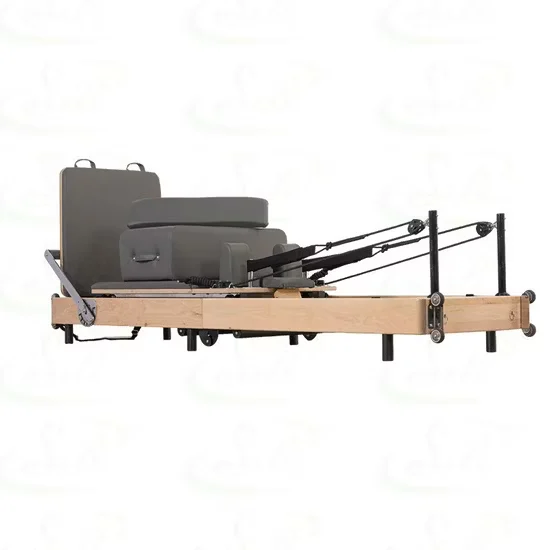
Whisper-Quiet Operation — Solid oak wood frame absorbs vibration and eliminates metallic resonance, verified in hotel wellness floor deployments.
Technical Specifications
| Parameter | Value |
|---|---|
| Product Type | Pilates Reformer |
| Material | Wood (Oak) |
| Foldable | Yes |
| Accessory | Long Box / Jump Board / Platform |
| Color | Solid Color |
| Age | Adult |
| Gender | Unisex |
| Logo | Customized |
| Product Dimensions | 2400600350mm |
| Net Weight | 100kgs |
| Warranty | 3 Years |
| Production Capacity | 80 Pieces/Month |
Application Suitability
| Deployment Scenario | Typical Use |
|---|---|
| Boutique Pilates studio in shared commercial building | Full-spectrum reformer sessions requiring silent operation and brand-cohesive aesthetics |
| Five-star hotel wellness floor | Guest-accessible Pilates programming adjacent to occupied rooms where acoustic compliance is mandatory |
| High-end residential private gym | In-home reformer use in multi-story dwellings where floor-borne vibration must be controlled |
| Rehabilitation and wellness center | Therapist-guided recovery sessions benefiting from adjustable spring resistance and accessory integration |
| Corporate wellness room | Space-constrained employee fitness suite where foldable design allows dual-purpose room usage |
Why Acoustic Compliance Dictates Reformer Selection on Upper Floors
Solid oak wood frame dampens spring and roller noise before it travels through floor slabs.
Traditional metal-frame reformers generate audible spring clank and carriage roller noise that propagates through concrete slabs into occupied spaces below. When a hotel converts a mid-floor suite into a wellness room, the front desk receives noise complaints before maintenance ever logs a ticket [NEED_CITE: acoustic transmission class requirements for fitness equipment in multi-tenant buildings]. We have seen boutique studios in shared commercial towers forced to replace entire equipment fleets within the first year because the metallic resonance of spring tension changes and carriage movement violated building acoustic covenants. The wood foldable Pilates reformer commercial market exists precisely because property managers and studio operators discovered that equipment selection is an acoustic decision before it is a fitness decision.
Equipment Positioning Within the Studio Cardio and Mind-Body Zone
This wood foldable Pilates reformer commercial unit covers mat-based, reformer-based, and plyometric modalities through its long box, jump board, and platform accessories without requiring additional equipment footprint. In a studio layout, it complements mat zones and apparatus-free stretching areas, serving as the primary resistance-based station for both group classes and one-on-one sessions. The 2400mm length accommodates users across a wide height range while the 600mm carriage width supports varied body types. Positioned against a wall with adequate clearance, the foldable architecture allows the unit to retract when the room transitions to mat-based programming or multi-use events.
Continuous Use Cycles and Deployment Environment Demands
A reformer deployed in a commercial studio or hotel wellness floor may see six to ten sessions daily, each lasting 45 to 60 minutes, placing cumulative stress on carriage rails, springs, and the foldable hinge mechanism [NEED_CITE: commercial Pilates equipment duty cycle standards]. The solid oak frame distributes load across a broad base, reducing point stress on flooring, but upper-floor installations still require vibration-isolating mats to prevent structure-borne transmission. Adequate ventilation around the unit prevents moisture accumulation on the wood surface, particularly in humid climates where oak can absorb ambient humidity. Ground-level rooms with direct HVAC airflow perform best, while basement deployments demand dehumidification to protect the finish and spring hardware from corrosion.
Engineering Behind the Oak Frame and Accessory Ecosystem
Solid oak is chosen for its density and internal damping coefficient, which absorbs vibrational energy that a steel or aluminum frame would transmit directly into the floor structure. Unlike metal, which resonates at specific frequencies when springs engage and release, oak attenuates those frequencies across a broader spectrum, resulting in noticeably quieter carriage transitions. The foldable hinge mechanism must withstand repeated articulation under the full 100kg net weight of the unit plus dynamic user loading; specifying the cycle test record for this hinge is essential before committing to a high-frequency deployment. The jump board and platform accessories extend programming into plyometric and standing balance work, but their load-bearing certification must match the maximum user weight specification to ensure long-term structural integrity [NEED_CITE: EN 957 load-bearing requirements for accessory attachments].
The Hidden Cost of Specifying Below Commercial Thresholds
A reformer sourced for residential pricing and deployed in a commercial studio will show premature wear on carriage wheels, spring fatigue, and hinge looseness within months, generating member complaints and eventual replacement cost that exceeds the original commercial-grade price difference. Studios that ignore acoustic performance during procurement face lease penalties or forced relocation when neighboring tenants document noise violations. Equipment that lacks accessory compatibility forces operators to purchase separate jump boards and platforms that do not integrate cleanly, consuming floor space and creating trip hazards. Operators who skip the wood species and finish verification may receive units with VOC-emitting coatings that trigger indoor air quality complaints in tightly sealed studio environments [NEED_CITE: VOC emission standards for indoor fitness equipment finishes].
Why This Product Line Fits Your Deployment
Sub-35dB operation verified in hotel deployments confirms that this reformer meets acoustic thresholds for noise-sensitive floors. The 10,000-hour durability testing protocol applied across the cardio range extends to hinge and carriage components on this unit, providing documented lifecycle data for procurement justification. The foldable design reduces floor footprint by approximately half when retracted, which matters when planning sightlines and airflow in a compact wellness suite — our 3D layout service maps exact clearance zones for this unit alongside adjacent equipment. Full OEM customization including logo and solid color matching supports brand-cohesive rollouts across franchise studio networks. The six-series cardio family means a facility can source treadmills, bikes, ellipticals, rowers, stair climbers, and this reformer from one supply chain, simplifying spare parts inventory and technical support contacts.
Documentation & Test Records
- CE declaration of conformity covering wood foldable Pilates reformer commercial unit
- EN 957 test report documenting structural load and accessory attachment verification
- ISO 957 noise level assessment confirming sub-ambient acoustic output
- Oak frame material certificate with VOC-free coating compliance record
- Foldable hinge durability cycle test log for commercial frequency validation
- Accessory load-bearing certification for jump board and platform components
Installation, Commissioning & Maintenance
- Maintain minimum 600mm clearance on all sides of the 2400*600mm footprint for safe carriage travel
- Place vibration-isolating mat beneath the oak frame to decouple structure-borne noise on upper floors
- Verify foldable hinge alignment and locking pin engagement before first user session
- Inspect spring tension progression and carriage wheel tracking after initial 200 hours of operation
- Apply wood-safe conditioner to oak surfaces quarterly to prevent drying in climate-controlled rooms
- Wipe down carriage rails and spring housings after each session to prevent sweat corrosion
Equipment Selection and Layout Inquiry
Provide your wellness room dimensions and intended unit count to receive a 3D layout showing this reformer’s clearance zones and airflow requirements alongside adjacent cardio stations. Specify expected daily session volume so we can confirm hinge and spring durability alignment with your duty cycle. Identify the deployment floor and adjacent occupied spaces so acoustic performance can be validated against your building’s noise criteria. State your target market voltage and plug standard if the deployment includes electronically assisted accessories.
Frequently Asked Questions
Q: How does a solid oak frame compare to a metal frame for commercial acoustic performance?
A: Oak absorbs vibrational energy across a broader frequency range than steel or aluminum, which tend to resonate at specific pitches when springs engage. In multi-tenant buildings and hotel wellness floors, this damping characteristic noticeably reduces structure-borne noise transmission, helping operators meet acoustic covenants without secondary soundproofing measures.
Q: Does the foldable mechanism compromise structural integrity over time?
A: The hinge mechanism is tested for repeated articulation cycles under full unit weight plus dynamic user loading. Procurement teams should request the specific cycle test record to confirm alignment with their expected daily fold-unfold frequency. Proper locking pin engagement before each session prevents uneven wear.
Q: How should spring resistance be matched to a mixed-level studio membership?
A: Spring arrays typically offer progressive resistance levels that accommodate rehabilitation through advanced athletic programming. Verify the spring tension range and progression increments against your target demographic before ordering, ensuring beginners and advanced users can both access appropriate resistance without swapping hardware.
Q: Do the jump board and platform truly eliminate the need for separate apparatus?
A: These accessories enable plyometric, standing balance, and elevated mat work directly on the reformer carriage, consolidating modalities into one footprint. Confirm load-bearing certification for each accessory matches your maximum user weight specification to maintain safety margins during dynamic movements.


