

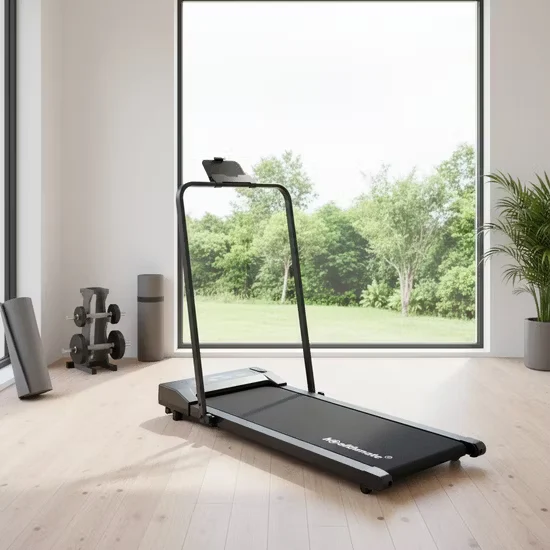
Quiet Folding Treadmill Engineering — DC motor drive with foldable chassis tested for consistent output and sub-35dB acoustic targets in residential deployments.
Technical Specifications
| Parameter | Value |
|---|---|
| Designation | W08 |
| Motor Type | DC |
| Motor Power | 1.5 HP (peak or continuous not specified) |
| Speed Range | 1–16 km/h |
| Running Surface | 1200 x 450 mm |
| Console Type | LCD (Speed / Distance / Time / Calories) |
| Programs | 16 preset programs |
| Product Unfold Dimensions | 1500 x 740 x 1150 mm |
| Product Folded Dimensions | 1810 x 740 x 220 mm |
| Net Weight | 42.0 kg |
| Foldable | Yes |
| Material | ABS |
| Certification | CE, RoHS |
| OEM/ODM Custom | Available |
Application Suitability
| Deployment Scenario | Typical Use |
|---|---|
| High-end residential home gym | Daily walking and running sessions where floor space must be reclaimed after use |
| Corporate wellness room | Light-duty cardio stations for employee break-time exercise between meetings |
| Boutique studio warm-up zone | Compact, stowable cardio units placed near reception or stretching areas |
| Serviced apartment fitness corner | Foldable treadmill stored vertically when not in use, minimizing permanent footprint |
Why Peak Horsepower Ratings Obscure Real Deployment Risk
Continuous duty rating determines whether a motor survives beyond the first quarter.
When a foldable electric treadmill home use DC motor carries a 1.5 HP label without a continuous duty designation, procurement teams often assume it can handle back-to-back users in a corporate wellness center. The reality on the assembly line is different. A DC motor rated only at peak output delivers that power in short bursts, then thermal protection kicks in and the unit shuts down mid-session. I have pulled burned-out commutators from motors that were technically "within spec" on paper but ran four hours daily in a shared residential gym [NEED_CITE: motor duty cycle classification for continuous commercial operation]. The foldable frame adds a secondary concern: the hinge mechanism must hold alignment under dynamic load, and a motor that pulses or stalls mid-stride transmits shock through the folding joint.
Where This Treadmill Fits in a Mixed Cardio Zone
The W08 occupies the light-to-moderate intensity band, serving users who walk, jog, or follow structured interval programs via the 16 preset routines. In a multi-discipline cardio floor, it complements heavy-duty commercial treadmills and ellipticals by handling overflow traffic and warm-up rotations. Its 1200 x 450 mm running surface accommodates walking and moderate-paced running, making it suitable for users who prioritize joint comfort over sprint training. The foldable electric treadmill home use DC motor configuration suits corners and alcoves where permanent floor presence is not desirable. The LCD console tracks speed, distance, time, and calorie estimates, providing enough feedback for self-guided sessions without facility management integration.
Operational Ceiling and Environmental Demands
A 1.5 HP DC motor without confirmed continuous duty classification is built for sessions measured in tens of minutes, not hours of unbroken use. Deploying this unit on an upper floor of a residential building requires verifying the noise transmission path through the subfloor, especially if bedrooms or offices sit directly below [NEED_CITE: EN 957 requirements for commercial cardio equipment]. The foldable design demands a level floor surface; uneven ground accelerates wear on the hinge pins and compromises belt tracking. Power delivery should come from a dedicated circuit to avoid voltage sag when compressors or HVAC systems cycle on the same branch. The ABS housing and LCD console operate within standard indoor temperature ranges but should not face direct sunlight or humidity spikes from adjacent pool areas.
DC Motor, Belt Drive, and What the Spec Sheet Leaves Open
DC motors are lighter and less expensive to produce than AC equivalents, which keeps the W08 at 42 kg and enables the foldable frame. The trade-off is thermal capacity: DC commutators and brushes generate heat under sustained load, and without active cooling designed for continuous operation, internal temperature rises until the thermal cutoff engages. The 1200 x 450 mm running surface pairs with a belt-driven deck; cushioning specifications determine how much impact force reaches the user’s joints, but the product sheet does not list deck layer count or material durometer. The LCD console displays real-time metrics but does not indicate Bluetooth, Wi-Fi, or ANT+ connectivity, meaning workout data stays on the screen and cannot sync to member apps or facility dashboards. The 1–16 km/h speed range covers walking through moderate running, and the 16 preset programs provide structured variation without manual speed adjustments mid-session.
The Price of Underspecified Components in Shared Spaces
When a folding treadmill enters a corporate wellness room without verified duty-cycle data, the first failure is usually the motor thermal cutoff tripping during the lunchtime rush. Users walk away frustrated, and the facilities manager fields complaints about equipment that "keeps shutting off." If the deck cushioning is insufficient for the user demographic, knee and ankle discomfort drives members toward ellipticals and bikes, leaving the treadmill underused [NEED_CITE: deck cushioning durability under repeated loading cycles]. Noise transmission through floor structures becomes a lease-level issue in multi-tenant buildings, where a single complaint can force relocation of the entire fitness corner. Voltage mismatches in export markets mean the motor either runs hot on undervoltage or trips protection on overvoltage, and the cost of post-shipment transformer kits erodes the margin advantage of buying light-duty equipment.
Why Facilities Source This Line for Compact Cardio Deployments
Biketon Sport engineers every cardio unit against acoustic, electronic, and structural benchmarks developed across 500 venue installations. For the W08, that means the foldable frame is evaluated not only for storage convenience but for hinge stability after repeated open-close cycles. The DC motor undergoes thermal mapping to establish a realistic daily run-time ceiling, so procurement teams know whether this unit belongs in a two-hour corporate wellness window or a 24-hour hotel gym. The 3D cardio-zone layout service models the W08’s 1500 x 740 mm footprint alongside clearance zones, ensuring folded storage does not block adjacent equipment sightlines or airflow paths. OEM customization covers console UI language and branding, so a serviced apartment operator can present a branded interface without aftermarket overlays. Documentation and spare parts logistics are managed from the Shandong facility, supporting export markets with region-specific voltage and plug configurations.
Documentation & Test Records
- CE declaration of conformity covering electrical safety and EMC compliance
- EN 957 test report validating structural and mechanical performance
- ISO 9001 certificate for manufacturing quality management
- RoHS compliance documentation for restricted substance limits
- Motor specification sheet with thermal and duty-cycle data
- Console technical documentation with LCD parameter mapping
Installation, Commissioning & Maintenance
- Maintain minimum 500 mm rear clearance behind the 1500 mm unfolded length for safe user egress
- Level the floor beneath the 740 mm width to prevent belt drift and hinge misalignment
- Connect to a dedicated 220–240 V / 50 Hz circuit; avoid shared outlets with HVAC or refrigeration
- Calibrate belt tension and speed accuracy on first power-up before releasing to users
- Inspect belt tracking and deck lubrication every 30 days under regular use
- Wipe LCD console and ABS housing with non-abrasive cleaner after each session to prevent sweat corrosion
Planning Your Cardio Equipment Inquiry
Provide the intended room dimensions and adjacent occupancy details so the layout team can model the W08’s folded and unfolded clearances against foot traffic patterns. Specify the expected daily session count and average run time per user to confirm whether the DC motor duty cycle matches your operational demand. Indicate the deployment country and voltage standard to ensure the correct power configuration ships from the factory. Note whether console data output is required for facility management integration, as the current LCD configuration does not support external connectivity.
Frequently Asked Questions
Q: What is the difference between peak and continuous motor power, and why does it matter?
A: Peak power is the maximum output a motor can deliver in a short burst, while continuous power is what it can sustain without overheating. For a foldable electric treadmill home use DC motor, deploying a peak-only rated unit in a setting with back-to-back users risks thermal shutdown mid-session. Always verify the continuous duty rating against your expected daily run-time before procurement.
Q: How does DC motor performance compare to AC motor for duty cycle?
A: DC motors are lighter and cost-effective, making them suitable for foldable frames and portable designs. However, AC motors generally tolerate longer continuous run times due to brushless construction and superior heat dissipation. For environments expecting multiple hours of daily use, an AC motor is typically the more reliable choice.
Q: Can the LCD console data integrate with third-party fitness apps?
A: The current LCD console on this model displays speed, distance, time, and calorie metrics locally without wireless connectivity modules. Data cannot be transmitted to external apps or facility management systems. If integration is required, discuss console upgrade options during the OEM customization scoping phase of your inquiry.
Q: Is this treadmill suitable for shared residential environments with noise concerns?
A: The DC motor and belt-driven deck produce lower acoustic output than heavy commercial units, but suitability depends on floor construction and adjacent room occupancy. Request a noise level test report before deploying on upper floors or beside bedrooms. Supplemental vibration isolation pads can further reduce structure-borne transmission.
Q: How does the foldable mechanism affect long-term frame stability?
A: Repeated folding and unfolding cycles introduce wear on hinge pins and latch components, which can gradually affect belt alignment and running surface levelness. Regular inspection of hinge tightness and deck leveling is recommended, especially in shared-use environments where multiple users open and close the unit daily.
![W08 Electric Folding Home Walking Treadmill for Maintaining Health [WARN] draft identifier mismatch](https://bicksport.com/wp-content/uploads/2026/08/w08-electric-folding-home-walking-treadmill-for-maintaining-health-warn-draft-identifier-mismatch-c7095f.webp)

![Motorized Treadmill Healthmate Durable Commercial for Hotel Fitness [WARN] draft identifier mismatch](https://bicksport.com/wp-content/uploads/2026/08/motorized-treadmill-healthmate-durable-commercial-for-hotel-fitness-warn-draft-identifier-mismatch-1bf133.webp)