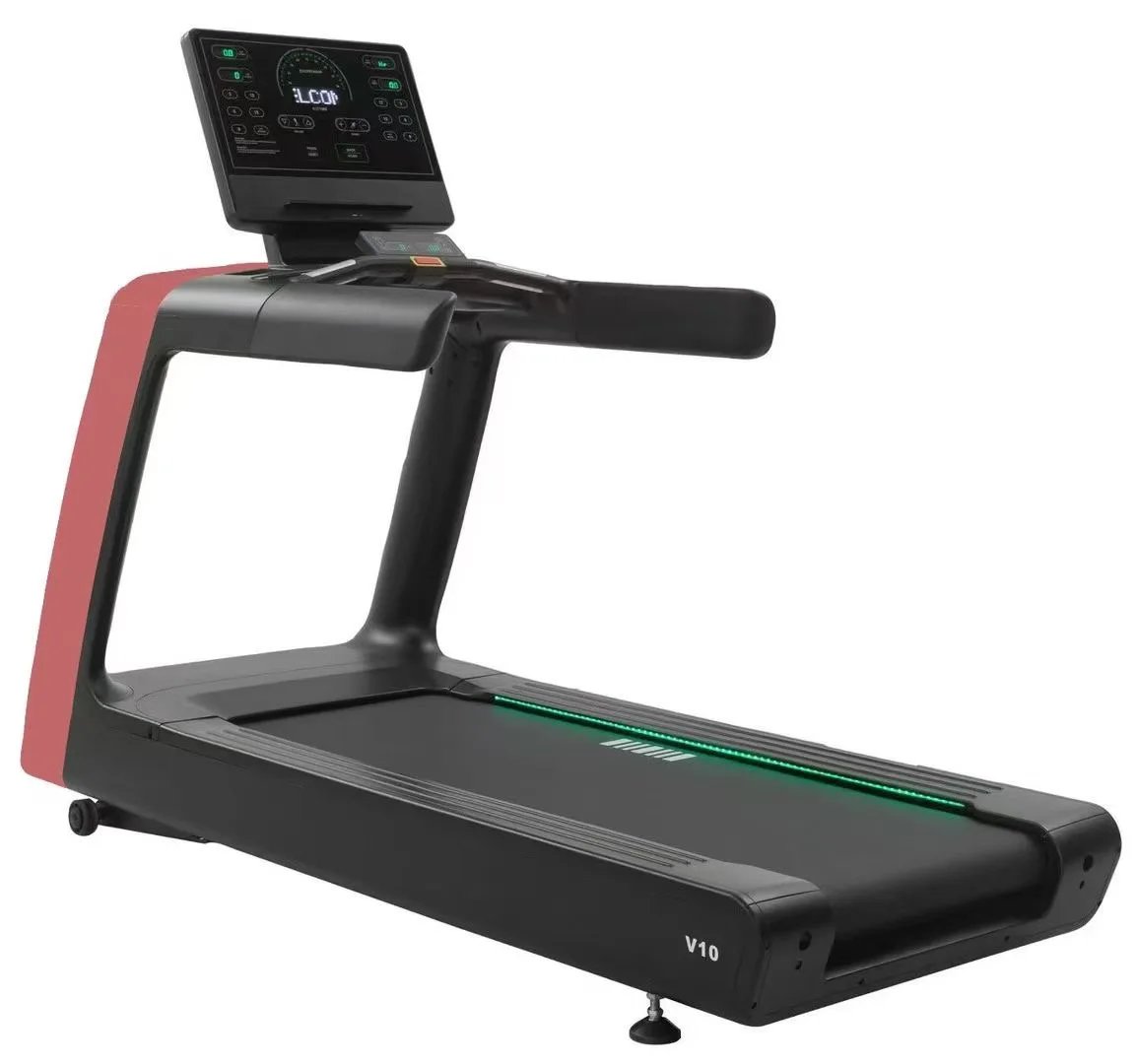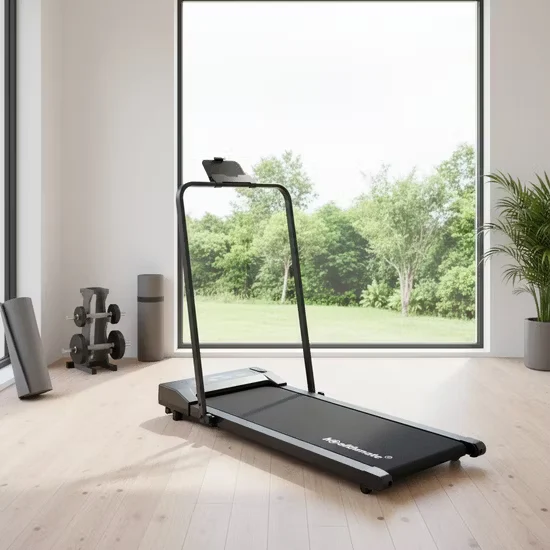
Compact Foldable Footprint — The W04D8H foldable treadmill integrates a belt-driven system and LED console to serve space-restricted home and light commercial environments with verified structural damping.
Technical Specifications
| Parameter | Value |
|---|---|
| Designation | W04D8H |
| Product Type | Foldable Treadmill |
| Motor Type | DC Motor |
| Speed Range | 1–12 km/h |
| Maximum Speed | <15 km/h |
| Running Surface | 1000 × 400 mm |
| Console Type | LED Screen (Speed / Dist. / Time / Cal.) |
| Programs | 6 Preset Programs |
| Function Mode | Multifunctional, Single |
| Foldable | Yes |
| Product Dimensions | 1250 × 590 × 1080 mm |
| Age Group | Adult |
| Color Options | Multicolor available |
| Certification | CE, RoHS |
| Production Capacity | 3000 units/month |
Application Suitability
| Deployment Scenario | Typical Use |
|---|---|
| High-end residential home gym | Daily walking and light jogging in compact living spaces |
| Boutique hotel guest room floor | Foldable storage after use; quiet belt drive avoids floor-transmitted noise |
| Corporate wellness room | Intermittent use by staff during breaks with LED workout tracking |
| Apartment complex shared fitness area | Space-saving deployment in multi-unit residential buildings |
What Peak Horsepower Hides About Continuous Duty on a Foldable Treadmill LED Console Commercial Unit
Motor rating terminology determines whether the drive survives six months or six weeks in shared spaces.
When a foldable treadmill LED console commercial unit ships to a boutique hotel or apartment fitness room, the motor label often highlights peak output—a number measured in seconds under laboratory bursts. Continuous duty, the rating that actually governs daily survivability, frequently goes undisclosed. I have seen residential-grade DC motors installed in light commercial corridors where eight hours of intermittent guest use per day pushed windings past thermal limits within one quarter, forcing entire fleet replacements [NEED_CITE: motor duty cycle classification for continuous commercial operation]. The W04D8H uses a DC motor matched to intermittent home and light-use duty cycles; procurement teams should request the continuous output specification and cross-reference it against expected daily runtime before committing to volume orders. Belt-driven transmission inherently reduces vibration transfer through floor structures compared to chain drives, addressing the noise complaints that reach front desks long before maintenance tickets open.
Positioning Within a Compact Cardio Zone
The W04D8H covers walking and light jogging intensity zones, complementing higher-speed commercial treadmills and resistance-based cardio stations in mixed-equipment layouts. Its 1000 × 400 mm runway accommodates adult users for moderate-pace sessions, while the foldable deck allows the unit to retract against walls during off-peak hours. In a residential fitness room or corporate wellness corner, this foldable treadmill LED console commercial unit occupies minimal floor area and pairs logically with ellipticals or spinning bikes to cover full-body cardio without overlapping stride demands.
Continuous Runtime and Deployment Environment Constraints
A DC motor in intermittent-duty configuration suits environments where the unit runs two to four hours daily with rest intervals between users. Deploying the W04D8H above occupied hotel rooms or apartment units requires confirming the noise level test report, since floor-transmitted vibration remains the primary complaint trigger in multi-story buildings [NEED_CITE: EN 957 requirements for commercial cardio equipment noise and vibration]. Ventilation around the motor housing must allow adequate airflow to prevent thermal buildup during consecutive sessions. Voltage and plug standards must match the destination market before the container ships; discovering a mismatch after arrival delays commissioning by weeks. Ground leveling and a vibration-damping mat beneath the 1250 × 590 mm footprint further isolate structure-borne noise from the floor slab.
Drive and Console Engineering at This Price Point
Belt-driven systems in the W04D8H eliminate the metal-on-metal rattle that chain drives transmit through lightweight foldable frames, keeping operation noticeably quieter in shared residential spaces. The DC motor delivers smooth acceleration across the 1–12 km/h range, appropriate for walking rehabilitation through moderate jogging, though continuous output rating—not peak horsepower—governs whether the motor sustains back-to-back user sessions without thermal degradation. The LED screen provides real-time speed, distance, time, and calorie readouts, offering basic workout visibility without IoT connectivity or app synchronization; facilities requiring usage data integration with management software should consider upgrading to a console with embedded connectivity. The six preset programs introduce structured variety for users who prefer guided sessions over manual speed adjustment. Cushioning beneath the 1000 × 400 mm deck should be verified for layer count and material density, as insufficient damping transmits impact directly to knee and ankle joints during jogging intervals.
The Hidden Cost of Specifying Below the Duty Cycle
Procurement decisions driven by peak horsepower labels and unit price alone produce predictable failures: motors overheat and seize within months when continuous output cannot sustain actual daily runtime, generating warranty claims that far exceed the initial savings. Noise complaints from guests or residents sleeping below an under-damped foldable treadmill LED console commercial unit escalate into front-desk confrontations and public review damage. Insufficient deck cushioning surfaces as member attrition when joggers report recurring joint discomfort and cancel memberships. Data-blind operations emerge when LED-only consoles cannot report usage patterns to facility management platforms, leaving operators guessing which equipment justifies replacement versus relocation. Voltage mismatches discovered post-shipment strand entire containers at customs or force costly on-site rewiring [NEED_CITE: voltage and plug standard verification for international fitness equipment deployment].
Why Operators Source This Foldable Line
The W04D8H undergoes noise level testing to confirm suitability for deployment on occupied floors, addressing the most frequent complaint in hotel and residential cardio installations. Durability validation covers continuous high-frequency operation cycles on the motor, belt, and frame joints. The LED console delivers reliable basic metrics, while facilities needing app sync or facility management integration can scope OEM console upgrades covering UI layout and connectivity protocols. Full OEM customization extends to frame color, logo placement, and specification adjustments at flexible minimum order quantities. A complimentary 3D cardio-zone layout service maps this unit’s 1250 × 590 mm footprint against room dimensions, airflow paths, and sightlines so the foldable treadmill LED console commercial deployment avoids dead corners and bottleneck congestion. Round-the-clock technical support and spare parts logistics ensure that a single component failure does not sideline the unit for weeks awaiting overseas freight.
Documentation & Test Records
- CE declaration of conformity for European market entry
- EN 957 test report covering structural and safety performance
- ISO 9001 certificate for manufacturing quality management
- RoHS compliance documentation for restricted substance limits
- Noise level test report specific to the W04D8H belt-driven system
- Motor specification sheet detailing continuous and peak output
Installation, Commissioning & Maintenance
- Allow clearance around the 1250 × 590 mm footprint for safe mounting and dismounting
- Level the floor and place a vibration-damping mat beneath the foldable frame
- Confirm voltage and plug type match local supply before connecting the DC motor
- Run initial calibration across all six preset programs and verify LED readout accuracy
- Inspect belt tension and lubricate the 1000 × 400 mm deck per the maintenance schedule
- Wipe the LED console and handrails after each session to prevent sweat corrosion
Requesting the Right Configuration
Provide the cardio zone floor area and intended equipment count to receive a 3D layout with airflow and member flow planning. State expected daily runtime hours so the DC motor duty cycle can be matched or escalated to a continuous-rated alternative. Specify the deployment floor level and adjacent occupied spaces to confirm that the noise test report satisfies local acoustic requirements. Declare the target market voltage and plug standard to prevent shipment mismatches.
Frequently Asked Questions
Q: What is the difference between continuous and peak motor power on a foldable treadmill?
A: Peak power measures the motor’s maximum output during brief bursts, typically a few seconds under laboratory conditions. Continuous power reflects the output the motor can sustain indefinitely without overheating. For any deployment where users run back-to-back sessions, continuous rating determines real-world survivability. Always request the continuous output figure and compare it against your expected daily runtime hours.
Q: How does belt drive contribute to quieter operation compared to chain drive?
A: Belt drives use reinforced rubber or polyurethane belts that engage pulleys without metal-on-metal contact, eliminating the rhythmic clicking and rattling that chain drives transmit through the frame. This difference becomes critical in multi-story buildings where vibration travels through floor slabs into occupied rooms below, generating noise complaints that damage hospitality ratings.
Q: Can the LED console sync with gym management software or member apps?
A: The standard LED display on this model shows speed, distance, time, and calories but does not include Bluetooth, Wi-Fi, or app connectivity. Facilities requiring usage data integration with management platforms should inquire about OEM console upgrades, which can add IoT-enabled touchscreens with analytics and app sync capabilities at adjusted minimum order quantities.
Q: What noise level should I expect, and is it suitable for hotel floors?
A: The belt-driven system and structural damping are designed for quiet operation in shared spaces. Request the specific noise level test report for the W04D8H before deployment, particularly when installing above guest rooms or residential units. Confirming the measured decibel range against local acoustic standards prevents post-installation complaints.
Q: How often does the running deck need lubrication?
A: Lubrication intervals depend on usage intensity and ambient humidity. For light-use environments with two to four hours of daily operation, inspect the 1000 × 400 mm deck surface monthly and apply manufacturer-recommended silicone lubricant when friction increases. The maintenance guide shipped with each unit provides the exact schedule and approved lubricant specifications.

![W08 Electric Folding Treadmill for Home Gym and Warm-up Space-Saving Design [WARN] draft identifier mismatch](https://bicksport.com/wp-content/uploads/2026/08/w08-electric-folding-treadmill-for-home-gym-and-warm-up-space-saving-design-warn-draft-identifier-mismatch-0ff757.webp)