
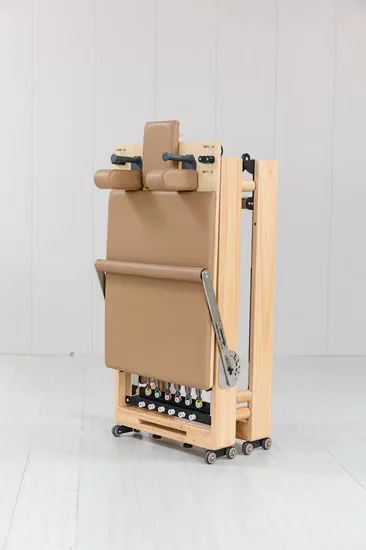
Structural Acoustic Damping — Solid-wood frame mass and grain orientation naturally absorb carriage vibration, reducing structure-borne noise transmission in shared-wall environments.
Technical Specifications
| Parameter | Value |
|---|---|
| Product Type | Pilates Reformer |
| Product Dimensions | 2400 x 600 x 350 mm |
| Net Weight | 100 kg |
| Frame Construction | Solid Wood |
| Finish | Solid Color (customizable) |
| Accessory Compatibility | Long Box / Jump Board / Platform |
| Folding Capability | Yes |
| Max User Weight | N/A |
| Logo Customization | Available |
| Warranty | 3 Years |
| Origin | China |
Application Suitability
| Deployment Scenario | Typical Use |
|---|---|
| Boutique Pilates and yoga studios | Stowable reformer training in multi-use rooms where floor space is reconfigured between classes |
| High-end residential home gyms | Noise-sensitive environments with shared walls where wooden-frame acoustics prevent neighbor complaints |
| Corporate wellness centers | Employee recovery and mobility programming requiring compact, full-length carriage travel |
| Private rehabilitation suites | Progressive spring-loaded resistance work for post-injury spinal articulation and lower-limb conditioning |
| Boutique hotel wellness floors | Foldable deployment in guest suites or shared wellness rooms with limited permanent equipment footprint |
Why Resonance Complaints Arrive Before the First Class Ends
A wooden frame dampens carriage oscillation at the source rather than transmitting it through the floor slab.
In my years commissioning studio equipment across Southeast Asia, I have watched metal-frame reformers generate pulley echo and carriage rattle that bleeds through shared walls within the first week. Operators replace pulleys, add rubber feet, and re-tension cables — yet the fundamental problem remains the steel frame’s tendency to act as a soundboard [NEED_CITE: structure-borne noise propagation in steel-frame vs. wood-frame fitness equipment]. A wooden portable Pilates reformer home folding design addresses this at the material level: solid timber mass and grain structure absorb vibration frequencies that tubular steel would amplify, making the difference between a studio that retains members and one that fields noise complaints from adjacent tenants.
Where This Reformer Sits in a Mixed-Modality Studio Layout
This unit covers full-length carriage travel across spinal articulation, leg press, and upper-body pulling planes — the three movement categories that define a comprehensive reformer session. In a studio mixing mat work with apparatus training, it complements fixed-frame clinical reformers by offering a stowable option for overflow capacity or multi-use rooms. The 2400 mm unfolded length accommodates taller users through complete range of motion, while the folding mechanism returns floor space to group classes once individual sessions conclude. The wooden portable Pilates reformer home folding format suits facilities that need apparatus-grade resistance without dedicating permanent square footage.
Continuous Use Cycles and Deployment Environment Requirements
A reformer in a studio running back-to-back sessions demands joint rigidity that survives thousands of fold-unfold cycles without developing play in the locking mechanism [NEED_CITE: cyclic loading standards for folding fitness equipment frames]. The solid-wood construction requires stable humidity to prevent grain movement from altering rail alignment, making climate-controlled interiors essential in tropical or monsoon-variable regions. Floor leveling beneath the unit prevents carriage drift during unilateral exercises, and the 100 kg net weight provides inherent stability without bolting to the subfloor. Facilities deploying multiple units should allow lateral clearance for accessory attachment and instructor circulation paths between stations.
Material and Resistance System Engineering Breakdown
The choice between solid-wood and tubular-steel frames extends beyond aesthetics. Wood’s cellular structure dissipates kinetic energy from carriage rebound at rail contact points, whereas steel conducts that energy outward as audible resonance. The spring-based resistance system delivers progressive loading — lighter springs for rehabilitation ranges, heavier springs for athletic conditioning — without the maintenance burden of pneumatic or hydraulic alternatives. Pulley cable routing through the wooden frame avoids metal-on-metal contact points that generate harmonic frequencies under load. Accessory attachment interfaces for the long box, jump board, and platform must maintain rigid coupling to the carriage rail under repetitive impact, a requirement that mortise-and-tenon joinery addresses more reliably than mechanical fasteners alone in solid-wood construction [NEED_CITE: joinery load ratings for repetitive dynamic exercise equipment].
The Hidden Cost of Specification Compromises
Operators who select reformers based on price per unit rather than frame construction and joint engineering often face cascading costs. Lightweight metal frames develop carriage wobble within months of daily studio use, generating pulley noise that prompts member complaints and eventual wholesale replacement. Spring systems specified without progressive gradient options limit programming scope, forcing instructors to supplement with mat work that dilutes the reformer class value proposition. Folding mechanisms rated for occasional home use rather than daily studio cycles develop joint play that compromises exercise precision and creates liability exposure during loaded movements.
Why This Product Line Addresses Studio Operator Pain Points
The solid-wood frame delivers measurable acoustic advantage in shared-wall deployments — an outcome our engineering team validates through resonance testing across grain orientations. The folding format preserves full 2400 mm carriage travel while returning floorspace for group programming, addressing the spatial economics that constrain studio revenue per square meter. Accessory compatibility across long box, jump board, and platform interfaces means one chassis supports the complete exercise library without secondary equipment purchases. OEM customization of logo and finish allows brand-aligned deployment across boutique studio chains, while the three-year warranty reflects confidence in joint construction under cyclic loading. Our facility planning team provides 3D studio layouts that account for reformer spacing, instructor circulation, and ventilation requirements specific to wood-frame equipment care.
Documentation & Test Records
- CE declaration of conformity covering structural and mechanical safety requirements
- EN 957 test report validating load ratings and endurance under cyclic operation
- ISO 9001 certificate confirming manufacturing process control
- Noise level assessment report documenting structure-borne vibration output
- Durability test record for folding mechanism and joint integrity over repeated cycles
- Spring resistance gradient specification and pulley cable tensile rating sheet
Installation, Commissioning & Maintenance
- Position on leveled flooring with full 2400 mm length clearance plus instructor circulation space on both sides
- Verify folding joint locking engagement before first loaded session and re-check after initial 50 use cycles
- Apply rail lubricant at intervals specified for solid-wood carriage surfaces to maintain smooth travel
- Inspect spring tension gradient and pulley cable condition monthly under studio-frequency use conditions
- Maintain stable ambient humidity to prevent wood grain movement from altering rail alignment tolerances
- Clean carriage rails and accessory attachment points after each session to prevent sweat corrosion of metal interfaces
Equipment Selection and Inquiry Guidance
Provide your studio floor area and intended unit count to receive a 3D layout incorporating reformer spacing, instructor pathways, and humidity control recommendations for solid-wood equipment. Specify your daily session volume per unit so we can confirm folding mechanism duty-cycle suitability. Indicate your deployment climate to receive wood species and finish recommendations aligned with local humidity ranges. Confirm whether accessory packages should include long box, jump board, or platform configurations based on your programming model.
Frequently Asked Questions
Q: How does solid-wood frame construction affect noise transmission compared to steel-frame reformers?
A: Solid wood’s cellular grain structure absorbs vibration energy at carriage contact points rather than conducting it outward as audible resonance. In shared-wall studio environments, this material property noticeably reduces structure-borne noise complaints from adjacent rooms. Steel frames, by contrast, act as soundboards that amplify pulley harmonics and carriage rattle across the floor slab.
Q: What is the carriage travel length on a folding reformer versus a fixed-frame commercial unit?
A: This folding reformer delivers full 2400 mm carriage travel when deployed — matching the working length of fixed-frame units. The folding mechanism returns the footprint for room reconfiguration between sessions, but the exercise range of motion remains uncompromised during use, preserving complete movement amplitude for taller users.
Q: Can the spring resistance system support progressive loading for rehabilitation and athletic training?
A: Yes. The spring-based system offers multiple resistance levels that accommodate post-injury rehabilitation at lighter loads and athletic conditioning at heavier settings. Instructors program progressive overload by combining spring selections and adjusting carriage travel leverage, making one unit suitable for clinical recovery and performance training within the same facility.
Q: What maintenance does a wooden-frame reformer require in humid or climate-variable environments?
A: Solid-wood frames require stable ambient humidity to prevent grain expansion or contraction that could alter rail alignment. Facilities in tropical or monsoon-variable regions should maintain climate-controlled interiors. Regular rail lubrication and periodic joint inspection under cyclic loading ensure long-term structural integrity and smooth carriage travel across seasons.


![Commercial Maple Wood Reformer Pilates for Studio & Gym Use (result)Commercial Maple Wood Reformer Pilates for Studio and Gym Use [WARN] draft identifier mismatch](https://bicksport.com/wp-content/uploads/2026/08/commercial-maple-wood-reformer-pilates-for-studio-gym-use-resultcommercial-maple-wood-reformer-pilates-for-studio-and-gym-use-warn-draft-identifier-mismatch-0e4674.webp)