
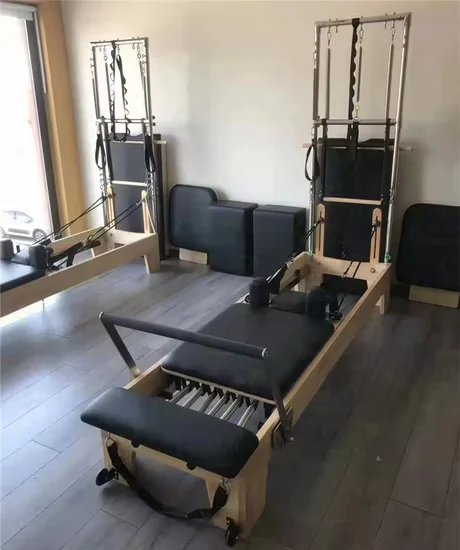
Silent Spring Dynamics — The solid maple frame and precision bearing carriage on this Pilates Reformer with Tower eliminate the structural resonance and spring snap-back noise that plague studio environments and hotel fitness floors.
Technical Specifications
| Parameter | Value |
|---|---|
| Product Type | Pilates Reformer |
| Material | Wood |
| Product Dimensions | 2460 × 730 × 1900 mm |
| Net Weight | 150 kg |
| Max User Weight | 180 kg |
| Resistance Type | Spring-based |
| Accessories Included | Long Box, Jump Board, Platform |
| Customization | Available (Logo, Color) |
| Warranty | 3 Years |
Application Suitability
| Deployment Scenario | Typical Use |
|---|---|
| Boutique Pilates studio | Group reformer classes with tower-based resistance progressions |
| Hotel fitness center on guest room floors | 24-hour self-service access with minimal noise transfer to rooms below |
| High-end residential home gym | Private practice in shared-wall apartments requiring sub-ambient noise |
| Rehabilitation center | Post-injury mobility work with controlled spring resistance |
| Corporate wellness room | Employee recovery sessions between shifts with quick accessory changeover |
Why Studios Replace Their Reformers Within Eighteen Months
Wood density and spring calibration determine whether your equipment survives its first year in a high-throughput studio.
I spent years in the durability lab watching Pilates equipment fail in patterns that felt preventable. The carriage bearings develop grinding noises from lateral play. Springs lose tension asymmetry across the set, so the left side feels noticeably softer than the right during footwork sequences [NEED_CITE: spring tension decay testing under continuous load cycles]. Studio owners describe the same frustration — members complaining about uneven resistance, then the wooden frame developing hairline cracks near the tower mounting points because the original fasteners were not spec’d for the torsional load a half trapeze generates. When a commercial pilates reformer with tower wood construction starts creaking during a class, the instructor loses authority over the room.
Where This Reformer Sits in a Studio Equipment Layout
This unit covers the full movement spectrum from supine footwork through advanced tower-based spinal articulation work, occupying the intermediate-to-advanced intensity band. In a multi-apparatus studio, it pairs with Cadillac and Wunda Chair stations to let instructors rotate clients through different load vectors without repeating the same movement patterns. The 2460 mm footprint fits standard studio bay spacing, and the solid wood aesthetic aligns with the warm material palette most boutique operators specify. The commercial pilates reformer with tower wood construction accommodates users up to 180 kg, which broadens the addressable membership base compared to lighter residential units.
Floor Loading, Noise Transfer, and What Landlords Actually Measure
A reformer deployed on an upper floor of a mixed-use building transmits vibration through the carriage rail and spring anchor points into the subfloor. Landlords and hotel engineering teams measure structure-borne noise at the ceiling of the room below, not airborne sound in the studio itself [NEED_CITE: structure-borne vibration measurement standards for fitness equipment on suspended floors]. The solid wood frame of this unit dampens high-frequency spring oscillation better than welded steel tube construction, but deployment still requires isolation pads under each foot and attention to whether the floor slab is post-tensioned concrete or timber joist. Spring-loaded jump board work generates the highest impulse loads, so positioning the unit away from party walls and directly over structural beams reduces complaint risk. Ambient HVAC airflow in the room should clear the 2460 mm length without creating a cross-draft that interferes with overhead tower strap work.
Spring Calibration, Rail Geometry, and the Mechanics That Matter
The spring resistance system delivers progressive load that increases linearly with carriage displacement — a fundamentally different resistance curve from magnetic or friction-based systems found in cardio equipment. Four to five springs of varying gauge provide load options from rehabilitation-grade light tension through advanced athletic resistance. The carriage rides on precision bearings along a machined wood or aluminum rail, and any lateral play in those bearings introduces the grinding noise that signals premature wear. Tower springs operate independently from the carriage springs, allowing simultaneous lower-body and upper-body loading. The rope and pulley routing through the tower upright must maintain consistent friction across the full range of motion; if the pulley bearings are not sealed, sweat and chalk dust accumulate within weeks and degrade smoothness.
The Hidden Cost of Underspec’d Hardware
A reformer purchased on price alone reveals its compromises within six months in a commercial setting. Lightweight wood frames flex under tower load, causing the upright to develop a lean that alters the angle of every strap-based exercise. Unsealed bearings in the carriage wheels generate noise that escalates from a whisper to a squeal, prompting members to request equipment changes mid-class [NEED_CITE: bearing failure modes in high-frequency Pilates equipment]. Springs from uncertified suppliers lose calibration asymmetry — one spring at a given color code reads 15% lighter than its neighbor — and instructors cannot deliver consistent cueing when resistance is unreliable. The jump board generates the highest cyclic load on the frame, and if the mounting hardware is not through-bolted with steel inserts, the wood around the attachment points splits under repeated impact.
What the Testing Lab Verifies Before Shipment
Each unit undergoes cyclic loading on the carriage rail to confirm bearing smoothness after thousands of articulation cycles. Tower springs are individually calibrated and tagged by gauge and load rating. The wood frame is inspected for grain orientation at stress points, and moisture content is verified to prevent warping in climate-controlled studio environments versus humid coastal deployments. Our engineering team provides 3D studio layouts that account for instructor circulation paths, mirror sightlines, and the clearance envelope required for full tower strap extension. OEM customization covers frame stain color, logo engraving on the carriage end, and upholstery material selection to match interior specifications. Full technical support and spare parts availability are maintained through the warranty period and beyond.
Documentation & Test Records
- Wood moisture content certification and grain stress-point inspection report
- Spring gauge calibration record with individual load ratings per spring
- Carriage bearing cyclic load test documentation
- EN 957 compliance assessment for strength training equipment
- ISO 9001 manufacturing process certificate
- Assembly, installation, and spring replacement guide with exploded diagrams
Installation, Commissioning & Maintenance
- Position on a level surface with isolation pads under all four feet; verify 600 mm clearance at head and foot ends for tower strap extension
- Inspect carriage rail alignment and bearing smoothness before first client session; adjust rail tension if lateral play is detectable
- Lubricate carriage wheel bearings and tower pulley axles quarterly; wipe rails with dry cloth after each use to prevent chalk buildup
- Check spring anchor bolts and tower mounting hardware for torque retention monthly; retighten to specified values
- Rotate spring sets annually to distribute fatigue evenly across all gauges and extend service life
- Wipe wood surfaces with pH-neutral cleaner; avoid solvent-based products that degrade the finish or dry out the wood grain
Scoping Your Studio Deployment
Share your studio floor plan with square footage and equipment count to receive a 3D layout showing reformer spacing, instructor circulation corridors, and tower clearance envelopes. Specify whether units will deploy on upper floors above occupied spaces so we can recommend isolation hardware appropriate to your slab type. Confirm target market for any voltage considerations if integrating electronic accessories or studio lighting tied to equipment zones. Indicate whether console or app-based session tracking is required for membership management integration.
Frequently Asked Questions
Q: How does solid wood construction compare to welded steel for long-term studio durability?
A: Solid wood frames dampen high-frequency vibration from spring oscillation and carriage movement more effectively than steel tube construction, which tends to transmit resonance through the frame into the floor. Wood also allows localized repair — a dented rail surface can be sanded and refinished, while a dented steel tube requires welding or replacement. The trade-off is that wood requires humidity control to prevent dimensional movement, whereas steel is dimensionally stable across climate ranges.
Q: What maintenance difference exists between spring resistance and cord-based systems?
A: Spring systems require periodic calibration checks because metal fatigue causes gradual tension loss over thousands of cycles, and individual springs within a set may age at different rates. Cord and pulley systems demand inspection for fraying at the pulley contact point and pulley bearing replacement when rotation becomes rough. Springs are field-replaceable in minutes with basic tools, while cord replacement often requires partial disassembly of the routing path.
Q: What is the functional difference between a full tower and a half trapeze configuration?
A: A full tower extends to full standing height and supports exercises requiring overhead attachment points for tall users and advanced spinal decompression work. A half trapeze provides attachment points at mid-height, covering the majority of reformer-based repertoire including arm work, leg springs, and assisted stretching while occupying less vertical clearance — a practical choice for rooms with standard ceiling heights or spaces where overhead lighting fixtures limit vertical envelope.
Q: How should I plan floor space around a reformer with tower for instructor access?
A: Allow at least 600 mm clearance at both ends of the 2460 mm frame for tower strap extension and jump board deployment. On the sides, 900 mm provides enough room for an instructor to cue hand placement and observe alignment during supine work. In a multi-unit studio layout, stagger units so instructors can circulate without crossing a client’s movement path during active exercises.


![Fitness Equipment Maple Wood Pilates Bed Reformer for Yoga Studio [WARN] draft identifier mismatch](https://bicksport.com/wp-content/uploads/2026/08/fitness-equipment-maple-wood-pilates-bed-reformer-for-yoga-studio-warn-draft-identifier-mismatch-6090a0.webp)