

10,000-Hour Durability Proof — Plate-loaded pivot bearings and reinforced steel frame tested for continuous high-frequency use without cable stretch or pulley degradation.
Technical Specifications
| Parameter | Value |
|---|---|
| Designation | 5013 |
| Product Type | Plate-Loaded Strength Machine |
| Exercise Part | Biceps |
| Material | Steel |
| Product Dimensions | 1466×1292×1502 mm |
| Net Weight | 93 kg |
| Max User Weight | 180 kg |
| Plate Horn Compatibility | Standard Olympic plates |
| Certification | ISO 9001, CE |
| Appliance | Community, Gymnasium |
| Fit Area | Professional Gym and Club |
| OEM/ODM | Available |
| Production Capacity | 500 PCS/Month |
| HS Code | 9506911900 |
Application Suitability
| Deployment Scenario | Typical Use |
|---|---|
| Chain gym free-weight and plate-loaded zone | High-volume biceps isolation work between compound pulling sessions |
| Hotel fitness center on guest room floors | Quiet, self-contained strength station requiring no cable maintenance |
| Corporate wellness room | Compact footprint biceps trainer for time-constrained executive workouts |
| Sports performance training center | Athlete-grade biceps loading with consistent tension curve |
| Community fitness center | Durable, low-maintenance station for unsupervised public access |
Why Cable Failures Keep Shutting Down Biceps Stations
Plate-loaded resistance eliminates the two most common failure points in commercial biceps machines: frayed cables and worn pulleys.
In high-traffic gyms, cable-based biceps stations accumulate wear at the pulley sheaves and cable crimps long before the frame shows fatigue. Maintenance teams replace cables on a recurring cycle, and each replacement means the station is offline during peak hours. A commercial plate-loaded seated biceps machine removes that entire failure chain — the resistance comes directly from Olympic plates on a steel horn, transmitted through sealed pivot bearings rather than flexible steel rope [NEED_CITE: cable vs plate-loaded maintenance intervals in commercial strength equipment]. I have watched gym operators rotate cable machines out of service three times a year while plate-loaded units beside them run without intervention.
Where This Station Fits in a Commercial Strength Layout
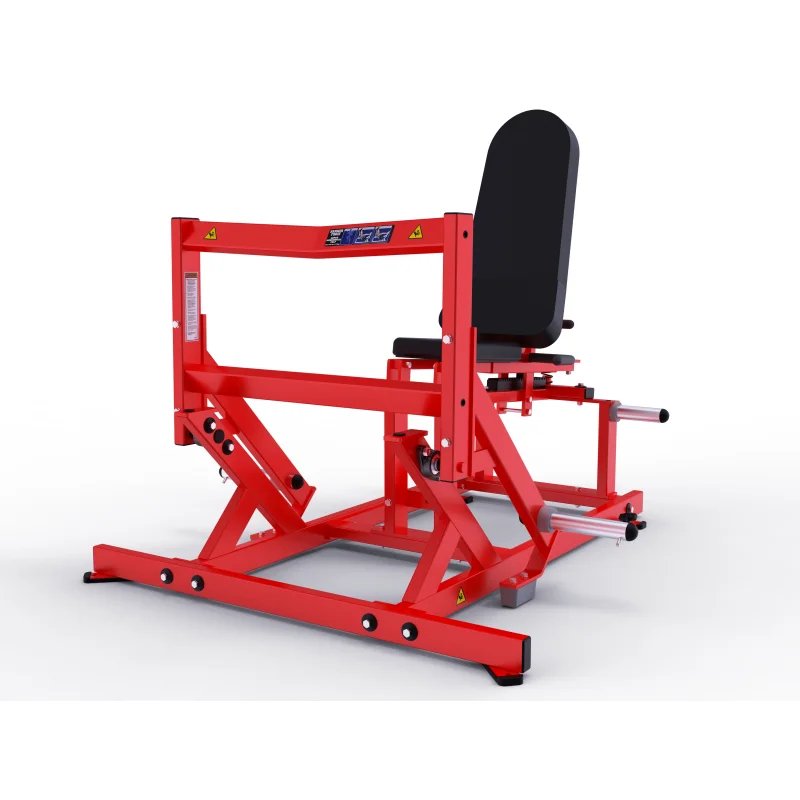
The 5013 covers strict biceps isolation across moderate to heavy loading ranges, complementing compound pulling equipment like lat pulldowns and seated rows already in the free-weight zone. Its seated, stabilized movement path suits high-density deployment where standing curl stations create congestion and form breakdown. The commercial plate-loaded seated biceps machine fits users across a wide anthropometric range thanks to the fixed ergonomic seat geometry, and it occupies a footprint that allows placement against walls or between rack bays without impeding traffic flow.
Continuous Operation and Floor-Level Deployment Considerations
A plate-loaded station has no motor, no electronics, and no duty-cycle rating to manage — which means it can operate around the clock in 24/7 facilities without thermal or electrical constraints. The critical deployment variable is floor loading: at 93 kg net weight plus loaded plates and user mass, point loads on the feet require a level, structurally rated surface. Noise transmission is limited to plate contact and pivot bearing rotation, making this unit suitable for hotel fitness centers on occupied floors where motorized equipment would generate complaints [NEED_CITE: floor loading standards for commercial plate-loaded strength equipment]. No dedicated electrical circuit is needed, simplifying installation in retrofit spaces.
Plate-Loaded Mechanics and Bearing Selection Explained
The resistance path on this machine runs from the Olympic plate horn through a rigid lever arm to sealed pivot bearings at the rotation axis. Unlike cable systems where the tension curve shifts as the cable wraps and unwraps around a pulley, the plate-loaded arc delivers resistance proportional to the gravitational load on the horn, producing a consistent tension profile through the full curl range. Sealed pivot bearings prevent contaminant ingress from sweat and floor dust, extending service intervals compared to open bushings. The reinforced steel frame resists deflection under asymmetric loading — a common stress when users load plates unevenly or apply momentum during heavy sets. Frame rigidity also keeps the movement path stable over years of use, preventing the wobble that develops in lighter-gauge tubing.
The Hidden Cost of Underspecifying Strength Stations
Facilities that install light-commercial biceps machines in high-traffic zones typically see pivot bearing failure and frame fatigue cracking within the first year of continuous public use. When bearings degrade, the lever arm develops lateral play that users feel immediately as looseness and imprecision — and they stop using the station. I have seen operators replace an entire row of underbuilt machines after member complaints about equipment that felt unstable under load [NEED_CITE: premature bearing failure rates in light-commercial vs commercial strength equipment]. The downtime, removal labor, and repeat procurement cost far exceed the initial price gap between light-commercial and commercial-grade construction.
Why This Product Line Covers the Strength Zone
The reinforced steel frame and sealed pivot bearings on this unit are tested for 10,000 hours of continuous high-frequency operation, matching the durability standard applied across the full Biketon Sport equipment range. The plate-loaded design eliminates cable and pulley maintenance entirely, reducing the service burden on facility maintenance teams. OEM and ODM customization covers frame color, pad upholstery, and logo placement at flexible minimum order quantities, allowing gym chains to maintain brand consistency across locations. Free 3D strength-zone layout planning accounts for the 1466×1292 mm footprint, plate-loading clearance, and user entry-exit circulation space so the station integrates cleanly into the floor plan. Technical support and spare parts availability run 24/7 for deployed units.
Documentation & Test Records
- CE declaration of conformity for plate-loaded strength equipment
- EN 957 test report covering structural integrity and safety
- ISO 9001 quality management system certificate
- Frame welding quality inspection and material specification report
- Pivot bearing seal specification and service interval record
- OEM customization scope document with color and upholstery options
Installation, Commissioning & Maintenance
- Confirm floor level and place vibration pads under all four feet of the 1466×1292 mm base
- Maintain minimum 600 mm clearance on plate-loading side for safe Olympic plate handling
- Verify plate horn collar type matches facility standard Olympic plates before first use
- Inspect sealed pivot bearings quarterly for smooth rotation and lateral play
- Wipe frame and pad upholstery after each use to prevent sweat corrosion on steel surfaces
- Check frame bolt torque at six-month intervals per installation guide specifications
Equipment Selection and Inquiry Guidance
Provide your strength zone area and existing equipment list to receive a 3D layout plan that positions this station with correct clearance and traffic flow. Specify your daily usage volume and whether the station will operate in supervised or unsupervised access to confirm the durability specification matches your facility profile. Indicate your target market so that OEM branding, pad material, and frame color can be scoped to your requirements.
Frequently Asked Questions
Q: How does plate-loaded resistance compare to cable-loaded biceps machines for maintenance?
A: Plate-loaded systems eliminate cables, pulleys, and crimp fittings entirely. The only wear components are the sealed pivot bearings, which require inspection rather than scheduled replacement. Cable machines in commercial environments typically need cable and pulley service multiple times per year, each time taking the station offline during operating hours.
Q: What frame steel grade and welding standards apply to this machine?
A: The frame uses structural steel rated for continuous commercial loading, with welding inspected against ISO 9001 quality procedures. The 93 kg net weight reflects the material mass required to resist deflection under asymmetric plate loading and repeated high-force curl sets without frame fatigue over the equipment service life.
Q: Can the seat and pad accommodate different user body sizes?
A: The seated ergonomic geometry is designed to isolate the biceps across a broad anthropometric range up to 180 kg user weight. The fixed movement path stabilizes the upper arm and reduces compensatory momentum, allowing users of varying limb lengths to perform strict curls without adjustment complexity.
Q: What OEM customization options are available and how do they affect lead time?
A: Customization covers frame powder-coat color, pad upholstery material and color, and logo placement on the frame. These options are available at flexible minimum order quantities. Standard lead time applies to stock configurations, while custom color and upholstery selections add a defined production window communicated at quotation stage.
Q: What are the floor loading and clearance requirements for installation?
A: The machine footprint is 1466×1292 mm with a 93 kg net weight plus loaded plates and user mass. The installation surface must be level and structurally rated for the combined static and dynamic load. Minimum clearance on the plate-loading side must allow safe handling of standard Olympic plates.
![Seated DIP Machine Osh014 Commercial Fitness Equipment for Gym [WARN] draft identifier mismatch](https://bicksport.com/wp-content/uploads/2026/08/seated-dip-machine-osh014-commercial-fitness-equipment-for-gym-warn-draft-identifier-mismatch-befbc1.webp)
