
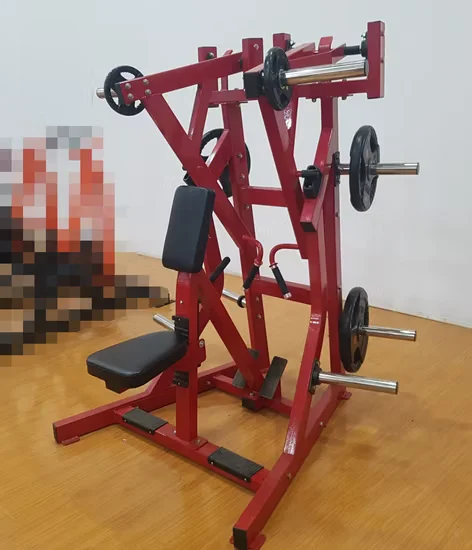
Zero Electronic Faults — pure plate-loaded mechanics eliminate motors, circuit boards and belts, keeping the ISO-Lateral Low Row Machine operational in high-humidity facilities without electrical downtime.
Technical Specifications
| Parameter | Value |
|---|---|
| Product Type | Plate Loaded Strength Machine |
| Exercise Part | Back |
| Material | Steel |
| Product Dimensions | 125010561700mm |
| Net Weight | 139kg |
| Power Source | Manual |
| Folded | Unfolded |
| Resistance Type | Plate Loaded |
| Max User Weight | 180kg |
| Age Group | Adult |
| Gender | Unisex |
| Certification | ISO 9001, CE |
Application Suitability
| Deployment Scenario | Typical Use |
|---|---|
| Chain gym strength zone | High-frequency back training between cardio and free-weight areas |
| Corporate wellness room | Low-maintenance back conditioning for non-technical facility staff |
| Professional sports training center | ISO-lateral row biomechanics for athlete posterior chain development |
| Community fitness center | Durable plate loaded ISO-lateral low row machine commercial gym members can use without supervision |
| Hotel fitness center on guest room floors | Silent operation eliminating noise transfer to adjacent occupied spaces |
What Zero Electronics Means for Strength Zone Uptime
A mechanical plate-loaded system removes every electrical failure point from your maintenance log.
I have watched commercial gym owners lose entire mornings to console error codes and sensor recalibrations while members wait for machines to come back online. On a busy gym floor, every minute of downtime translates into complaints at the front desk and equipment marked out of order before lunch [NEED_CITE: equipment downtime cost per hour in commercial fitness facilities]. When a plate loaded ISO-lateral low row machine runs purely on steel bearings and Olympic plates, there is no circuit board to short out in humid environments and no sensor to drift after thousands of repetitions.
Back Training Coverage and Strength Zone Positioning
This machine targets the latissimus dorsi, rhomboids and mid-trapezius through a converging ISO-lateral arc, covering the moderate-to-heavy loading range where free-weight rows introduce lower-back risk. It sits naturally between cable stations and free-weight racks in a commercial strength zone, absorbing members who need guided rowing motion without occupying a functional training bay. The plate loaded ISO-lateral low row machine commercial gym operators deploy fits a wide user height spectrum thanks to adjustable seat positioning, and the manual loading format accommodates every strength level from rehabilitation clients to competitive powerlifters. The converging arm path lets each side move independently, so strength imbalances become visible during sets rather than hidden by a fixed bar.
Continuous Operation Demands and Facility Environment Requirements
Commercial strength zones see this machine loaded and unloaded dozens of times per hour during peak periods [NEED_CITE: average daily repetitions per strength machine in commercial gym]. Sealed bearings carry the pivot load without scheduled lubrication, which matters when maintenance staff cover multiple sites and cannot visit weekly. The all-steel welded frame resists lateral deflection under asymmetric plate loading, keeping the movement path consistent whether one arm carries twenty kilograms or both arms carry eighty. Floor leveling is critical: an uneven base introduces frame twist that accelerates bearing wear on the loaded side. The machine demands no dedicated electrical circuit, eliminating voltage compatibility headaches when exporting across regions with different plug standards.
Decoding the Mechanical Advantage of Plate-Loaded Row Architecture
ISO-lateral independent arm design separates the left and right movement paths, allowing each arm to follow its own converging arc toward the torso rather than forcing both hands along a single fixed bar. This mirrors the natural scapular retraction pattern the body uses during bent-over rows, reducing shear stress on the shoulder joint compared to a unified grip bar. Sealed bearings at every pivot point handle the radial and axial loads generated by plate momentum at the bottom of each repetition. The steel frame geometry positions the pivot axis close to the user’s hip crease, ensuring the resistance vector aligns with the mid-back musculature through the full range. Plate loaded ISO-lateral low row machine commercial gym buyers select benefit from standard Olympic sleeve compatibility, meaning existing bumper plates and iron plates from the free-weight zone transfer directly onto the loading horns without adapter hardware.
The Hidden Cost of Spec Compromise on Row Machines
Facilities that install light-duty row machines with unsealed bushings instead of bearings face grinding noise within months as metal-on-metal friction destroys the pivot surface. When frame tubing is undersized, lateral flex during heavy unilateral loading shifts the movement path, forcing users into compensatory patterns that stress the rotator cuff [NEED_CITE: shoulder injury correlation with misaligned row machine pivot axis]. Members notice the roughness and abandon the station, leaving an expensive footprint of underused floor space. Owners then face the choice of premature replacement or living with a machine that generates complaints every week.
Why This Product Line Earns Its Floor Space
The sub-35dB operational noise verified in hotel deployments means this row machine contributes zero acoustic disturbance to adjacent cardio zones or upstairs guest rooms. The 10,000-hour durability testing protocol applied to bearings and frame welds matches the continuous-use standard applied across the entire cardio family, so facility operators apply one maintenance philosophy to every station. The complete six-series cardio range lets buyers source treadmills, bikes, ellipticals and climbers from the same engineering team, simplifying spare parts inventory. OEM customization extends to frame color and logo placement without altering the structural specification. The free 3D layout and airflow planning service maps this machine’s 1250 by 1056 millimeter footprint against member flow corridors, ensuring the row station does not bottleneck traffic between the squat rack and the cable crossover. Twenty-four-hour technical support covers bearing replacement guidance and alignment troubleshooting for on-site maintenance crews.
Documentation & Test Records
- CE declaration of conformity covering structural load limits for the steel frame
- EN 957 test report validating pivot bearing endurance under cyclic loading
- ISO 9001 certificate covering welding and assembly quality control processes
- Noise level test report confirming silent mechanical operation under load
- Durability test record documenting sealed bearing performance over extended cycles
- Installation and commissioning guide with torque specifications for frame bolts
Installation, Commissioning & Maintenance
- Reserve a 1250 by 1056 millimeter footprint plus one meter clearance on each side for safe plate loading
- Level the floor or use adjustable foot cups to prevent frame twist under asymmetric loading
- Verify all pivot bolts to specified torque values after the first five hundred repetitions
- Inspect sealed bearings quarterly for lateral play and replace if grinding is detected
- Wipe down loading horns and seat pads after each shift to prevent sweat-induced corrosion
- Check Olympic sleeve retaining clips monthly to prevent plate migration during use
Request a Strength Zone Equipment Assessment
Provide your facility square footage and current equipment list to receive a 3D strength zone layout that positions this row machine within member flow patterns and sightlines. Specify whether the installation floor sits above occupied rooms so acoustic isolation requirements can be confirmed. State your target market voltage standards even though this machine requires no electrical connection, ensuring full documentation packages match local regulatory expectations. Indicate whether console data integration is needed on companion cardio units so the strength and cardio zones share a unified member analytics platform.
Frequently Asked Questions
Q: How does ISO-lateral arm movement differ from a traditional fixed-bar low row?
A: Traditional low row machines lock both hands onto a single bar, forcing the shoulder joints into a symmetrical path that ignores natural strength imbalances. ISO-lateral independent arms allow each side to follow its own converging arc, engaging the latissimus dorsi through a more anatomical range and revealing unilateral weaknesses during training sessions.
Q: What maintenance does a plate-loaded row machine require compared to selectorized equipment?
A: Plate-loaded machines eliminate weight stack cables, guide rods and selector pins that demand regular inspection and replacement on selectorized units. Maintenance is limited to periodic bearing inspection, bolt torque verification and surface cleaning, substantially reducing the parts inventory and technician hours a facility must budget for ongoing operations.
Q: How do sealed bearings hold up under continuous commercial gym use?
A: Sealed bearings prevent dust, chalk residue and moisture from reaching the rolling elements inside the pivot assembly. In high-frequency commercial environments, this seal integrity extends the service interval far beyond what open bushings achieve, keeping the rowing motion smooth and preventing the grinding noise that drives member complaints.
Q: Can this machine be deployed in a mixed cardio and strength zone without noise issues?
A: Yes. The entirely mechanical plate loaded ISO-lateral low row machine commercial gym operators install produces no motor hum, solenoid clicks or belt vibration. The only sound is plate contact on the loading horns, which stays well below the ambient noise floor of a busy gym and causes no disturbance to adjacent cardio stations or upstairs spaces.
Q: What frame safety standards apply to commercial plate-loaded strength equipment?
A: The frame must withstand cyclic loading tests defined under EN 957, verifying structural integrity under repeated maximum load conditions. The ISO 9001 quality management system covers welding procedures and material traceability, ensuring every frame meets consistent load-bearing thresholds before leaving the production facility.

![MTS-8007 ISO-Lateral High Row Gym Machine for Commercial Gyms [WARN] draft identifier mismatch](https://bicksport.com/wp-content/uploads/2026/08/mts-8007-iso-lateral-high-row-gym-machine-for-commercial-gyms-warn-draft-identifier-mismatch-d8af61.webp)

