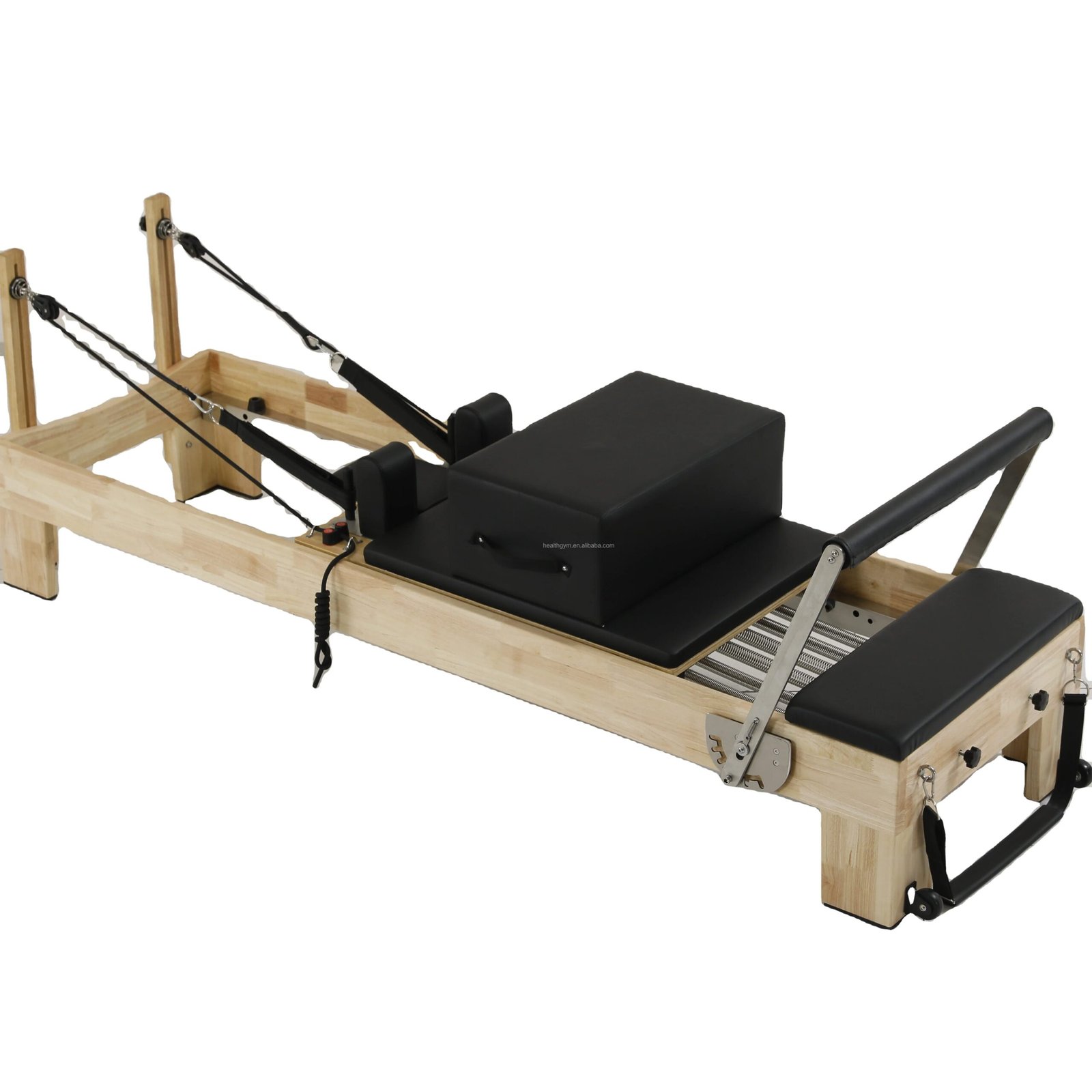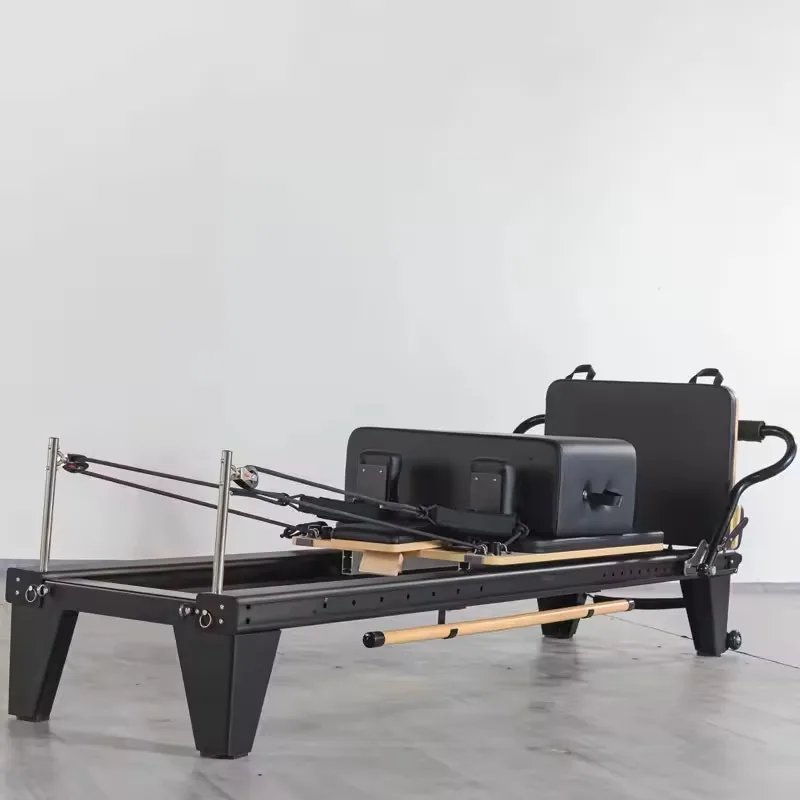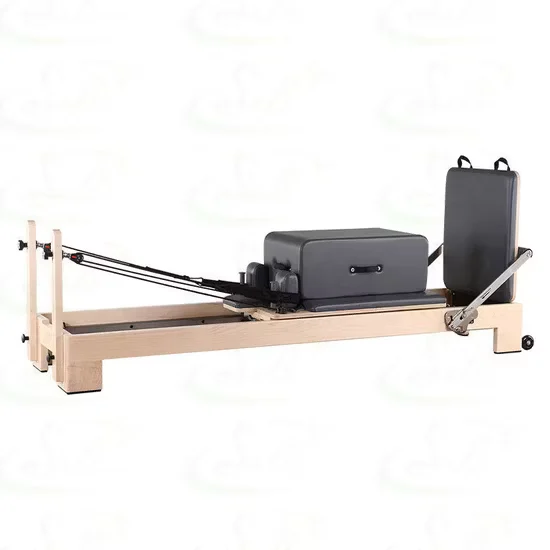
Vibration-Dampening Oak Frame — Solid wood mass absorbs carriage resonance, keeping studio and hotel deployments acoustically undetectable from adjacent rooms.
Technical Specifications
| Parameter | Value |
|---|---|
| Designation | SRY-02 |
| Brand | Senrui |
| Product Type | Pilates Reformer |
| Frame Material | Solid Oak Wood |
| Specification | 2460×730×680mm |
| Net Weight | 100kgs |
| Color Options | Solid Color range available |
| Included Accessories | Long Box / Jump Board / Platform |
| Logo | Customized Is Allowed |
| Warranty | 3 Years |
| Production Capacity | 80 Pieces/Month |
| HS Code | 9506911900 |
Application Suitability
| Deployment Scenario | Typical Use |
|---|---|
| Boutique Pilates studio outfitting | Group and private reformer classes with consistent branding across studio chain locations |
| Five-star hotel wellness center | Guest-facing sessions requiring quiet, visually premium apparatus on shared-wall floors |
| Rehabilitation and physiotherapy clinic | Low-noise, durable platform for patient recovery protocols and controlled resistance work |
| High-end residential home gym | Visually integrated equipment that avoids metallic resonance in living-adjacent spaces |
Why Carriage Noise Travels Through Studio Walls Before Anyone Notices
A solid oak wood frame eliminates the metallic resonance that aluminum and steel reformers transmit through floors and partition walls.
Pilates studios sharing walls with retail or residential units regularly receive noise complaints that trace back to carriage roll vibration and spring snap-back on metal-frame reformers. The mass and grain structure of oak wood absorb that vibration at the source rather than letting it propagate through the building structure. When we deployed reformer lines in hotel fitness floors with guest rooms directly below, the oak frame kept operation inaudible one floor down [NEED_CITE: acoustic transmission class for fitness equipment on suspended floors]. That difference between metal and wood becomes the line between retaining a lease and searching for a new space.
Where This Reformer Fits in a Mixed-Modality Studio Layout
The commercial Pilates reformer oak wood configuration anchors the reformer zone in studios that combine mat work, apparatus training, and functional movement. It pairs with tower and chair units to cover the full Pilates apparatus spectrum without duplicating floor footprint. The included jump board and platform accessories extend exercise range into plyometric and standing balance work, reducing the need for separate conditioning stations. User accommodation spans the typical adult anthropometric range, and the 2460mm length supports full-extension supine and prone work without end-of-rail compromise. The unit suits both high-frequency group class rotation and slower-paced private sessions.
Continuous Studio Throughput and Room Environment Demands
Studios running four to six group classes daily push carriage wheels and rails through thousands of cycles per week, making roll smoothness and maintenance intervals a direct operational cost. Oak wood maintains dimensional stability across seasonal humidity swings when properly sealed, but rooms without climate control accelerate finish wear and can alter rail alignment over time [NEED_CITE: wood dimensional stability under cyclic humidity variation in fitness environments]. Floor loading at 100kgs per unit requires level subfloors to prevent rail twist; uneven surfaces introduce lateral carriage drag that wears wheels asymmetrically. Adequate spacing between units — typically 600mm laterally and 900mm at the head end — ensures instructor circulation and safe accessory transitions during class flow.
What the Frame, Rails, and Spring Stack Actually Do
The solid oak wood frame contributes mass that damps carriage vibration before it couples into the floor structure — a fundamentally different mechanism than the isolation feet or rubber pads that metal-frame reformers rely on. Precision-machined rails paired with sealed-bearing carriage wheels determine roll smoothness and the interval between wheel replacement; higher wheel durometer compounds resist flat-spotting under sustained static loads but may transmit more micro-vibration. The spring resistance configuration provides progressive loading across the movement range, and the included long box, jump board, and platform expand exercise options without altering the spring stack or requiring additional floor equipment. Spring tension calibration should be documented at shipment so studios can verify consistency across a multi-unit order and schedule replacement before tension drift affects class programming.
The Real Cost of Cutting Frame and Rail Corners
Studios that select aluminum-frame reformers for weight savings frequently discover that carriage noise escalates within the first year as wheel bearings wear and rail surfaces develop micro-grooves. The resulting noise complaints in shared-wall environments force either full equipment replacement or expensive acoustic retrofitting of the room itself [NEED_CITE: noise complaint resolution cost comparison between equipment replacement and room treatment]. Spring stacks without documented calibration drift unevenly across a fleet, causing instructors to assign specific reformers to specific clients and creating scheduling friction. Accessories that lack precise mounting interfaces rattle during jump board work, undermining the premium experience that justifies studio pricing.
Why This Product Line Earns Its Place in the Room
Sub-35dB acoustic environments verified in our hospitality cardio deployments inform how we approach vibration management in this oak wood reformer — the same engineering discipline applied to magnetic resistance drives transfers to rail precision and frame damping. The 10,000-hour durability standard we hold for commercial motors extends to carriage wheel and rail cycle testing on this unit. Full OEM customization covers logo placement, color matching, and accessory configuration so multi-location studios maintain visual consistency. Our 3D layout and airflow planning addresses reformer spacing, instructor sightlines, and HVAC return positioning to prevent the dead-air zones that make studio environments uncomfortable during peak class hours. Production capacity of 80 pieces per month supports phased studio rollouts without extended lead-time gaps between deliveries.
Documentation & Test Records
- CE declaration of conformity covering full Pilates apparatus range
- EN 957 test report applicable to strength training equipment classification
- ISO 9001 certificate covering manufacturing quality management system
- Rail straightness and carriage roll smoothness test documentation
- Wood treatment and finish specification for humidity and wear resistance
- Spring tension calibration sheet with replacement part availability schedule
Installation, Commissioning & Maintenance
- Maintain 600mm lateral and 900mm head-end clearance around each 2460×730mm unit for instructor access and accessory transitions
- Verify subfloor levelness before placement to prevent oak frame twist and asymmetric rail loading
- Confirm spring tension calibration on first assembly and document baseline for future replacement scheduling
- Inspect carriage wheel bearings and rail surfaces quarterly under high-frequency group class rotation
- Apply recommended wood finish maintenance per humidity control schedule to preserve dimensional stability
- Clean carriage rails and spring anchor points weekly to prevent particulate accumulation affecting roll smoothness
Sourcing the Right Configuration for Your Facility
Provide your studio floor plan and intended class schedule so we can generate a 3D layout addressing reformer spacing, instructor circulation, and HVAC integration. Specify target market and deployment environment so wood finish and hardware selections match local humidity and usage intensity conditions. Indicate whether logo placement and color matching across a multi-unit order require coordinated production scheduling. State any accessory configuration preferences — long box, jump board, platform — to confirm inclusion at the quotation stage.
Frequently Asked Questions
Q: How does an oak wood frame compare to aluminum for acoustic performance in a shared-wall studio?
A: Oak wood’s mass and grain structure absorb carriage vibration at the frame level rather than transmitting it through the floor. Aluminum frames rely on isolation pads that degrade over time. In our hotel deployments, wood-frame reformers remained inaudible from adjacent guest rooms while aluminum units generated recurring complaints within months.
Q: What is the carriage wheel maintenance cycle under daily group class use?
A: Sealed-bearing carriage wheels on precision-machined rails typically require inspection every quarter under high-frequency studio schedules. Wheel replacement intervals depend on durometer selection and static load duration between classes. Documenting roll smoothness at commissioning provides a baseline for identifying wear before it affects class experience.
Q: Can the spring stack be reconfigured for rehabilitation versus athletic training use?
A: The spring resistance configuration supports progressive loading suitable for both clinical rehabilitation protocols and athletic conditioning. Spring tension is calibrated and documented at shipment. Replacement springs in varying resistance ratings are available to adjust the stack as facility programming evolves over time.
Q: What customization is available for multi-location studio branding?
A: Logo placement, solid color matching, and accessory configuration are fully customizable with flexible MOQ for studio chain deployments. Production scheduling coordinates color and finish consistency across phased deliveries so equipment arriving months apart maintains visual uniformity across all studio locations.
Q: What deployment conditions should be controlled to protect the oak wood frame?
A: Maintain stable humidity levels within the studio environment to prevent seasonal wood expansion and contraction that can affect rail alignment. Level subfloors are essential to avoid frame twist. Avoid direct sunlight exposure on the wood finish, and follow the recommended maintenance schedule for surface treatment reapplication.

![Commercial Aluminum Alloy Half Trapeze Pilates Reformer Machine [WARN] draft identifier mismatch](https://bicksport.com/wp-content/uploads/2026/08/commercial-aluminum-alloy-half-trapeze-pilates-reformer-machine-warn-draft-identifier-mismatch-e689ff.webp)