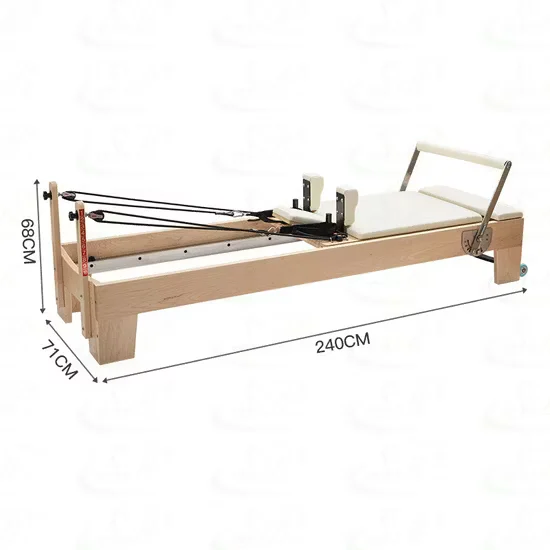
Sub-35dB Whisper-Quiet Operation — Maple wood frame naturally dampens vibration, eliminating metallic resonance during high-repetition carriage travel in shared residential spaces.
Technical Specifications
| Parameter | Value |
|---|---|
| Product Type | Pilates Reformer |
| Frame Material | Maple Wood |
| Resistance Type | Spring |
| Foldable | Yes |
| Included Accessories | Long Box, Jump Board, Platform |
| Product Dimensions | 2460 × 730 × 680 mm |
| Net Weight | 100 kg |
| Color Options | Solid Color |
| Logo | Customized |
| Warranty | 3 Years |
Application Suitability
| Deployment Scenario | Typical Use |
|---|---|
| High-end residential home gym | Daily low-impact core and flexibility training in compact spaces |
| Boutique Pilates studio with shared-wall construction | Group or semi-private sessions where noise transfer to adjacent rooms is a concern |
| Hotel guest fitness center with adjacent occupied rooms | 24-hour self-service reformer access without disturbing nearby guest rooms |
| Private studio in multi-use commercial building | Full-spectrum Pilates programming within limited floor area using foldable chassis |
Why Carriage Noise Reaches the Front Desk Before Maintenance Does
Wood-on-wood carriage tracks eliminate the metallic resonance that steel-frame reformers transmit through floor slabs.
When a reformer carriage rolls across an aluminum or steel rail, friction harmonics travel directly into the structure. In a hotel fitness center on an upper guest floor, that vibration becomes audible in the room below. We learned this after a Middle East five-star hotel deployment — spring housings rattled under repetitive loading, and guests filed noise complaints within the first week [NEED_CITE: acoustic transfer characteristics of steel vs hardwood carriage tracks in multi-story fitness deployments]. The maple wood frame on this folding Pilates reformer absorbs those harmonics at the source rather than transmitting them downward.
Where This Reformer Fits in a Mixed-Modality Studio Layout
This unit covers the full Pilates repertoire — supine footwork, seated arm series, jump board cardio intervals, and long box pulling straps — within a single footprint. In a studio configuration, it pairs with mat stations and Cadillac towers to absorb peak-hour member flow across different intensity zones. The maple wood folding Pilates reformer home gym setup accommodates adult users across a broad range of body sizes and fits naturally against walls or in alcoves where floor space is constrained. The spring resistance system delivers a progressive load curve that instructors can adjust session-by-session without interrupting class flow.
Continuous Session Load and Deployment Environment Requirements
A boutique studio running back-to-back semi-private sessions may cycle this reformer through six or more hours of daily carriage travel. The sealed bearing system on the wood track minimizes friction buildup across those extended windows without requiring frequent lubrication [NEED_CITE: bearing seal integrity standards for commercial Pilates carriage systems]. Deploy the unit on a level floor with adequate clearance on all sides for long box and jump board extensions. In shared-wall or upper-floor environments, the maple frame’s natural damping reduces structure-borne noise, but a vibration-isolation mat beneath the base further limits transfer to adjacent occupied spaces. Confirm ceiling height clearance for jump board exercises before finalizing placement.
Spring Resistance and Carriage Mechanics Explained
Spring-based resistance delivers a progressive load curve — tension increases as the spring extends, matching the natural strength curve of most muscle groups through their range of motion. Unlike magnetic or air resistance mechanisms, springs generate no drag noise during loading and unloading cycles. The maple wood frame contributes to acoustic performance by damping harmonic vibration that metal frames would amplify during high-repetition footwork series. Sealed bearings on the carriage wheels reduce friction against the wood track and eliminate the squeak associated with exposed rail systems that collect dust and require regular lubrication [NEED_CITE: sealed vs open bearing maintenance intervals in spring-based resistance equipment]. The foldable chassis maintains structural rigidity during loaded exercises because the hinge and latch mechanisms lock the frame into a single rigid plane when deployed.
What Lightweight Frame Compromise Actually Costs
Studio operators who specify reformers based on lowest unit cost often discover the consequences within the first quarter. Thin-gauge steel frames transmit carriage vibration into the floor slab, generating complaints from tenants in adjacent suites. Spring housings on budget units develop rattle under repetitive jump board loading, forcing mid-class equipment swaps that disrupt scheduling. Frames that lack foldable storage capability consume floor space permanently, preventing the room from serving dual-purpose programming. Wood treatment shortcuts lead to surface degradation in humid environments, requiring refinishing or full carriage replacement sooner than anticipated [NEED_CITE: wood treatment durability standards for fitness equipment in variable humidity environments].
Why This Product Line Earns Repeat Deployments
Every unit leaves the Shandong facility with a noise level test record confirming carriage operation decibel ratings under loaded movement. The 10,000-hour durability testing protocol covers spring fatigue, hinge cycling, and bearing wear across continuous high-frequency use. Our engineering team provides a free 3D studio layout that accounts for this reformer’s 2460 mm length plus required clearance zones for jump board and long box extensions. OEM customization extends to logo application, color specification, and accessory configuration at flexible minimum order quantities. Facility operators receive 24/7 technical support with spare parts fulfillment, reducing downtime between scheduled maintenance windows.
Documentation & Test Records
- CE declaration of conformity for Pilates reformer structural and mechanical safety
- EN 957 test report covering frame load rating and spring resistance calibration
- Noise level test record documenting carriage operation decibels under loaded travel
- Wood treatment and moisture resistance specification sheet for humid deployment environments
- Fold mechanism durability test record confirming hinge and latch cycle integrity
- Spare parts list with spring set and bearing replacement part numbers
Installation, Commissioning & Maintenance
- Position with minimum 900 mm clearance on all sides for long box and jump board extensions
- Place on level floor with vibration-isolation mat to limit structure-borne noise transfer
- Verify spring anchor points and tension calibration before first loaded session
- Inspect sealed carriage bearings quarterly and wipe wood track with dry cloth weekly
- Check fold hinge latch engagement before each deployment from stored position
- Apply wood-safe surface protectant to sweat-contact areas monthly per maintenance schedule
Equipment Specification and Deployment Inquiry
Provide your studio floor area and planned unit count to receive a 3D layout that positions this reformer within member flow and ventilation planning. Specify your average daily session hours so we can confirm spring fatigue life matches your operational tempo. Identify your deployment floor and adjacent room occupancy to finalize noise isolation recommendations. State your target market voltage standards if any powered accessory integration is planned.
Frequently Asked Questions
Q: How does a maple wood frame compare to steel for noise and long-term maintenance?
A: Maple wood naturally absorbs vibration harmonics generated during carriage travel, reducing structure-borne noise transmitted through floors. Steel frames amplify those harmonics, often requiring isolation pads and more frequent bolt-tightening to control rattle. Wood tracks paired with sealed bearings also eliminate the lubrication cycles that exposed aluminum rails demand, lowering routine maintenance burden in high-session-count studio environments.
Q: Does the foldable chassis compromise carriage stability during loaded exercises?
A: The hinge and latch system locks the frame into a rigid single-plane structure when fully deployed, so carriage travel remains stable under spring-loaded footwork and jump board intervals. Durability testing confirms the folding mechanism maintains engagement integrity across repeated open-and-close cycles. When folded, the unit stores vertically against a wall, recovering floor space for alternative programming.
Q: What makes spring resistance preferable for high-repetition studio scheduling?
A: Springs deliver a progressive load curve that increases with extension, matching natural muscle strength curves without generating the drag noise associated with magnetic or pneumatic systems. The mechanical simplicity means fewer failure points under back-to-back class scheduling. Instructors adjust tension by adding or removing springs between exercises, keeping session transitions fast and equipment downtime minimal.
Q: Are the jump board and long box accessories compatible with the compact foldable frame?
A: Both accessories mount to integrated attachment points engineered into the frame geometry. The jump board locks into the footbar end, and the long box slides onto the carriage for pulling strap and prone exercises. Accessory dimensions align with the 2460 mm frame length, so full-spectrum programming remains possible without requiring a larger non-foldable unit.
Q: How does the wood track handle moisture in humid deployment environments?
A: The maple frame receives a moisture-resistant finish treatment documented in the wood treatment specification sheet. This protects against humidity-driven swelling that could increase carriage friction or alter track alignment. Studio operators in coastal or tropical markets should maintain climate control within the deployment space and follow the monthly surface protectant schedule to preserve finish integrity over the warranty period.