

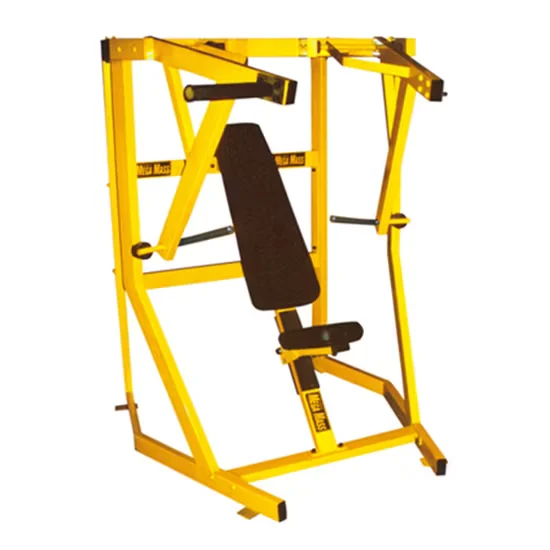
Acoustic-Grade Frame Stability — 140kg steel construction ensures zero resonance during high-frequency chest press training on upper facility floors.
Technical Specifications
| Parameter | Value |
|---|---|
| Product Type | ISO-Lateral Bench Press |
| Designation | 5001 |
| Power Source | Manual |
| Resistance Type | Plate-loaded / Pin-loaded (customizable) |
| Exercise Part | Chest |
| Movement Pattern | ISO-Lateral independent arm |
| Frame Material | Steel |
| Product Dimensions | 1323 × 1599 × 1746 mm |
| Net Weight | 140 kg |
| Foldable | Unfolded |
| Age Group | Adult |
| Gender | Unisex |
| Appliance | Gymnasium |
| Customization | Available |
| Certification | RoHS, ISO 9001, CE |
Application Suitability
| Deployment Scenario | Typical Use |
|---|---|
| hotel fitness center on guest room floors | low-noise chest training accessible 24/7 without disturbing adjacent rooms |
| chain gym cardio zone | paired with selectorized strength lines for high-throughput member circuits |
| corporate wellness room | compact footprint fitting limited square footage while covering push movement patterns |
| high-end residential home gym | stable steel frame tolerating daily use without floor vibration transfer |
| sports performance training center | independent arm tracking for athletes requiring unilateral load assessment |
Why Frame Mass Defines Long-Term Deployment Value
A 140kg steel frame anchors every rep without lateral drift, even under maximum plate loading.
Facility operators who spec lighter chest machines report wobble complaints within months, especially when users load asymmetric plates or perform explosive concentric phases [NEED_CITE: commercial strength equipment frame stability requirements under EN 957]. The ISO-Lateral Bench Press addresses this through sheer structural mass combined with reinforced weld joints at every pivot point. In my time on the assembly floor in Jinan, I watched lighter bench units shift mid-set during load testing — the 140kg chassis here simply does not translate horizontal force to the floor. For hotel deployments above occupied guest rooms, that mass also dampens vibration transmission through the slab.
Positioning Within the Strength Zone Layout
This commercial ISO-lateral bench press chest machine occupies the push-movement station in a structured strength circuit, complementing pull-down, rowing, and shoulder press units. Its independent arm mechanism serves both bilateral and unilateral training without requiring a separate machine. The 1323 × 1599 mm footprint fits standard commercial spacing grids, leaving adequate member flow lanes on each side. It accommodates users across a wide anthropometric range thanks to the adjustable seat and back pad geometry.
Continuous Use and Environmental Placement Factors
A selectorized or plate-loaded chest press carries no motor, so duty cycle concerns shift entirely to pivot bearings and cable routing [NEED_CITE: bearing lifespan under continuous commercial load cycles]. In 24-hour hotel gyms and chain facilities, this unit cycles hundreds of times daily — sealed bearings and hardened guide rods must tolerate that rhythm without developing play. Floor placement should account for the 1746 mm height clearance and a minimum 600 mm service corridor behind the frame for cable inspection. Noise transmission is minimal since there is no motor, but plate clatter during heavy eccentrics can transfer through unprotected flooring. A rubber mat beneath the footprint absorbs impact and protects finished surfaces.
Interpreting the Structural and Mechanical Specifications
The 140 kg net weight indicates a frame built from heavy-gauge steel tube, likely 3 mm wall thickness or above, which is the threshold where commercial frames resist deformation under repeated off-axis loading. ISO-Lateral independent arm design means each side rides its own pivot axis, allowing natural convergence during the press arc — this reduces shear force on the shoulder joint compared to fixed-bar machines. The manual power source eliminates electrical failure points entirely; resistance comes from gravity acting on loaded plates or a pin-selected stack. Movement smoothness depends on bearing quality at the pivot and any linear guide rods if a stack-loaded variant is chosen [NEED_CITE: sealed bearing specifications for commercial selectorized strength equipment]. The unfolded configuration is permanent, reflecting the structural rigidity required for institutional deployment.
The Hidden Cost of Underspecifying Frame Mass
Operators who purchase 60–80 kg chest presses for commercial floors discover frame flex within the first year — the unit rocks during heavy sets, users lose confidence, and maintenance tickets multiply [NEED_CITE: frame fatigue failures in light-commercial versus full-commercial strength equipment]. Lightweight frames also transmit vibration directly to floor slabs, triggering noise complaints in hotels and residential towers. When pivot bearings are undersized, they develop play that manifests as clicking and grinding, requiring complete bearing replacement rather than simple adjustment. Data from facility audits shows these machines are pulled from the floor and replaced at significant capital loss, whereas a 140 kg unit with oversized bearings runs for years without structural service.
Why This Product Line Holds Up Under Audit
Every unit in the Bickton commercial cardio and strength family undergoes 10,000-hour continuous operation testing on critical components — for this bench press, that means pivot bearings and guide rods are cycled under load far beyond typical warranty periods. The sub-35dB acoustic standard from the cardio range informs how we approach strength equipment noise: plate contact surfaces and pivot points are engineered to minimize metallic resonance. The six-series equipment family means a facility can source every cardio and strength discipline from one production line, simplifying spare parts logistics. Full OEM customization covers frame color, pad upholstery, and logo application to match venue branding. Free 3D layout planning accounts for this unit’s exact footprint and the sightlines needed around it. Technical support responds around the clock for commissioning questions.
Documentation & Test Records
- CE declaration of conformity for the ISO-Lateral Bench Press frame and moving assemblies
- EN 957 test report covering static and dynamic load verification
- ISO 9001 certificate for the manufacturing quality management system
- RoHS compliance declaration for all painted and plated surfaces
- Durability test record documenting pivot bearing and guide rod cycle counts
- Assembly and commissioning guide with exploded diagrams and torque specifications
Installation, Commissioning & Maintenance
- Maintain minimum 600 mm clearance behind and beside the 1323 × 1599 mm footprint for member passage and service access
- Place on level flooring with a high-density rubber mat to absorb plate impact and protect slab finishes
- Inspect pivot bearings and guide rods for play after the first 500 operating hours, then at six-month intervals
- Verify all frame bolts reach specified torque values after initial assembly and after the first 30 days of use
- Wipe down steel frame and upholstery after each session with pH-neutral cleaner to prevent sweat corrosion
- Confirm pad foam density and upholstery integrity quarterly to maintain user comfort and safety
Requesting a Deployment Quote
Submit your strength zone square footage and planned equipment list so we can produce a 3D layout that accounts for this press’s footprint, member flow corridors, and ventilation clearances. Specify whether the unit deploys above occupied spaces so we can confirm appropriate floor matting and vibration isolation. Indicate target market and any OEM requirements including frame color, pad material, and branding placement.
Frequently Asked Questions
Q: What is the difference between ISO-Lateral and traditional fixed-path chest machines?
A: ISO-Lateral machines allow each arm to move independently along its own pivot axis, which mirrors the natural convergence of a free-weight bench press. Traditional fixed-path machines force both arms along a single rigid bar, which can create shoulder joint shear when the user’s biomechanics do not match the preset arc. The independent movement also enables unilateral loading for rehabilitation and athletic assessment.
Q: How does the 140 kg frame weight affect stability during heavy training?
A: The 140 kg mass provides a low center of gravity and high rotational inertia, meaning the frame resists tipping and lateral shift even when users load heavy plates asymmetrically or perform explosive repetitions. Lighter frames in the 60–80 kg range tend to rock during aggressive sets, which compromises user confidence and accelerates bearing wear at every pivot point.
Q: Can the frame color and branding be customized for our venue?
A: Full OEM and ODM customization is available, covering powder-coat color selection, pad upholstery material and stitching, and logo application on the frame shroud. Minimum order quantities are flexible, and production includes color sample approval before the full run begins. Lead times adjust based on the complexity of the custom specification.
Q: What maintenance intervals are recommended for the pivot bearings?
A: Sealed pivot bearings in this commercial unit are designed for extended service intervals. We recommend inspecting for lateral play after the first 500 hours of operation, then every six months under normal commercial use. If play is detected, individual bearing cartridges can be replaced without disassembling the entire frame, minimizing equipment downtime on the floor.

![Commercial Reverse Hyper Extension Machine for Professional Gyms [WARN] draft identifier mismatch](https://bicksport.com/wp-content/uploads/2026/08/commercial-reverse-hyper-extension-machine-for-professional-gyms-warn-draft-identifier-mismatch-90bef3.webp)
![Commercial Multi Function Power Rack Pull Up Gym Equipment [WARN] draft identifier mismatch](https://bicksport.com/wp-content/uploads/2026/08/commercial-multi-function-power-rack-pull-up-gym-equipment-warn-draft-identifier-mismatch-881358.webp)