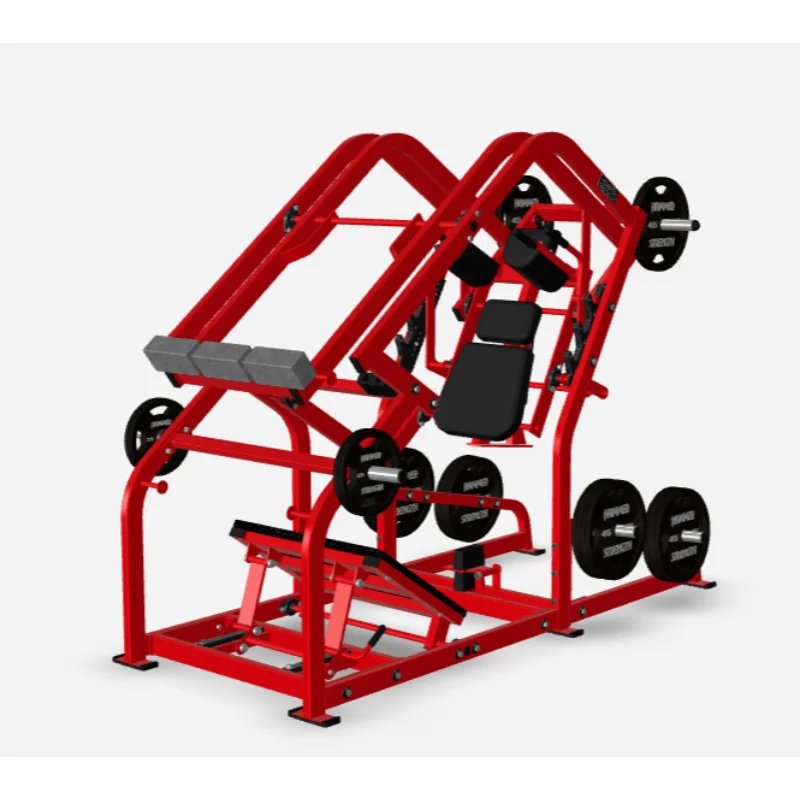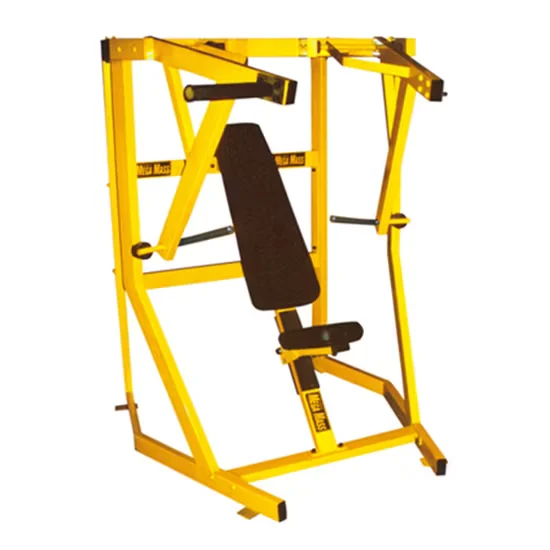
Steel-Rigid Load Path — Full steel welded frame and ISO-lateral independent arm geometry eliminate structural flex and resonance even under repeated heavy loading cycles.
Technical Specifications
| Parameter | Value |
|---|---|
| Designation | OS-H5004 |
| Product Type | Plate Loaded ISO-Lateral Decline Bench |
| Exercise Part | Chest |
| Power Source | Manual |
| Resistance Type | Plate loaded |
| Frame Material | Steel |
| Product Dimensions | 1300 × 1150 × 1750 mm |
| Net Weight | 141 kg |
| Foldable | No |
| Max User Weight | Not specified |
| Main Frame Color | Available per customer requirements |
| Cushion Color | Available per customer requirements |
| OEM/ODM | Acceptable |
| Certification | ISO 9001, CE |
| Production Capacity | 1000 units |
Application Suitability
| Deployment Scenario | Typical Use |
|---|---|
| Chain gym strength zone | High-frequency chest isolation training within mixed cardio and strength layouts |
| Corporate wellness room | Compact plate loaded station for employee fitness programs with limited floor space |
| Community fitness center | Durable decline press option for adult members of varying strength levels |
| Sports performance training center | Targeted lower-chest development for athletes requiring precise load management |
| Hotel fitness center | Low-maintenance manual station compatible with 24-hour unattended access |
Why Frame Resonance Travels Further Than You Think in Mixed-Use Facilities
A welded steel frame with adequate cross-section mass stops vibration before it reaches the floor slab.
When a decline bench flexes under load, that micro-deflection transfers into the floor as low-frequency vibration. In facilities where the strength zone shares a slab with guest rooms or quiet offices, [NEED_CITE: structural vibration transmission through concrete floor slabs in multi-use buildings] that energy becomes a complaint. I have watched hotel procurement teams scrap entire batches of lighter-gauge benches after night-shift guests reported a rhythmic hum traveling through ceiling panels. The OS-H5004 commercial plate loaded ISO-lateral decline bench counters this with a full steel frame and reinforced base that suppresses structural deformation during repetitive loading sets, keeping vibration energy contained at the contact pads rather than broadcasting it through the building.
Positioning Within the Strength Zone Layout
This ISO-lateral decline bench targets the lower pectoral region through a converging arc that matches the natural fiber orientation of the chest. It pairs with flat and incline press stations to complete a three-angle pressing cluster, allowing members to cycle through all chest subdivisions without leaving one footprint. The manual plate loaded design means no electrical conduit or dedicated circuit is needed, so it fits into zones where power routing is impractical. Its 1300 × 1150 mm footprint leaves enough clearance for standard plate storage and spotter access. The commercial plate loaded ISO-lateral decline bench accommodates adult users across a broad strength range since load is dictated entirely by the plates selected.
Continuous Operation and Deployment Environment Requirements
A plate loaded station carries no motor, no electronics, and no duty-cycle ceiling — it runs as long as members load and press. The limiting factor becomes pivot bearing wear and cushion compression rather than thermal failure [NEED_CITE: bearing service life under cyclic radial load in gym equipment pivots]. Deploy it on a level concrete subfloor with rubber matting to decouple residual plate-drop shock from the structure. Because there is no console or data port, no network integration is required, which simplifies deployment in basement gyms or remote annexes where connectivity is unreliable. Ensure ceiling height exceeds 1750 mm plus overhead clearance for loading plates on the horn.
Decoding the Mechanical Specification Sheet
The ISO-lateral arm design allows each side to move independently, so a strength imbalance between left and right does not force the stronger side to compensate — this is a biomechanical distinction from fixed-bar decline stations where the bar couples both limbs. The 141 kg net weight signals a frame with sufficient mass to resist tipping during aggressive off-axis loading; lighter benches require bolt-down anchoring that limits layout flexibility. Plate loaded resistance delivers a linear force curve that mirrors the actual weight selected, avoiding the variable tension profiles introduced by elastic or pneumatic systems. The unfolded, non-folding construction eliminates hinge points that would otherwise become wear items and rattle sources over time. Cushion and frame color are available per customer requirements, allowing visual alignment with existing equipment lines.
The Hidden Cost of Underspecified Frame Gauge
Facilities that procure benches based on cushion appearance rather than frame mass end up replacing units within the first high-traffic year. Thin-wall tubing develops hairline cracks at weld intersections under repeated eccentric loading, and the failure is rarely caught during routine inspection because it occurs inside the joint [NEED_CITE: fatigue crack propagation in thin-wall welded steel gym frames]. Noise from loose pivot hardware becomes a background annoyance that members attribute to the overall facility rather than a single machine, driving attrition without a clear complaint trail. A bench that flexes under load also shifts the movement path away from the intended ISO-lateral arc, reducing training specificity and increasing shoulder impingement risk for heavier users.
Why This Product Line Earns Its Place on the Floor
Every unit undergoes structural testing aligned with the 10,000-hour durability standard applied across our cardio and strength families. The full steel frame and sealed pivot bearings are validated for continuous high-frequency use in unattended commercial environments. OEM and ODM customization extends to frame color and cushion upholstery, so the commercial plate loaded ISO-lateral decline bench matches existing brand palettes without a separate sourcing exercise. Our engineering team provides a 3D strength-zone layout that accounts for plate storage radius, spotter clearance, and sightline integration with adjacent cardio equipment. Documentation and technical support are available around the clock to resolve commissioning questions on site.
Documentation & Test Records
- CE declaration of conformity covering the full plate loaded ISO-lateral decline bench assembly
- EN 957 test report validating structural integrity and safety under static and dynamic load
- ISO 9001 certificate confirming manufacturing quality management systems
- Durability test record documenting pivot bearing and frame cycle performance
- Weld inspection report detailing joint penetration and surface finish standards
- Assembly and commissioning guide with torque specifications for all fasteners
Installation, Commissioning & Maintenance
- Position the OS-H5004 on a level surface with minimum 600 mm clearance on all sides for plate loading and spotter access.
- Place on rubber matting to isolate plate-drop vibration from the floor slab and protect the frame finish.
- Inspect all pivot bolts at commissioning and re-torque after the first 500 use cycles per the provided specifications.
- Wipe cushion surfaces after each session to prevent sweat-induced vinyl degradation and maintain upholstery warranty.
- Lubricate pivot bearings annually with manufacturer-specified grease to preserve smooth ISO-lateral arm travel.
- Verify frame color and cushion color match purchase order before removing protective shipping film.
Planning Your Next Strength Equipment Procurement
Share your strength zone square footage and existing equipment list to receive a 3D layout that positions this decline bench within a pressing cluster optimized for member flow. Specify the daily throughput expectation so we can confirm pivot bearing intervals align with your maintenance schedule. Note the deployment floor and adjacent room types to verify whether supplemental vibration isolation is needed. Confirm your target market plate standard to ensure loading horn diameter compatibility.
Frequently Asked Questions
Q: How does ISO-lateral arm movement differ biomechanically from a fixed-bar decline press?
A: Each arm moves on its own pivot axis, so the left and right sides are not mechanically coupled. This prevents the dominant side from absorbing extra load when a strength imbalance exists, which is common after injury or during early training phases. The converging arc also tracks the natural fiber angle of the lower pectoral more closely than a straight barbell path.
Q: What maintenance advantage does plate loaded equipment offer in high-traffic commercial gyms?
A: Without motors, circuit boards, or electronic sensors, there are no electrical components to fail under continuous operation. Maintenance is limited to periodic bolt torque checks and annual pivot bearing lubrication. This dramatically reduces unplanned downtime and eliminates the need for specialized electronic repair technicians on call.
Q: How do frame material and welding quality affect equipment service life?
A: Full steel frames with adequate wall thickness resist fatigue cracking at weld intersections under repeated loading. Proper joint penetration and post-weld finishing prevent stress concentrations that initiate micro-cracks. A heavier net weight generally signals thicker tubing and more substantial gussets, which directly correlates to longer structural life in high-frequency commercial environments.
Q: What noise isolation strategies work when strength zones sit beside cardio or quiet areas?
A: Rubber matting under equipment decouples impact vibration from the structural slab. Selecting heavier-gauge frames with sufficient mass reduces resonant amplification of plate loading sounds. Positioning plate loaded stations away from shared walls and orienting loading horns inward minimizes the acoustic footprint that reaches adjacent rooms.
Q: What does OEM customization cover and how is minimum order confirmed?
A: Frame color, cushion upholstery color, and logo placement are all configurable. Custom specifications are scoped after the initial inquiry, where our team confirms color matching, quantity thresholds, and lead time. The process applies equally to single-facility orders and multi-site rollouts requiring consistent branding across locations.
![V-Squat Machine Hip and Glute Gym Equipment for Commercial Use [WARN] draft identifier mismatch](https://bicksport.com/wp-content/uploads/2026/08/v-squat-machine-hip-and-glute-gym-equipment-for-commercial-use-warn-draft-identifier-mismatch-0fdabd.webp)
![Commercial Gym Equipment Hammer Strength Smith Machine 5045 for Professional Gyms [WARN] draft identifier mismatch](https://bicksport.com/wp-content/uploads/2026/08/commercial-gym-equipment-hammer-strength-smith-machine-5045-for-professional-gyms-warn-draft-identifier-mismatch-db4eae.webp)