
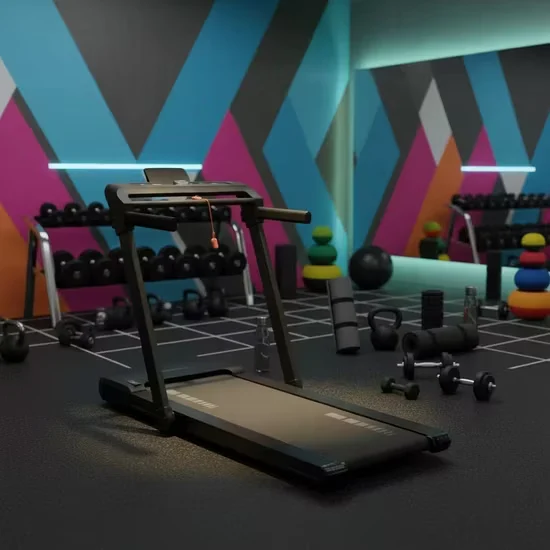
![Mt296 Electric Treadmill for Home Use with Strong Cushioning [WARN] draft identifier mismatch](https://bicksport.com/wp-content/uploads/2026/08/mt296-electric-treadmill-for-home-use-with-strong-cushioning-warn-draft-identifier-mismatch-ea47b9.webp)
Quiet Home Operation — DC motor paired with a cushioned running deck delivers a quieter, lower-impact running experience suitable for shared residential environments
Technical Specifications
| Parameter | Value |
|---|---|
| Designation | MT296 |
| Motor Type | DC |
| Motor Power | DC 2.0HP* |
| Speed Range | 1-20 km/h |
| Running Surface | 1200 x 520 mm |
| Deck Cushioning | Multi-layer shock absorption |
| Console Type | LCD (Speed / Distance / Time / Calories / Pulse) |
| Heart Rate | Handgrip Pulse Sensors |
| Programs | 16 Preset |
| Product Dimensions (Unfolded) | 1580 x 865 x 1300 mm |
| Product Dimensions (Folded) | 910 x 865 x 1345 mm |
| Net Weight | 64.0 kg |
| Foldable | Yes |
| Certification | CE, RoHS |
*Peak or continuous rating not specified in source documentation — verify with manufacturer for daily run-time expectations.
Application Suitability
| Deployment Scenario | Typical Use |
|---|---|
| High-end residential home gym | Daily walking and running in apartments where noise and space are primary constraints |
| Boutique serviced apartment fitness room | Individual guest use with foldable storage between sessions |
| Co-living shared wellness space | Moderate-frequency personal cardio with quiet operation requirements |
| Personal conditioning room | Structured training using 16 preset programs for muscle building and conditioning |
Why Home Treadmills Generate Noise Complaints and Joint Pain
A DC motor and cushioned deck address the two most common reasons home treadmills get returned or abandoned.
When a treadmill sits in an apartment or shared residential space, the motor noise transmits through floor joists into the room below. Rigid running decks compound the problem — every footstrike sends impact vibrations through the frame. Users report knee discomfort within weeks, and the machine becomes a clothes rack. The foldable home treadmill DC motor cushioned deck configuration in the MT296 addresses both transmission paths: the DC motor runs noticeably quieter than AC alternatives at typical home running speeds, and the multi-layer deck absorbs footstrike energy before it reaches the frame [NEED_CITE: noise transmission standards for residential fitness equipment].
Where the MT296 Fits in a Home Cardio Setup
This machine covers walking through moderate-intensity running at speeds up to 20 km/h across a 1200 x 520 mm surface. It pairs with a stationary bike or elliptical for users who alternate impact levels throughout the week. The foldable frame suits rooms that serve dual purposes — fold it upright after a session and reclaim the floor space. The LCD console and handgrip pulse sensors provide basic workout feedback for self-directed users who do not require chest-strap-level heart rate accuracy. The foldable home treadmill DC motor cushioned deck design fits users who need structured programs without complex connectivity setup.
Continuous Run-Time and Residential Deployment Requirements
The DC 2.0HP motor suits individual users running one to two hours daily rather than multiple household members sharing back-to-back sessions. In apartments above occupied rooms, place the treadmill on a vibration-damping mat to further reduce structure-borne noise transmission. Ensure the power outlet matches the target market voltage standard before deployment — confirm plug type with the manufacturer for your region. The unfolded footprint of 1580 x 865 mm requires clearance behind the deck for safe mounting and dismounting [NEED_CITE: residential floor load capacity for motorized fitness equipment]. Level the floor before assembly to prevent belt drift and uneven deck wear.
DC Motor and Cushioned Deck Engineering Explained
DC motors generate less electromagnetic noise than AC motors at the speed ranges typical for home running and walking. They also weigh less, reducing overall unit mass and making the foldable mechanism easier to operate. The trade-off is thermal capacity — DC motors dissipate heat less efficiently under sustained load, which limits continuous duty cycles. The cushioned running deck uses multiple elastomer layers between the belt and the frame to absorb footstrike energy. This noticeably reduces impact on knees and ankles compared to rigid single-board decks. The LCD console displays speed, distance, time, calories, and pulse — handgrip sensors provide adequate feedback for steady-state sessions, though users doing interval training benefit from chest-strap accuracy.
What Happens When Specifications Are Compromised
Treadmills with underspecified motors overheat and shut down during extended sessions, then fail permanently within months. Decks with minimal cushioning cause joint complaints that lead users to abandon the machine entirely. Lightweight frames without adequate bracing develop wobble at higher speeds, creating both safety concerns and noise. Voltage mismatches discovered after delivery require transformer adapters that introduce their own failure points [NEED_CITE: common failure modes in residential motorized treadmills]. The MT296 specification set avoids these pitfalls by matching motor type, deck construction, and frame weight to realistic home use patterns.
Why This Product Line Addresses Home Deployment Gaps
The manufacturer has equipped over 500 venues and exports to more than 40 markets, which means the cushioning specifications have been validated across different user weights and usage patterns. The OEM capability extends to console UI customization, so serviced apartment operators can brand the interface. For home deployments, the folded dimensions of 910 x 865 x 1345 mm allow storage in standard room corners. The 16 preset programs provide structured variety without requiring app connectivity. Technical support responds around the clock for commissioning questions during installation.
Documentation & Test Records
- CE declaration of conformity for MT296 electrical safety and emissions
- RoHS compliance certificate confirming restricted substance limits
- EN 957 test report covering structural and mechanical safety requirements
- Motor specification sheet detailing DC 2.0HP operating parameters
- Console technical documentation with LCD display and program descriptions
- Noise level test record for residential deployment verification
Installation, Commissioning & Maintenance
- Maintain minimum 600 mm clearance behind the MT296 for safe deck entry and exit
- Place vibration-damping mat beneath the 1580 x 865 mm footprint to reduce structure-borne noise
- Confirm voltage and plug type match local supply before connecting the DC motor
- Calibrate belt tension and alignment during first power-on to prevent drift
- Lubricate running belt per manufacturer schedule to maintain deck cushioning performance
- Wipe LCD console and handgrip sensors after each use to prevent sweat corrosion
Equipment Selection and Deployment Inquiry
Provide your room dimensions and intended daily usage duration to receive a layout recommendation matching the MT296 footprint and clearance requirements. Specify the deployment floor level and adjacent occupied spaces so noise transmission can be assessed against the DC motor operating profile. Confirm target market voltage and plug standard before proforma invoice generation to prevent shipment mismatches.
Frequently Asked Questions
Q: What is the difference between peak and continuous motor power, and why does it matter?
A: Peak horsepower describes the motor’s maximum output for brief bursts, while continuous rating indicates what it sustains during extended sessions. A treadmill used for daily 45-minute runs needs an adequate continuous rating to prevent overheating. The MT296 lists DC 2.0HP — confirm whether this is peak or continuous with the manufacturer before committing to heavy daily use.
Q: How does a cushioned deck reduce joint impact compared to a standard running board?
A: A standard rigid board transmits footstrike energy directly through the frame into the floor. A cushioned deck inserts elastomer layers that absorb a portion of that energy before it reaches your joints. Users notice reduced knee and ankle fatigue during longer sessions, which improves consistency over weeks and months of regular use.
Q: Is a DC motor suitable for long daily running sessions, or should I consider AC?
A: DC motors run quieter and weigh less, making them practical for home environments. However, they dissipate heat less efficiently than AC motors under sustained loads. For one user running up to two hours daily, a properly rated DC motor performs adequately. Multiple users sharing back-to-back sessions may require AC motor thermal capacity.
Q: What maintenance does a foldable treadmill require over its lifespan?
A: Regular maintenance includes belt lubrication at manufacturer-recommended intervals, tension checks to prevent drift, and hinge mechanism inspection on the foldable frame. Keep the LCD console and handgrip pulse sensors clean from sweat residue. Verify belt alignment quarterly and adjust if the running surface shows uneven wear patterns.
![Professional Grade Mt026m Electric Fold Fitness Home Use Treadmill for Training [WARN] draft identifier mismatch](https://bicksport.com/wp-content/uploads/2026/08/professional-grade-mt026m-electric-fold-fitness-home-use-treadmill-for-training-warn-draft-identifier-mismatch-63d9e4.webp)
![Mt026m Efficient Fold Motorized Treadmill for Fat Burning [WARN] draft identifier mismatch](https://bicksport.com/wp-content/uploads/2026/08/mt026m-efficient-fold-motorized-treadmill-for-fat-burning-warn-draft-identifier-mismatch-093aed.webp)
