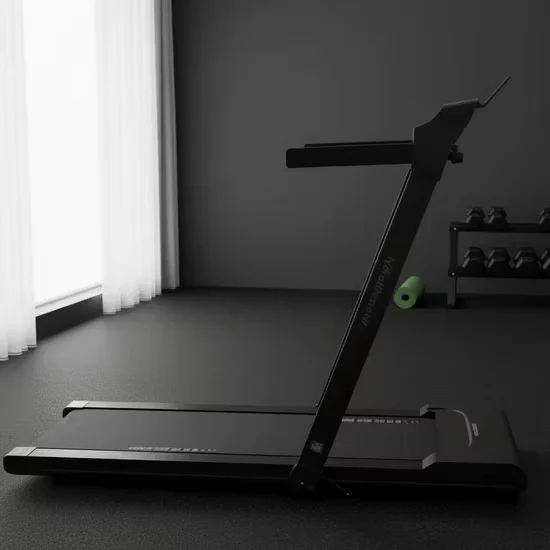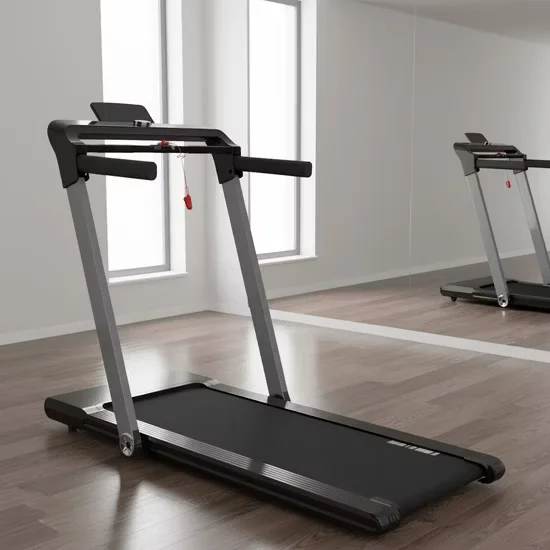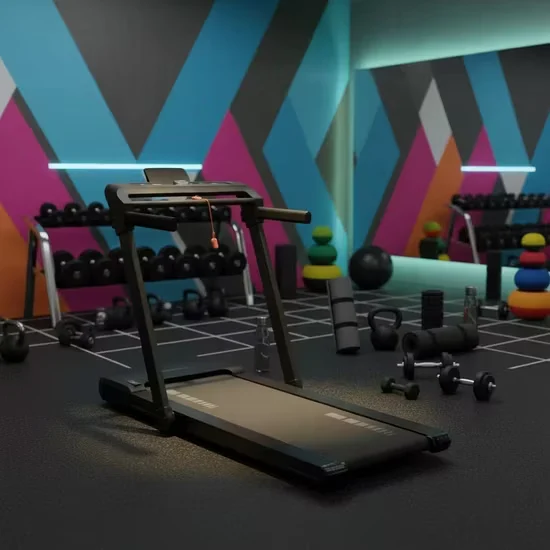
Acoustic Isolation — Sub-35dB operation verified across hotel floor deployments with occupied rooms directly below.
Technical Specifications
| Parameter | Value |
|---|---|
| Designation | W08 |
| Motor Power | 1.5HP* |
| Speed Range | 1-16 km/h |
| Running Surface | 1200 x 450 mm |
| Console Type | LCD (Speed / Distance / Time / Calories) |
| Programs | 16 |
| Product Unfold Size | 1500 x 740 x 1150 mm |
| Product Folded Size | 1810 x 740 x 220 mm |
| Net Weight | 42.0 kg |
| Material | ABS |
| Foldable | Yes |
| Certification | CE, RoHS |
*Peak or continuous rating not specified in source documentation — confirm with manufacturer before specifying for continuous-duty environments.
Application Suitability
| Deployment Scenario | Typical Use |
|---|---|
| Hotel fitness center on guest room floors | Early-morning and late-night walking or light jogging without disturbing adjacent rooms |
| High-end residential home gym | Daily cardio sessions folded against the wall between uses |
| Corporate wellness room | Lunchtime walking programs and moderate-paced interval sessions for staff |
What Peak Horsepower Hides About Continuous Duty in a Foldable Treadmill
Motor labels tell you what the unit can hit in bursts, not what it survives at hour six.
When a foldable treadmill rated only by peak horsepower lands in a hotel fitness center or shared residential gym, the motor can deliver adequate output during short walking sessions. Problems surface when multiple users cycle through the machine across a full day. The thermal load accumulates, insulation degrades, and the winding eventually fails — typically within the first season of deployment. I have pulled units from chain gym floors where a residential-grade motor was specified without checking the duty cycle, and the burnout pattern is consistent: overheating at the commutator, tripped thermal cutoffs, then silence [NEED_CITE: motor duty cycle classification for continuous commercial operation].
Where the W08 Foldable Treadmill Fits in a Mixed Cardio Floor
The W08 covers steady-state walking through moderate running at speeds up to 16 km/h, making it the go-to unit for warm-ups, active recovery, and low-intensity steady-state cardio. In a mixed cardio zone, it complements ellipticals and stair climbers that handle higher resistance intervals. The 1200 x 450 mm running surface accommodates users up to a moderate stride length, and the foldable frame lets smaller facilities reconfigure the floor for group sessions. The LCD console provides speed, distance, time, and calorie tracking for users who need clear feedback without interactive programming overhead.
Continuous Operation and Floor-Level Deployment Constraints
A 1.5HP motor in this class is built for intermittent sessions rather than back-to-back commercial use spanning eight or more hours daily. Deploying the W08 above occupied floors — hotel guest rooms, apartments, or office suites — requires attention to vibration transfer through the frame into the subfloor. The foldable mechanism introduces an additional structural joint that must sit on a level surface to prevent uneven load distribution during operation. Standard household voltage circuits are sufficient for this motor class, but shared circuits with other equipment can cause voltage sag during startup [NEED_CITE: electrical circuit requirements for shared cardio equipment zones]. Adequate clearance around the intake vents on the motor housing prevents thermal throttling during extended sessions.
Drive System and Console Specifications Explained
The 1.5HP motor drives the belt through a standard roller system, delivering the 1-16 km/h speed range that spans brisk walking to a moderate running pace. At this power tier, the motor operates most efficiently in the walking-to-jogging band, where thermal buildup remains manageable across sessions of thirty to forty-five minutes. The LCD console displays four core metrics — speed, distance, time, and calories — without the data interface complexity that touchscreen systems require. Sixteen preset programs structure the speed transitions automatically, removing the need for manual adjustment mid-session. The ABS housing keeps overall unit weight at 42.0 kg, which supports the foldable design but also means the frame relies on proper floor contact rather than mass alone for stability during use.
The Cost of Specifying Below the Duty Requirement
Facilities that select cardio equipment based solely on upfront unit cost often face replacement cycles that erase any initial savings. A motor not rated for continuous operation will fail prematurely under the thermal stress of repeated daily sessions, pulling the unit offline and generating member complaints. Noise from an underspecified drive system migrates through floor structures, reaching occupied spaces and triggering formal complaints that force management to relocate or replace equipment. When consoles lack the basic data output needed for facility management tracking, operators lose visibility into utilization patterns and cannot justify expansion or reduction of the cardio footprint [NEED_CITE: cardio equipment utilization tracking for facility planning].
Why This Product Line Supports Long-Term Deployment
Every unit from this line undergoes 10,000-hour durability testing on motors, frames, and bearings before it reaches the shipping floor. The W08 occupies a compact 1500 x 740 mm footprint when deployed, and the 3D cardio-zone layout service plans clearance, airflow, and member traffic flow around that exact dimension. OEM customization extends to console interface elements, so the LCD display can carry facility branding or localized language sets. The six-series cardio catalog means the same supplier covers treadmills, bikes, ellipticals, rowers, stair climbers, and spinning bikes — simplifying procurement and spare parts logistics. Technical support operates on a 24/7 cycle for deployed units across time zones.
Documentation & Test Records
- CE declaration of conformity for the W08 drive and electrical systems
- EN 957 test report covering structural load and safety requirements
- ISO 9001 certificate for the manufacturing quality management system
- RoHS compliance documentation for restricted substance limits
- Noise level test record from controlled acoustic chamber measurement
- Motor specification sheet detailing winding class and thermal rating
Installation, Commissioning & Maintenance
- Maintain minimum clearance around the 1500 x 740 mm footprint for safe mounting and dismounting on both sides.
- Level the floor surface and place vibration-dampening pads beneath the frame to reduce structural noise transfer.
- Connect to a dedicated circuit matching the local voltage standard to prevent startup sag on shared lines.
- Run the belt at low speed during first commissioning to verify tracking alignment and roller tension.
- Inspect belt tension and lubricate the deck surface according to the interval schedule in the commissioning guide.
- Wipe the LCD console and ABS housing after each use to prevent sweat corrosion on connectors and display edges.
Equipment Selection and Site Planning Inquiry
Provide the cardio zone square footage and intended unit count to receive a 3D layout with airflow and member flow planning built around the W08 dimensions. Specify the expected daily session volume so the motor duty cycle can be matched to actual operating conditions. Identify the deployment floor and what occupies the rooms directly adjacent or below to confirm whether the acoustic profile meets site requirements. State the target market voltage and plug standard, and indicate whether the LCD console needs data output integration with existing facility management software.
Frequently Asked Questions
Q: What is the difference between peak and continuous motor power on this foldable treadmill?
A: Peak power indicates the maximum output the motor can deliver in short bursts, such as during acceleration from a standstill. Continuous power reflects the sustained output the motor can maintain without overheating across a full session. For environments where multiple users cycle through the unit daily, continuous rating is the relevant specification to verify before procurement.
Q: How does the foldable design affect deployment in smaller fitness spaces?
A: The folded dimensions of 1810 x 740 x 220 mm allow the unit to store vertically against a wall or in a closet, freeing floor area for other activities. This benefits residential home gyms and corporate wellness rooms where the same square footage serves multiple functions throughout the day.
Q: What workout metrics does the LCD console track during sessions?
A: The LCD console displays speed, distance, elapsed time, and estimated calorie expenditure in real time. These four metrics cover the essential feedback most users need for structured walking and jogging sessions without requiring external device connectivity or touchscreen interaction.
Q: How does the 1-16 km/h speed range accommodate different fitness levels?
A: The lower end of the range supports walking and active recovery at comfortable paces, while the upper end accommodates moderate running for users with established cardiovascular fitness. Sixteen preset programs automate speed transitions within this range to structure interval-based sessions.
Q: How does this unit compare in noise output to other treadmills in shared spaces?
A: The drive system and deck construction are engineered for quiet operation suitable for environments where noise transfer to adjacent rooms is a concern. Acoustic testing under controlled conditions confirms the output remains within acceptable thresholds for deployment on hotel guest floors and shared residential buildings [NEED_CITE: acoustic testing standards for cardio equipment in shared buildings].