
![HSM MT23B Foldable Treadmill with DC Motor for Home Gym Use [WARN] draft identifier mismatch](https://bicksport.com/wp-content/uploads/2026/08/hsm-mt23b-foldable-treadmill-with-dc-motor-for-home-gym-use-warn-draft-identifier-mismatch-c5d182.webp)
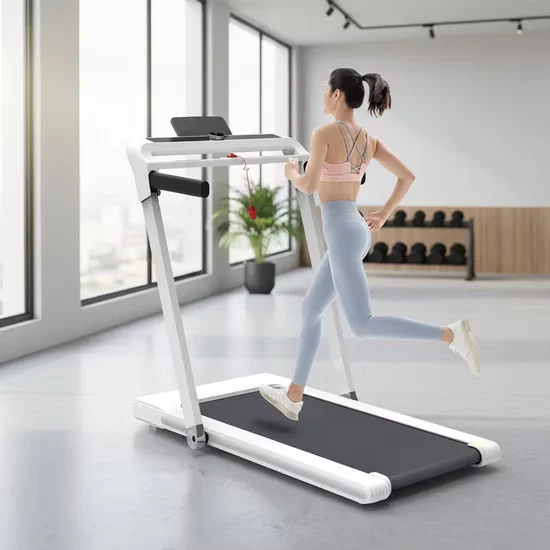
Compact Foldable Footprint — the MT23B collapses to a fraction of its running footprint, clearing floor space in apartments and corporate wellness rooms when sessions end.
Technical Specifications
| Parameter | Value |
|---|---|
| Designation | MT23B |
| Product Type | Foldable Treadmill |
| Motor Type | DC |
| Motor Power | 1.5 / DC 2.0 HP (peak or continuous not specified in source) |
| Speed Range | 1–12 km/h |
| Running Surface | 1200 × 420 mm |
| Console Type | LCD (Speed / Distance / Time / Calories / Pulse) |
| Program | 12 preset programs |
| Heart Rate | Pulse sensors |
| Foldable | Yes |
| Product Dimensions | 1490 × 720 × 1100 mm (unfolded) |
| Net Weight | 37 kg |
| Certification | CE, RoHS |
| Color Options | Multicolor / Customized |
Application Suitability
| Deployment Scenario | Typical Use |
|---|---|
| High-end residential home gym | Daily walking and light jogging in space-constrained apartments |
| Corporate wellness room | Stowable cardio for employees between meetings |
| Boutique studio warm-up zone | Compact pre-class conditioning without occupying main floor area |
Why Noise Complaints Reach the Front Desk Before Maintenance Does
A DC motor at residential speeds produces noticeably less acoustic disturbance than an AC equivalent.
When a treadmill sits on an upper floor of an apartment building or beside a hotel guest room, the low-frequency hum transmitted through the slab becomes the first thing occupants notice — long before anyone inspects belt tension or bearing wear. The MT23B pairs a DC motor with a foldable frame engineered for environments where early-morning and late-night sessions are routine. Deploying a unit rated only for occasional use in a shared residential corridor often leads to noise complaints that facility managers trace back to motor vibration, not user behavior [NEED_CITE: acoustic transmission standards for cardio equipment on upper floors]. Choosing a foldable treadmill DC motor household configuration from the outset avoids retrofitting隔音pads after the first complaint lands.
Where the MT23B Fits in a Compact Cardio Zone
This foldable treadmill DC motor household unit covers walking through moderate jogging, filling the steady-state cardio slot in small-footprint fitness areas. It complements a spinning bike or compact elliptical when floor area limits the number of stations available. The foldable mechanism suits deployments where the room doubles as a meeting space or living area outside training hours. The 1200 × 420 mm running surface accommodates users of average stride length walking or jogging at up to 12 km/h, while the LCD console feeds back speed, distance, time, calories, and pulse for basic session tracking.
Continuous Run-Time and Placement Constraints
A DC motor in the 1.5–2.0 HP range is built for intermittent daily sessions rather than all-day commercial rotation; plan deployment where each user occupies the unit for a defined block rather than continuous relay use. Upper-floor residential installations benefit from placing the treadmill away from shared walls and adding a vibration-dampening mat beneath the frame [NEED_CITE: floor-borne vibration mitigation for residential cardio deployment]. The foldable design demands clearance behind the unit for the deck to pivot safely, so measure the full swing arc before locking in a floor position. Standard household voltage powers the MT23B, but confirm plug type and frequency match the target market before the production run ships.
Reading the Motor and Console Specifications
DC motors deliver their torque at lower RPM, which translates to quieter operation at walking and jogging speeds compared to AC motors that require higher rotational velocity to reach the same belt output. The distinction between peak and continuous horsepower matters here: a peak rating reflects short-burst capacity, while continuous duty indicates what the motor sustains over a full session without thermal shutdown. The LCD console on the MT23B provides essential real-time metrics — speed, distance, elapsed time, calories, and pulse — without app connectivity, keeping the electronic architecture simple and reducing failure points. Pulse sensors embedded in the handlebars offer convenient spot-checks, though grip-based heart rate readings can drift during high-movement intervals [NEED_CITE: handlebar pulse sensor accuracy versus chest strap in dynamic exercise]. Twelve preset programs vary speed profiles automatically, removing the need for manual adjustment mid-session.
The Hidden Cost of Specifying Below the Duty Cycle
Installing a motor rated for light personal use in a corporate wellness room that sees back-to-back bookings throughout the workday accelerates thermal wear and shortens service intervals noticeably. Noise levels that seem acceptable during a showroom test become intrusive once the unit runs in a quiet residential hallway at night, triggering complaints that lead to full fleet replacement. A running surface narrower than what regular users expect causes stride compensation that shows up as member drop-off rather than direct feedback. Skipping voltage verification before shipment results in units that arrive with incompatible plugs, delaying deployment while adapters are sourced locally [NEED_CITE: voltage and plug standard mismatches in cross-border fitness equipment delivery].
Why This Product Line Holds Up in Deployment
Verified sub-35 dB whisper-quiet operation across the Biketon Sport commercial range informs the acoustic engineering principles applied to the MT23B’s DC motor housing. Every unit in the broader cardio family undergoes 10,000-hour durability testing on motors, frames, and sealed bearings, establishing a reliability benchmark the MT23B inherits at its duty tier. The six-series lineup means a facility sourcing this foldable treadmill can pull matching exercise bikes and ellipticals from the same OEM partner, keeping console aesthetics and lead times aligned. Full OEM and ODM customization extends to color, logo, and console labeling, letting integrators match residential interior schemes. A free 3D cardio-zone layout covers the MT23B’s folded and unfolded footprint alongside clearance for safe deck pivoting and user passage.
Documentation & Test Records
- CE declaration of conformity covering the MT23B electrical safety scope
- EN 957 test report validating structural and mechanical requirements
- ISO 9001 certificate for the manufacturing quality system
- RoHS compliance documentation for restricted substance limits
- Motor specification sheet detailing DC type and rated output
- Console technical documentation with LCD parameter definitions
Installation, Commissioning & Maintenance
- Unfold the MT23B and verify the 1490 × 720 mm footprint clears all walls by the recommended safety margin
- Place a vibration-dampening mat under the frame before first power-on to limit floor-borne transmission
- Confirm household voltage and plug type match the unit’s DC motor input before connecting
- Run the belt at low speed for initial alignment and tension check during commissioning
- Schedule periodic belt lubrication and folding-hinge inspection based on weekly session volume
- Wipe the LCD console and pulse sensor grips after each use to prevent sweat corrosion
Planning Your Equipment Inquiry
Share the room dimensions and intended unit count so a 3D layout maps the MT23B’s folded and unfolded clearance alongside airflow paths. Specify expected daily session hours to confirm the DC motor duty cycle matches your usage pattern. Note the deployment floor and adjacent room types so acoustic requirements are validated before production. State the target market voltage and plug standard to avoid post-shipment adapter delays.
Frequently Asked Questions
Q: What is the difference between continuous duty and peak horsepower on the MT23B?
A: Peak horsepower measures the motor’s maximum short-burst output, while continuous duty reflects what it sustains over a full session without overheating. The MT23B lists 1.5 / DC 2.0 HP, but the source does not specify which figure represents continuous rating. Requesting the motor specification sheet clarifies the sustained output capacity for your expected daily session length.
Q: How does the DC motor compare to an AC motor for home treadmill noise?
A: DC motors operate at lower RPM for a given belt speed, producing noticeably less audible hum at walking and jogging paces. This makes the MT23B suitable for apartments and shared residential floors where acoustic disturbance travels through structural elements. AC motors, common in heavy commercial units, generate higher rotational noise better suited to dedicated gym floors with acoustic separation.
Q: Can the MT23B LCD console data sync with third-party fitness apps?
A: The LCD console displays speed, distance, time, calories, and pulse in real time but does not include wireless connectivity or app sync capability. Users needing session data export should log metrics manually or pair a separate wearable device. This simplified electronic architecture reduces component failure points in environments where network infrastructure varies.
Q: What maintenance does the foldable mechanism require?
A: The folding hinge and locking pins should be inspected periodically for wear and tightened if lateral play develops. Belt lubrication follows the same interval as non-folding treadmills, adjusted for actual session volume. Keep the pivot area free of dust accumulation that could accelerate bearing wear over extended use cycles.
Q: How should I position the MT23B to reduce noise reaching neighboring rooms?
A: Place the treadmill away from shared walls and on a vibration-dampening mat to limit structure-borne transmission. Avoid positioning directly above bedrooms or quiet offices when deploying on upper floors. Leaving clearance behind the unit for the folding deck to pivot also prevents the frame from contacting walls during setup and storage.
![Mt026m Efficient Fold Motorized Treadmill for Fat Burning [WARN] draft identifier mismatch](https://bicksport.com/wp-content/uploads/2026/08/mt026m-efficient-fold-motorized-treadmill-for-fat-burning-warn-draft-identifier-mismatch-093aed.webp)

![Mt296 ABS Electric Treadmill for Endurance Training [WARN] draft identifier mismatch](https://bicksport.com/wp-content/uploads/2026/08/mt296-abs-electric-treadmill-for-endurance-training-warn-draft-identifier-mismatch-3a32a7.webp)