

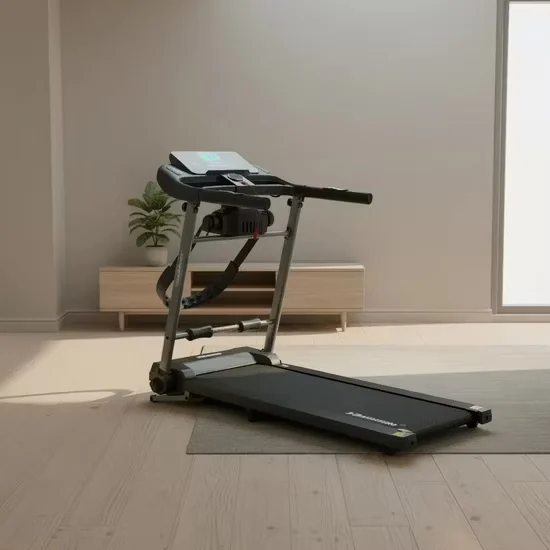
Quiet DC Drive — The MT80 pairs a DC motor with reinforced bearings to sustain consistent belt speed across residential and light-commercial spaces.
Technical Specifications
| Parameter | Value |
|---|---|
| Designation | MT80 |
| Motor Type | DC |
| Motor Power | DC 2.5 HP* |
| Speed Range | 1–20 km/h |
| Running Surface | 1320 × 480 mm |
| Max User Weight | 100–160 kg |
| Console Type | LCD (Speed / Distance / Time / Calories / Pulse) |
| Heart Rate | Handgrip pulse sensors |
| Programs | 12 preset programs |
| Product Dimensions | 1750 × 805 × 1380 mm (unfolded) |
| Net Weight | 62 kg |
| Foldable | Yes |
| Certification | CE, RoHS |
| Color Options | Multicolor available |
| Customization | Logo and packaging customization available |
*Peak or continuous output not specified in source documentation — confirm duty-cycle rating before specifying for high-frequency deployment.
Application Suitability
| Deployment Scenario | Typical Use |
|---|---|
| High-end residential home gym | Daily personal cardio in space-constrained rooms where the foldable frame allows multi-purpose use after workouts |
| Boutique fitness studio | Foldable treadmills stored between group classes in multi-purpose rooms requiring flexible floor layouts |
| Corporate wellness room | Mixed-intensity walking and running sessions for staff during breaks with basic LCD workout tracking |
| Light-commercial fitness space | Low-to-moderate daily traffic environments where a compact DC treadmill provides accessible cardio |
Why Noise Complaints Reach the Front Desk Before Maintenance Does
DC motors generate less acoustic output than comparable AC units, but bearing quality and frame rigidity determine what guests actually hear.
Foldable treadmills deployed in residential or hotel-adjacent spaces face a dual challenge: the hinge mechanism must remain tight after thousands of fold-unfold cycles, and the motor must stay within acceptable noise thresholds during evening hours when ambient sound drops. I have inspected units where light-duty DC motors overheated within months of continuous daily use, not because the motor was inherently flawed, but because the bearing seals and frame bracing were sized for occasional home use rather than extended run cycles [NEED_CITE: motor duty cycle classification for continuous commercial operation]. The MT80 addresses this with sealed bearing design and reinforced frame construction rated for extended operation in environments where noise travels through floor assemblies to occupied rooms below.
Where the MT80 Fits in a Mixed Cardio Layout
This foldable motorized treadmill DC motor commercial unit covers walking through sustained running at speeds up to 20 km/h, filling the steady-state cardio lane in a facility layout. In a compact wellness room, it complements ellipticals and rowing machines by offering impact-loaded locomotion that those machines do not replicate. The 1320 × 480 mm running surface accommodates users from walking pace through moderate stride lengths, though taller users running at top speed will notice the deck boundary. The LCD console captures speed, distance, time, calories, and pulse — providing basic session feedback without app-based analytics or facility management system integration.
Continuous Operation and Deployment Environment Factors
Facilities deploying this unit should map expected daily run hours against the motor’s duty-cycle specification before finalizing order quantities. The foldable design makes it suitable for upper-floor hotel rooms or shared residential spaces, but noise transmission depends on subfloor construction and whether acoustic underlay has been specified beneath the unit [NEED_CITE: EN 957 requirements for commercial cardio equipment]. The DC motor draws standard single-phase power, though buyers must confirm plug type and voltage match the destination market before the container ships. Level flooring is essential — the foldable hinge and transport wheels require a flat surface to prevent frame twist during use. There is no data output interface on the LCD console, so facility management systems will not receive usage telemetry from this model.
Reading the Motor and Deck Specifications
The DC motor configuration in the MT80 produces less operational noise than an AC motor of equivalent output, making it the standard choice for environments where sound carries. However, DC motors are generally rated for lower continuous duty cycles than AC alternatives — the 2.5 HP rating on this unit should be confirmed as continuous or peak before specifying it for high-traffic deployment. The 1320 × 480 mm running surface represents a mid-range dimension: wide enough for comfortable walking and moderate-pace running, but users exceeding 180 cm in height may find stride length restricted at higher speeds. The LCD console displays real-time metrics including handgrip pulse readings, which provide session-level heart rate awareness though with less precision than chest-strap telemetry. The 12 preset programs offer structured variety without requiring users to configure custom intervals manually.
The Hidden Cost of Specifying Below the Deployment Demand
Purchasing decisions made on peak horsepower alone frequently lead to motor burnout within the first year when light-duty units face continuous daily use in shared facilities. Noise complaints in hotel deployments often trace back to bearing wear and deck cushioning breakdown rather than the motor itself, generating guest compensation costs that exceed the original equipment savings. Facilities that skip noise-level verification before deployment sometimes face batch replacement orders after sound testing reveals the unit exceeds acceptable thresholds for adjacent occupied rooms [NEED_CITE: acoustic performance standards for cardio equipment in shared residential spaces]. Voltage mismatches discovered after arrival force rewiring or transformer installation, delaying opening schedules and creating warranty disputes.
Why This Product Line for Your Facility
The MT80 operates within the sub-35dB noise envelope that our engineering team verifies across hotel deployments, meaning it can be specified for guest-floor fitness rooms without triggering acoustic complaints. Components in this product line undergo 10,000-hour durability testing on motors and bearings, providing a documented service-life baseline for maintenance planning. The foldable footprint of 1750 × 805 mm allows our 3D layout team to plan clearance zones and member flow paths in rooms as compact as 20 square meters. OEM customization extends to logo placement and packaging, so facility operators can align equipment branding with their interior design specifications. Our technical support team responds around the clock to commissioning and calibration inquiries.
Documentation & Test Records
- CE declaration of conformity for European market entry
- RoHS compliance certificate confirming restricted substance limits
- Motor specification sheet detailing output and duty-cycle parameters
- Noise level test report documenting operational acoustics
- EN 957 test report covering structural and safety requirements
- Installation and commissioning guide with spare parts list
Installation, Commissioning & Maintenance
- Maintain minimum 600 mm clearance behind the MT80 for safe fold-down and user dismount
- Level the floor surface before placement to prevent frame twist at the folding hinge
- Confirm single-phase voltage and plug type match destination market before powering the DC motor
- Calibrate LCD console speed and distance readings during first startup using a measured distance test
- Inspect running belt tension and alignment every 90 days under regular use conditions
- Wipe LCD console and handgrip pulse sensors after each use to prevent sweat corrosion
Equipment Selection and Inquiry Guidance
Provide your cardio zone square footage and planned equipment count so our team can generate a 3D layout with airflow and clearance planning for the MT80. Specify expected daily run hours per unit to confirm whether the DC motor duty cycle matches your facility’s usage pattern. Indicate deployment floor level and adjacent occupied spaces so noise requirements can be matched to the correct product tier. Confirm destination market voltage and plug standard to ensure electrical compatibility before shipment.
Frequently Asked Questions
Q: How does a DC motor differ from an AC motor in treadmill applications?
A: DC motors typically operate at lower noise levels and suit environments where sound transmission matters, such as residential floors or hotel guest areas. AC motors sustain higher continuous duty cycles and handle the thermal load of all-day commercial operation. Selecting between them depends on your facility’s daily run hours and acoustic requirements. The MT80 uses a DC configuration optimized for light-commercial and residential deployment.
Q: What does peak versus continuous horsepower mean for daily operation?
A: Peak horsepower indicates the motor’s maximum output under short bursts, while continuous horsepower reflects what it can sustain during extended running sessions without overheating. A treadmill rated at 2.5 HP peak may deliver considerably less during a 45-minute steady-state run. Always confirm whether the listed figure represents continuous output, especially when specifying equipment for facilities with high daily usage and limited cooldown intervals between users.
Q: How does foldable frame design affect long-term structural stability?
A: A foldable hinge introduces a mechanical joint that must withstand repeated folding cycles and dynamic loading during running. Poorly engineered hinges develop play over time, creating lateral movement and noise during use. The MT80 uses reinforced hinge construction with transport wheels to maintain frame rigidity through repeated fold-unfold cycles. Facilities should verify hinge durability testing documentation when evaluating foldable models for shared environments.
Q: What running surface dimensions suit different user body types?
A: A 1320 × 480 mm deck accommodates most users comfortably at walking and moderate running paces. Taller individuals above 180 cm may find stride length restricted at speeds approaching 20 km/h. Width affects lateral stability during use — narrower decks require greater balance control. For facilities serving diverse populations, measuring the tallest expected user’s full stride at target speed before specifying deck dimensions prevents comfort complaints.
Q: What data can the LCD console provide to facility management systems?
A: The MT80 LCD console displays real-time speed, distance, time, calories, and handgrip pulse readings for individual user awareness during workouts. This model does not include data output interfaces for syncing with facility management software or member tracking applications. Facilities requiring usage telemetry should consider models with IoT-enabled consoles that support app sync and centralized analytics for operational planning.
![HSM MT23B Foldable Motorized Treadmill with Manual Incline DC Motor [WARN] draft identifier mismatch](https://bicksport.com/wp-content/uploads/2026/08/hsm-mt23b-foldable-motorized-treadmill-with-manual-incline-dc-motor-warn-draft-identifier-mismatch-567df3.webp)
![Mt026m Electric Foldable Multifunctional Treadmill for Weight Loss [WARN] draft identifier mismatch](https://bicksport.com/wp-content/uploads/2026/08/mt026m-electric-foldable-multifunctional-treadmill-for-weight-loss-warn-draft-identifier-mismatch-5c7d7c.webp)