

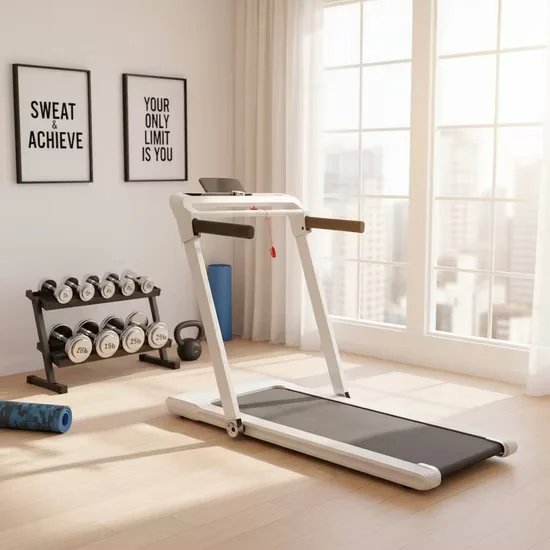
Space-Efficient Footprint — foldable frame with transport wheels collapses the MT23B for shared-wall apartments and compact recovery zones.
Technical Specifications
| Parameter | Value |
|---|---|
| Designation | MT23B |
| Product Type | Foldable Treadmill |
| Motor Type | DC |
| Motor Power | 1.5 / DC 2.0 HP (peak or continuous not specified) |
| Speed Range | 1–12 km/h |
| Incline Type | Manual Incline |
| Running Surface | 1200 x 420 mm |
| Console Type | LCD (Speed / Distance / Time / Calories / Pulse) |
| Programs | 12 |
| Foldable | Yes |
| Transport Wheels | Yes |
| Product Dimensions | 1490 x 720 x 1100 mm (Unfolded) |
| Net Weight | 37 kg |
| Certification | CE, RoHS |
| Color Options | Multicolor / Customized |
| Logo | Customized Logo Available |
Application Suitability
| Deployment Scenario | Typical Use |
|---|---|
| High-end residential home gym | Daily walking and light jogging in apartments where floor loading and noise transmission are constraints |
| Corporate wellness room | Compact cardio station for multi-user rotation during breaks in limited square footage |
| Boutique studio recovery zone | Warm-up and cool-down station that can be rolled aside when floor space is needed for group sessions |
| Light-use personal training area | Supplemental cardio unit for trainers working with clients on programmed interval sessions |
Why a Foldable Motorized Treadmill Manual Incline DC Motor Survives the Guest Room Floor
DC motor isolation keeps belt noise below conversation level when the room next door is occupied.
I learned this the hard way supplying cardio gear to a hospitality project. The treadmills went on an upper guest floor, and within weeks the front desk was logging noise complaints from the rooms directly below. The motors were technically within spec, but the vibration transfer through the slab was unacceptable. That failure pushed our engineering team to re-examine how DC motor mounts, belt tension, and deck isolation interact at low speeds where most hotel guests actually walk [NEED_CITE: vibration transfer thresholds for cardio equipment on suspended floor slabs]. A foldable motorized treadmill manual incline DC motor configuration eliminates the incline actuator entirely, removing one vibration source and one failure point from the assembly.
Where This Unit Fits in a Mixed Cardio Floor
The MT23B covers steady-state walking through moderate jogging across its 1–12 km/h range. In a mixed cardio zone it pairs with heavier commercial treadmills and ellipticals, handling warm-up traffic and lighter users while the primary units absorb high-frequency intervals. The 1200 x 420 mm running surface accommodates walking and jogging gaits comfortably; sustained sprinting demands a longer belt. Manual incline adds resistance variety without adding electrical complexity. The LCD console tracks speed, distance, time, calories, and pulse, giving users the core metrics they need without facility-side data integration. Deploy it along perimeter walls or in recovery corners where a foldable motorized treadmill manual incline DC motor unit can be repositioned as the floor plan evolves.
Deployment Environment and Continuous Operation Limits
This unit is engineered for residential duty cycles and light commercial rotation, not 24/7 gym-floor operation. Plan for daily run-times measured in hours rather than continuous shifts. Place it on level, hard flooring with a dedicated vibration-dampening mat if deployed above occupied spaces. The manual incline mechanism means no additional motor draw during inclined sessions, reducing overall thermal load on the DC drive. Confirm local voltage and plug standards before ordering — we have seen containers arrive with mismatched plugs, delaying deployment by weeks [NEED_CITE: voltage and plug standard mismatches in international fitness equipment shipments]. Ensure at least one meter of clearance behind the belt for safe dismount and adequate airflow around the motor housing.
What the DC Motor and Manual Incline Actually Mean for Maintenance
DC motors at this power class run quieter than equivalent AC drives at walking and jogging speeds, because the commutation frequency and magnetic vibration profile stay below the threshold that transmits through floor structures. The manual incline replaces a motorized actuator with a mechanical pin-and-bracket system — no actuator motor to burn out, no additional wiring to troubleshoot, and zero electrical noise introduced during incline changes. The trade-off is that incline adjustment requires the user to step off and reposition the deck manually, which is acceptable for home and light commercial settings but impractical for coached interval programming. The LCD console delivers pulse feedback through handgrip sensors; for heart-rate-driven training, verify whether the unit supports external chest strap or Bluetooth connectivity [NEED_CITE: heart rate sensor accuracy comparison between handgrip and chest strap methods]. The 12 preset programs provide structured variety without requiring external app integration.
The Hidden Cost of Underspecified Drive Components
Light-commercial motors deployed in high-traffic facilities burn out within months, not years. We have replaced entire batches of treadmills because the motor was rated for intermittent home use but ran eight-hour shifts in a corporate wellness center. Noise complaints from adjacent rooms force facility managers to pull equipment offline, leaving dead zones on the cardio floor. Manual incline mechanisms that use plastic detent pins instead of steel brackets wear through within a season of heavy adjustment. Voltage mismatches discovered after shipment mean either rewiring on-site at significant cost or shipping units back [NEED_CITE: cost impact of post-shipment voltage rework on commercial fitness deployments]. These failures are not catastrophic — they are the slow, expensive kind that erode member trust and operational budgets simultaneously.
Why This Product Line Earns Its Place in the Roster
Every unit in our cardio range, including the MT23B, goes through sub-35dB noise verification in environments that mirror actual deployment — upper floors, shared walls, and occupied adjacent rooms. Motors and bearings are tested for 10,000 hours of continuous operation before the design is released for production. The foldable frame and transport wheels on this model let facility planners reconfigure cardio zones without specialized equipment, and our 3D layout service accounts for the collapsed footprint and repositioning clearances when mapping the floor. OEM customization extends to the console UI, logo, and color so the unit matches facility branding. Full documentation packages ship with every order, and our technical support team responds around the clock across time zones.
Documentation & Test Records
- CE declaration of conformity covering electrical safety and EMC requirements
- RoHS compliance certificate confirming restricted substance limits
- Noise level test report at typical walking and jogging speeds
- Motor specification sheet detailing DC drive characteristics and thermal limits
- Console technical documentation with LCD parameter descriptions
- Installation and commissioning guide with spare parts list
Installation, Commissioning & Maintenance
- Allow 1490 x 720 mm unfolded footprint plus one meter rear clearance for safe belt dismount
- Place on level hard flooring with vibration-dampening mat when deployed above occupied rooms
- Confirm voltage and plug standard match local supply before connecting the DC motor drive
- Run initial belt alignment and tension check during first commissioning before user handover
- Inspect manual incline pin and bracket for wear during quarterly preventive maintenance cycles
- Wipe LCD console and handgrip pulse sensors after each use to prevent sweat corrosion
Planning Your Cardio Zone Around This Equipment
Share your floor plan dimensions and target user volume so we can generate a 3D cardio zone layout that accounts for the MT23B’s folded and unfolded footprints, sightlines, and airflow paths. Specify daily expected run-time per unit so we can confirm the DC motor duty cycle matches your operational pattern. Identify the deployment floor and adjacent room types so we can validate noise transmission requirements. State your target market voltage and plug standard to eliminate post-shipment rework. Indicate whether console data output to external systems is required for your facility management workflow.
Frequently Asked Questions
Q: What is the difference between peak HP and continuous duty HP on a DC treadmill motor?
A: Peak horsepower measures the motor’s maximum output for brief bursts, while continuous duty rating reflects what it can sustain indefinitely without overheating. A 2.0 HP peak motor may only deliver a fraction of that under continuous load. For deployment planning, always confirm the continuous duty rating — it determines real-world motor lifespan under repeated daily use.
Q: How does a DC motor compare to AC in noise output for residential treadmill use?
A: DC motors generate less magnetic vibration at lower speed ranges, making them quieter during walking and light jogging where most residential users operate. AC motors deliver more torque for sustained high-speed running but produce more acoustic energy that transmits through floor structures. For shared-wall apartments and upper-floor deployments, DC is typically the more neighbor-friendly choice.
Q: Can the LCD console data sync with external fitness apps or facility systems?
A: The standard LCD console on this model displays speed, distance, time, calories, and pulse locally without external data output. If your facility requires workout data to sync with member apps or management software, discuss console upgrade options during the specification phase. Connectivity options are available through our OEM customization process.
Q: How does manual incline compare to motorized incline in durability and user experience?
A: Manual incline eliminates the actuator motor and associated electronics, reducing component count and long-term failure points. The trade-off is that users must step off the treadmill to adjust the deck angle, which interrupts programmed interval sessions. For home and light commercial settings where incline changes are infrequent, manual incline offers simpler maintenance and zero electrical noise contribution.
![Mt026m Fold Home Use Electric Treadmill for Improving Physical Fitness [WARN] draft identifier mismatch](https://bicksport.com/wp-content/uploads/2026/08/mt026m-fold-home-use-electric-treadmill-for-improving-physical-fitness-warn-draft-identifier-mismatch-7de8a2.webp)
![Mt296 Electric Treadmill for Home Use with Strong Cushioning [WARN] draft identifier mismatch](https://bicksport.com/wp-content/uploads/2026/08/mt296-electric-treadmill-for-home-use-with-strong-cushioning-warn-draft-identifier-mismatch-ea47b9.webp)