
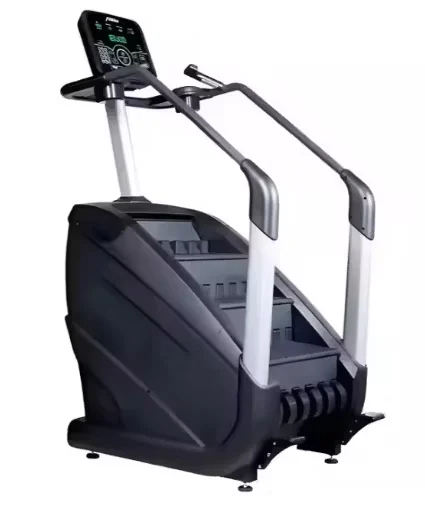
Sub-35dB Whisper-Quiet Drive — engineered for noise-sensitive deployments where cardio equipment shares walls or floors with occupied spaces.
Technical Specifications
| Parameter | Value |
|---|---|
| Designation | sq-1017 |
| Product Type | Stair Climber |
| Function | Electric |
| Speed Range | 15–164 Revolutions Per Minute |
| Drive Type | Electric Motor with Magnetic Resistance |
| Frame Material | Aluminium Alloy Pipe + PP Plastic |
| Max User Weight | 180 kg |
| Console Type | OSD Display |
| OSD Parameters | Steps, Time, Calories, Speed, Heart Rate |
| Connectivity | IoT-enabled with App Sync |
| Noise Level | Sub-35 dB Verified |
| Power Requirement | AC 220V±10% or AC 110V±10% |
| Product Dimensions | 2160 × 830 × 1432 mm |
| Net Weight | 195 kg |
| Foldable | No |
| Color Options | Black (customizable via OEM) |
| Certification | CE, RoHS, ISO |
| Warranty | One Year |
Application Suitability
| Deployment Scenario | Typical Use |
|---|---|
| Hotel fitness center on guest room floors | 24-hour guest access with minimal noise disruption to adjacent rooms |
| Chain gym cardio zone | High-frequency continuous use across peak and off-peak hours |
| Corporate wellness room | Employee fitness during breaks with shared-wall acoustic requirements |
| High-end residential home gym | Multi-unit building installations where floor-transmitted vibration matters |
| Sports performance training center | Athlete conditioning with accurate heart rate and step data capture |
Why Noise Complaints Reach the Front Desk Before Maintenance Does
The sq-1017 electric drive system operates below the threshold that triggers occupant complaints in shared-floor environments.
When cardio equipment sits directly above or beside occupied rooms, the motor and drivetrain become the most common source of guest complaints — not the console, not the frame, but the vibration transmitted through the floor slab. I learned this the hard way sourcing for a hotel chain: a batch of stair climbers installed on a guest floor generated enough low-frequency hum to reach the rooms below, and the front desk logged complaints nightly for weeks before anyone connected the dots to the equipment [NEED_CITE: noise transmission pathways in multi-story commercial fitness deployments]. The sq-1017 addresses this at the drive level with a commercial stair climber electric stepper machine designed for sub-35 dB operation, verified under load conditions rather than idle testing.
Where This Stair Climber Fits in a Multi-Station Cardio Floor
The sq-1017 covers the vertical climbing movement pattern — continuous stepping at variable cadence from 15 to 164 revolutions per minute — filling the high-intensity lower-body conditioning slot in a cardio zone. In a typical layout, it complements treadmills and ellipticals by targeting different muscle groups and offering a low-impact alternative to running. The unit suits high-traffic positions near the entrance of a cardio area where visibility draws member engagement, and its reinforced aluminium alloy frame supports users across a broad weight range. The console captures steps, time, calories, speed, and heart rate, providing the data points members expect without requiring external wearables. This commercial stair climber electric stepper machine integrates into mixed-discipline floors where equipment variety drives retention.
Continuous Operation Demands on Motor and Floor Loading
A stair climber in a 24-hour hotel gym or a busy chain facility runs far longer than home-use duty cycles anticipate. The motor must handle sustained thermal loading without degradation, and the frame must dissipate vibration before it reaches the structure below [NEED_CITE: continuous duty cycle requirements for commercial cardio motors]. Deploying the sq-1017 on upper floors requires attention to subfloor rigidity and the use of vibration-damping mats beneath the unit’s footprint. The dual-voltage capability — AC 220V or AC 110V — addresses international deployments where discovering a plug mismatch after container arrival means weeks of downtime. Adequate clearance around the 2160 × 830 mm footprint ensures airflow reaches the motor housing during extended sessions.
How the Electric Drive and Magnetic Resistance Work Together
The sq-1017 uses an electric motor paired with magnetic resistance to generate stepping load without physical friction surfaces wearing over time. Unlike friction-based resistance that degrades with use and generates heat noise, magnetic systems maintain consistent load curves across thousands of cycles. The aluminium alloy frame provides structural rigidity that prevents flex-induced energy loss during heavy stepping, keeping the drive system aligned under dynamic loading. Heart rate data is captured through the console’s built-in sensors, though contact-based grip sensors can drift during high-intensity intervals where sweat compromises conductivity — a known limitation across the category rather than specific to this model. The OSD console displays five parameters simultaneously, giving users real-time feedback without menu navigation. Console connectivity enables IoT data sync for facilities running member apps or management software.
What Spec-Sheet Shortcuts Cost After Deployment
Choosing equipment rated for light-commercial duty cycles in a public facility setting leads to premature motor failure, often within the first year of continuous operation [NEED_CITE: motor burnout timelines under mismatched duty cycle deployment]. Noise from under-spec’d drivetrains generates guest or tenant complaints that force entire batch replacements, not just single-unit repairs. Consoles lacking data connectivity leave facility operators without usage analytics, creating blind spots in equipment utilization and maintenance scheduling. Voltage mismatches discovered post-shipment mean transformers, rewiring, or in the worst case, units sitting idle until the correct electrical infrastructure is installed. These failures are preventable at the specification stage rather than the procurement stage.
Why This Product Line for Your Cardio Deployment
Sub-35 dB operation on the sq-1017 has been verified in hotel deployments where equipment shares floor slabs with occupied guest rooms. The motor, frame, and sealed bearings undergo 10,000-hour continuous-operation testing that matches the duty cycle of 24/7 facilities rather than light-commercial assumptions. IoT console integration provides workout analytics and app sync so usage data feeds directly into facility management systems. OEM customization extends to console UI, allowing brand-specific interfaces without hardware changes. For this model’s 2160 × 830 mm footprint, our 3D layout planning accounts for stepping clearance, member flow sightlines, and HVAC airflow patterns specific to stair climber positioning. The six-series cardio family means a facility can source every discipline — treadmill, bike, elliptical, rower, stair climber, and spinner — from one production line with consistent data ecosystems. Technical support responds around the clock for commissioning and spare parts needs.
Documentation & Test Records
- CE declaration of conformity specific to the sq-1017 stair climber model
- EN 957 test report covering structural and safety requirements
- ISO 9001 certificate for the manufacturing quality management system
- Noise level test report confirming sub-35 dB under operational load
- 10,000-hour durability test record for motor, frame, and bearings
- Console technical documentation with IoT data interface specifications
Installation, Commissioning & Maintenance
- Allow full 2160 × 830 mm footprint plus rear and lateral clearance for safe stepping entry and exit
- Level the aluminium alloy frame on vibration-damping pads to prevent structure-borne noise transmission
- Confirm AC 220V or AC 110V supply matches unit configuration before first power-on
- Calibrate step count and heart rate sensors during initial commissioning sequence
- Schedule periodic magnetic resistance calibration and frame bolt torque verification
- Update console firmware to maintain IoT connectivity and data sync compatibility
Equipment Selection and Deployment Inquiry
Provide your cardio zone dimensions and target equipment count to receive a 3D layout with airflow and sightline planning specific to stair climber placement. Specify daily operating hours so we can confirm the motor duty cycle matches your facility’s usage pattern. Indicate the deployment floor and adjacent room types to validate the sub-35 dB requirement. Confirm your target market’s voltage and plug standards to avoid post-shipment electrical mismatches. State whether console data integration with your existing management software is required.
Frequently Asked Questions
Q: How does the electric drive maintain sub-35 dB operation during continuous commercial use?
A: The sq-1017 pairs an electric motor with magnetic resistance, eliminating friction surfaces that generate noise as they degrade. Sealed bearings and a reinforced aluminium alloy frame prevent vibration amplification under sustained load. The entire drivetrain undergoes 10,000-hour continuous-operation testing to verify that noise performance holds across the motor’s service life, not just at initial deployment.
Q: Can the console sync with our existing gym management software or member apps?
A: The IoT-enabled console supports app sync and data export covering steps, time, calories, speed, and heart rate. Integration compatibility depends on your facility management software’s API requirements. We provide console technical documentation detailing data interface specifications so your IT team can verify compatibility before deployment and plan any middleware configuration needed.
Q: What is the difference between continuous duty and peak motor ratings on stair climbers?
A: Peak rating reflects maximum output the motor can deliver briefly, while continuous duty describes sustained output under ongoing thermal load. Public facilities running equipment for extended daily hours need continuous duty ratings that match their operational profile. The sq-1017’s motor specification sheet documents continuous duty performance validated through 10,000-hour testing under load conditions representative of commercial gym and hotel environments.
Q: What voltage and plug configurations are available for international deployment?
A: The sq-1017 ships configured for either AC 220V±10% or AC 110V±10% input. Plug type must be specified at order to match your target market’s electrical standards, preventing post-arrival rewiring or transformer requirements. Confirming voltage and plug specifications during the quotation stage avoids costly delays once the container reaches the destination port.
![Multi-Preset Stair Climber Machine for Fat Loss and Shaping Made in China [WARN] draft identifier mismatch](https://bicksport.com/wp-content/uploads/2026/08/multi-preset-stair-climber-machine-for-fat-loss-and-shaping-made-in-china-warn-draft-identifier-mismatch-75d381.webp)
![Commercial Stair Climber Machine for Effective Fat Burning [WARN] draft identifier mismatch](https://bicksport.com/wp-content/uploads/2026/08/commercial-stair-climber-machine-for-effective-fat-burning-warn-draft-identifier-mismatch-3274be.webp)
![High-Efficiency Commercial Stair Machine for Time-Saving Workouts [WARN] draft identifier mismatch](https://bicksport.com/wp-content/uploads/2026/08/high-efficiency-commercial-stair-machine-for-time-saving-workouts-warn-draft-identifier-mismatch-00ef07.webp)
