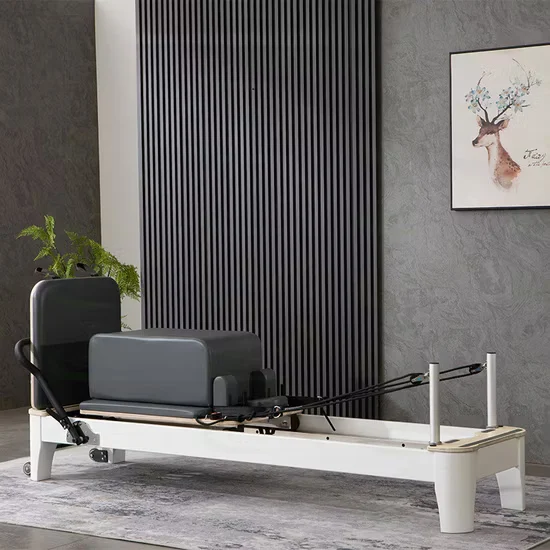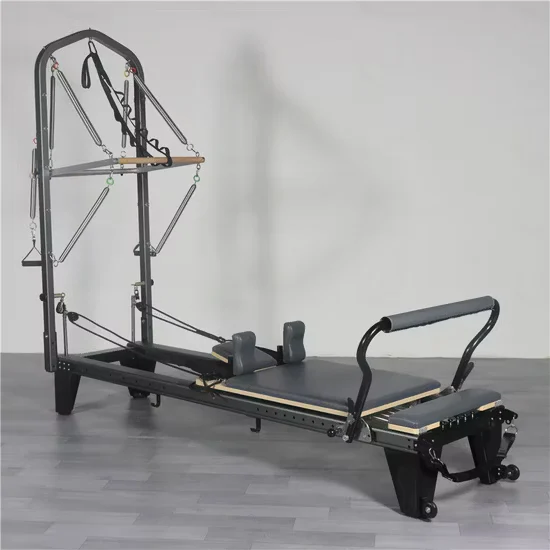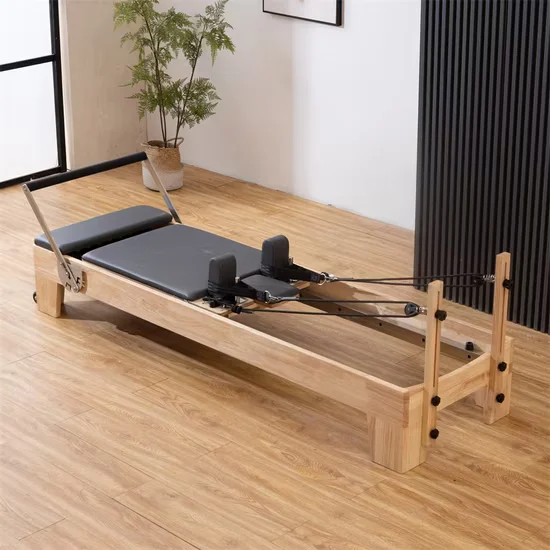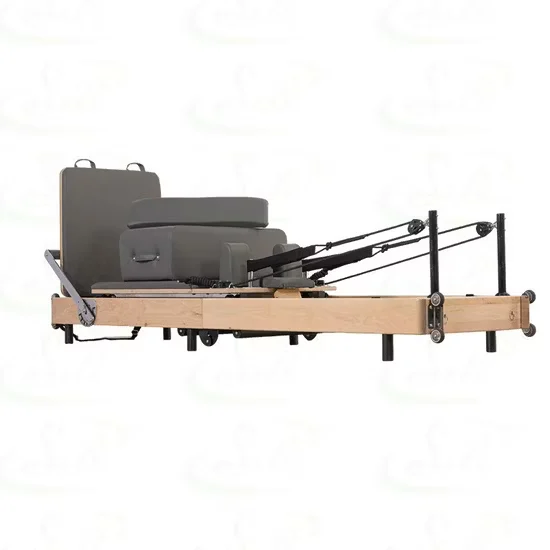
Whisper-Quiet Wooden Construction — Solid wood frame naturally dampens rail and spring vibrations, achieving near-silent operation suitable for noise-sensitive hotel floors and shared residential spaces.
Technical Specifications
| Parameter | Value |
|---|---|
| Product Type | Pilates Reformer |
| Material | Wood |
| Specification | 2400600350mm |
| Net Weight | 100kgs |
| Accessory Options | available with Long Box / Jump Board / Platform |
| Color | Solid Color |
| Customization | available with custom logo and color |
| Warranty | 3 Years |
Application Suitability
| Deployment Scenario | Typical Use |
|---|---|
| hotel wellness center on guest room floors | Quiet reformer sessions without disturbing adjacent occupied rooms |
| boutique Pilates studio | Full accessory suite supporting comprehensive class programming |
| high-end residential home gym | Wooden aesthetics blending with interior design while maintaining low noise |
| rehabilitation and physiotherapy clinic | Progressive spring resistance for controlled therapeutic movement |
Why Resonance Complaints Start on the Guest Room Floor Below
Wood naturally absorbs the vibration that metal amplifies through floor structures.
In my years sourcing cardio for Middle East hotel properties, the noise complaints that reached the front desk first were always structural — not the motor whine, but the low-frequency resonance transferring through concrete slabs from metal-frame equipment above occupied rooms. When a Pilates studio sits on an upper floor or shares a wall with guest corridors, every carriage return and spring engagement transmits through the frame into the building structure. Metal reformers act as acoustic bridges, converting spring oscillation into floor-borne vibration that guests perceive as unexplained thumping at odd hours [NEED_CITE: acoustic transmission through building structures from fitness equipment].
Positioning Within the Studio Floor Plan
This commercial wood Pilates reformer occupies the low-impact, controlled-movement zone where members transition between high-intensity cardio and recovery work. The 2400mm length requires dedicated floor space with clearance on all sides for carriage extension and instructor access, typically positioned away from entry traffic where concentration matters most. The spring resistance system supports progressive loading from rehabilitation protocols through advanced conditioning, accommodating users across a wide strength spectrum without equipment changes. Optional Long Box and Jump Board accessories extend the movement vocabulary from supine core work through plyometric sequences, allowing a single station to support an entire class curriculum.
Continuous Operation and Deployment Environment Considerations
The wooden frame demands attention to ambient humidity and temperature stability, as extreme fluctuations can cause dimensional changes that affect rail alignment and carriage smoothness over extended operation periods. Hotels deploying this equipment on guest floors benefit from the inherent acoustic dampening but must ensure HVAC systems maintain consistent climate conditions year-round [NEED_CITE: wood dimensional stability requirements for fitness equipment environments]. Floor-leveling becomes critical — unlike heavy cast-iron cardio machines that self-stabilize through mass, a 100kg wooden reformer transfers any substrate unevenness directly into rail binding and asymmetric carriage travel. Power requirements are minimal since this is a purely mechanical system, eliminating electrical infrastructure concerns and voltage compatibility issues that plague international deployments.
Rail Precision and Spring Resistance Architecture
The carriage rail system determines long-term noise performance and movement quality more than any other component. Wood-on-wood or wood-on-bearing interfaces require precise machining tolerances to prevent lateral play that generates knocking sounds during directional changes. Multi-stage spring systems provide graduated resistance curves — lighter springs for rehabilitation and isolation work, heavier springs for compound strength movements — without the sudden load jumps that compromise movement control. The spring attachment points and carriage connection hardware must maintain tight tolerances through thousands of engagement cycles, as any loosening introduces metallic clicking that defeats the acoustic advantages of the wooden frame itself [NEED_CITE: spring fatigue and preload specifications for commercial Pilates equipment].
What Happens When Specifications Get Compromised
Facilities that select reformers based on visual appearance alone discover acoustic failures only after installation, when guests in adjacent rooms begin reporting mysterious rhythmic noises during early morning sessions. Metal-frame units in wood-adjacent constructions create galvanic corrosion at connection points, gradually increasing friction noise and requiring progressively more aggressive lubrication schedules that stain flooring and create maintenance overhead. Springs rated for light commercial duty lose their linear resistance curve within months of high-frequency studio use, making class programming unreliable as instructors cannot predict actual load delivery [NEED_CITE: spring rate degradation under continuous commercial cycling].
Why This Product Line Addresses Deployment Realities
The sub-35dB operational target verified across our cardio deployments extends logically to this wooden reformer, where the material choice itself provides acoustic isolation that metal cannot match regardless of engineering intervention. The 10,000-hour durability testing protocol applied to motors and bearings informs the rail and spring validation methodology here, ensuring continuous studio scheduling without premature component replacement. Full OEM capability including custom logo and color allows the equipment to match existing studio aesthetics or hotel brand standards without compromising structural integrity. The 3D layout planning service addresses the spatial requirements specific to reformer deployments, calculating the carriage extension envelope and instructor circulation paths that determine actual usable capacity in a given room.
Documentation & Test Records
- CE declaration of conformity applicable to mechanical fitness equipment
- EN 957 test report covering structural integrity and safety requirements
- ISO 9001 certificate demonstrating quality management system compliance
- Noise level test report documenting operational acoustics under load
- Durability test record for rail and spring system cycle validation
- Installation and commissioning guide with spare parts list
Installation, Commissioning & Maintenance
- Verify floor levelness within tolerance across the full 2400*600mm footprint before positioning
- Maintain stable humidity to prevent wooden frame dimensional changes affecting rail alignment
- Establish routine spring inspection schedule checking for fatigue and preload retention
- Clean wooden surfaces with appropriate products avoiding moisture saturation or chemical damage
- Calibrate carriage travel and verify smooth full-range movement during initial commissioning
- Document accessory mounting procedures for Long Box and Jump Board changeovers
Equipment Selection Consultation
Provide your studio dimensions and planned class capacity to receive a detailed layout showing reformer spacing, instructor circulation paths, and accessory storage integration. Specify the deployment floor level and adjacent room usage so we can confirm acoustic performance meets your operational requirements. Identify whether the units will support scheduled group classes or open-access member use, as this affects spring specification and maintenance interval planning. Clarify your market’s voltage standards if integrating any electronic accessories or lighting features in the future.
Frequently Asked Questions
Q: What acoustic differences exist between wooden and metal frame reformers in multi-story buildings?
A: Wood’s natural damping characteristics absorb vibration energy that metal frames transmit through structural connections into floors and walls. In hotel deployments where equipment sits above occupied guest rooms, this material difference prevents low-frequency resonance complaints that metal frames generate during repetitive carriage movements, particularly during early morning or late evening sessions when ambient noise floors are lowest.
Q: How does the spring resistance system support progressive loading across different user capabilities?
A: Multiple springs with different tension ratings allow instructors to configure resistance from very light rehabilitation loads through heavy compound strength work. The system provides smooth, linear resistance curves without sudden load jumps, ensuring movement control remains predictable throughout the full range of motion regardless of user strength level or exercise complexity.
Q: What rail surface characteristics affect long-term operational noise?
A: Rail machining precision and surface finish determine whether the carriage travels smoothly or develops lateral play that generates knocking during directional changes. Properly finished rails maintain tight tolerances through extended use, while compromised surfaces introduce friction variations and binding that create noise and require increasingly aggressive maintenance intervention to preserve acceptable operation.
Q: Can the Long Box, Jump Board, and Platform accessories be purchased or replaced individually?
A: Yes, each accessory is available separately and designed for straightforward mounting and removal without specialized tools. This modularity allows facilities to expand their equipment capabilities incrementally or replace worn components without replacing the entire reformer unit, supporting both initial budget constraints and long-term maintenance planning.
Q: What maintenance practices prevent wooden frame deformation or cracking over time?
A: Maintain stable ambient humidity within recommended ranges to prevent wood from absorbing or releasing moisture that causes dimensional changes. Avoid direct sunlight exposure that creates uneven drying and stress concentrations. Clean with products formulated for wood surfaces, avoiding excessive moisture or harsh chemicals that degrade protective finishes and expose raw material to environmental damage.