
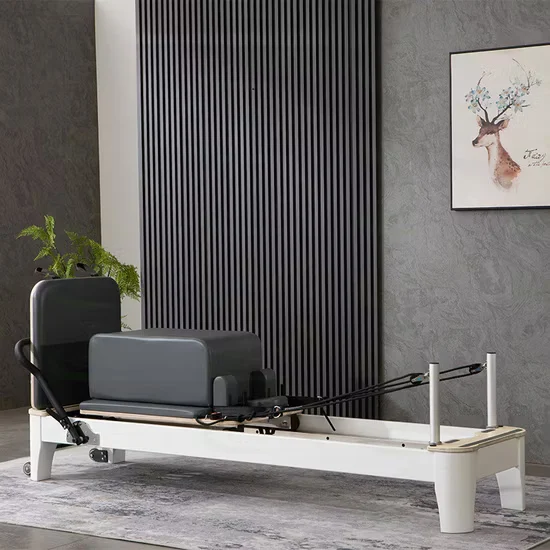
Vibration-Damped Solid Wood — 100 kg net mass and solid timber construction absorb spring-loaded reformer oscillations, keeping upper-floor studios quiet during group classes.
Technical Specifications
| Parameter | Value |
|---|---|
| Product Type | Pilates Reformer |
| Frame Material | Solid Wood |
| Finish | Solid Color (White) |
| Included Accessories | Long Box / Jump Board / Platform |
| Product Dimensions | 2460 × 730 × 680 mm |
| Net Weight | 100 kg |
| Target User | Adult, Unisex |
| Customization | Logo and finish available on request |
| Warranty | 3 Years |
| HS Code | 9506911900 |
| Production Capacity | 80 Pieces/Month |
Application Suitability
| Deployment Scenario | Typical Use |
|---|---|
| Boutique Pilates studio | Group reformer classes across beginner to advanced programming |
| Yoga training center | Complement to mat work for resistance-based flexibility sessions |
| High-end residential wellness suite | Private daily practice with low-vibration, quiet operation |
| Corporate wellness room | Mid-day guided sessions for employee wellness programs |
| Rehabilitation and wellness center | Controlled spring-resistance movement for guided recovery work |
Why Vibration Complaints Reach the Studio Manager Before Maintenance Does
Mass and material determine what the floor below actually hears.
Lightweight reformers with thin steel or aluminum frames transmit spring recoil directly into floor structures. On upper floors of mixed-use buildings, that oscillation travels as low-frequency vibration — the kind guests in the room below register as a rhythmic thud rather than identify as fitness equipment. The problem rarely shows up during the showroom demo because the reformer is sitting on a concrete slab at ground level. Deploy the same unit on a timber-framed second floor above occupied office space, and the resonance becomes a tenant complaint within the first week of group classes [NEED_CITE: vibration transmission thresholds for fitness equipment on suspended floors]. A 100 kg solid wood frame behaves differently: timber has inherent damping properties that absorb and dissipate oscillation energy rather than channeling it into the floor structure.
Where This Reformer Fits in a Mixed-Format Cardio and Mind-Body Zone
This commercial Pilates reformer wood yoga training unit covers the full resistance spectrum of spring-loaded movement — from light rehabilitation-range tension through advanced athletic loading. In a studio that also stocks mats, barrels and chairs, the reformer serves as the primary resistance-training anchor that draws members into scheduled class slots. The 2460 mm footprint requires dedicated floor space with clearance on all sides for carriage travel and instructor access, making it best suited to facilities that allocate distinct zones rather than open-plan layouts. Users across a wide range of body sizes can train on the platform without accessory changes, which keeps class transitions efficient.
Upper-Floor Deployment and Continuous Class Scheduling
Studios running back-to-back group classes five or six days a week need equipment that tolerates sustained use without structural fatigue in the frame or carriage rails. The solid wood construction provides dimensional stability across seasonal humidity shifts — a factor that causes metal-frame reformers to develop carriage rattle and rail misalignment over time [NEED_CITE: wood vs metal frame dimensional stability under commercial use cycles]. Floor loading at 100 kg net weight plus dynamic user load requires confirmation that the suspended floor structure meets capacity ratings. For multi-story deployments, positioning the reformer zone along load-bearing walls rather than mid-span reduces deflection concerns. The white finish reflects ambient light evenly, supporting consistent lighting for video content capture without hotspots.
Reading the Frame, Spring and Carriage Specifications
Solid wood frames in commercial Pilates reformer wood yoga training applications provide rigidity under lateral and torsional loads generated during jump board work and standing exercises. The joinery method — whether mortise-and-tenon, dowel-reinforced, or bolted gusset — determines long-term structural integrity more than the wood species alone. The included accessory set of long box, jump board and platform covers the majority of class formats without requiring supplemental purchases: the long box enables prone and seated pulling sequences, the jump board introduces plyometric loading for athletic programming, and the platform extends the carriage for supine work beyond standard range. Spring resistance progression across the unit determines whether the reformer supports both introductory rehabilitation sessions and advanced athletic conditioning within a single class block. Carriage rail smoothness and wheel bearing specification directly affect how the movement feels during slow eccentric control — the phase where members most notice stick-slip irregularities.
The Hidden Cost of Underspecifying Reformer Frames
Studios that purchase lightweight reformers for commercial group programming typically encounter three failure modes within the first year. Carriage wheels develop flat spots under continuous use, producing a rhythmic bump that members describe as "the machine feels broken" even though the unit still functions. Frame joints loosen under the asymmetric loading of jump board exercises, requiring monthly retightening that pulls maintenance staff away from other tasks. Finish degradation on composite or laminate frames becomes visible under studio lighting within months, undermining the premium positioning that justifies class pricing [NEED_CITE: commercial reformer maintenance frequency by frame material]. Operators who replace an entire fleet after two to three years absorb procurement, installation and member disruption costs that exceed the price difference of specifying heavier, more durable construction from the outset.
What This Product Line Brings to a Studio Buildout
The solid wood frame and 100 kg mass place this reformer in the category built for daily commercial scheduling without structural compromise. The white finish and customizable logo options let multi-location operators maintain visual consistency across studios while adapting accent details to each site’s interior design. The complete accessory package — long box, jump board and platform — means a new studio can launch full-spectrum reformer programming on day one without tracking down compatible add-ons from separate suppliers. For facilities planning a cardio and mind-body zone, the 2460 × 730 mm footprint and required safety clearances factor directly into 3D layout planning, where reformer spacing affects both instructor sightlines and airflow in climate-controlled rooms. The 3-year warranty covers structural and mechanical components under commercial use frequency, and OEM customization scope extends to color, finish and branding elements.
Documentation & Test Records
- CE declaration of conformity for fitness equipment category
- EN 957 test report covering structural load and safety requirements
- ISO 9001 certificate for manufacturing quality management
- Frame and carriage durability test record under cyclic loading
- Accessory load rating verification for jump board dynamic use
- Installation guide with floor preparation and assembly sequence
Installation, Commissioning & Maintenance
- Maintain minimum 600 mm clearance on all sides for carriage travel and instructor access during group classes
- Confirm floor levelness within tolerance to prevent carriage drift on the 2460 mm rail length
- Inspect spring tension anchors and carriage wheel bearings at intervals matching class scheduling density
- Clean wood surfaces with pH-neutral products only to preserve the white finish against sweat and humidity
- Verify accessory mounting points on long box and jump board before each class session begins
Scoping the Reformer Zone for Your Facility
Share your studio floor plan and intended class capacity to receive a 3D layout showing reformer spacing, instructor positioning and airflow considerations. Specify whether deployment is ground-floor or suspended structure so floor loading can be confirmed against the 100 kg unit weight plus dynamic loads. Indicate your target market so accessory configuration and customization options align with local studio expectations and brand standards.
Frequently Asked Questions
Q: How does a solid wood frame compare to metal in a commercial studio environment?
A: Solid wood provides inherent vibration damping that metal frames lack, meaning spring recoil energy dissipates within the frame rather than transferring into the floor structure. This matters most on upper floors where transmitted vibration reaches occupied rooms below. Wood also maintains dimensional stability across humidity changes, reducing carriage rattle development over years of daily group class scheduling.
Q: Which class formats require the long box, jump board and platform?
A: The long box enables seated rowing and prone pulling sequences common in intermediate to advanced group reformer classes. The jump board supports plyometric and cardiovascular intervals that diversify class programming beyond traditional spring work. The platform extends carriage range for supine exercises. Having all three accessories included means a studio can offer full-spectrum reformer Pilates without sourcing compatible add-ons separately.
Q: What customization elements are available for multi-location brand consistency?
A: Logo placement, color and finish options can be tailored so that reformers across multiple studio locations share a cohesive visual identity. This customization scope supports operators who maintain strict brand standards in their interior design while deploying identical functional equipment configurations at each site for consistent member experience and instructor familiarity.
Q: What floor loading considerations apply for upper-floor studio installations?
A: At 100 kg net weight plus dynamic user loading during exercises, the reformer requires a suspended floor structure rated for both static and cyclic loads. Positioning units along load-bearing walls rather than mid-span reduces deflection. Facilities planning multi-story deployments should confirm structural capacity with their building engineer before finalizing the equipment layout and spacing.
Q: What does the 3-year warranty cover under commercial use frequency?
A: The warranty covers structural frame integrity and mechanical components including carriage rails, wheels and spring anchors under commercial scheduling conditions. This coverage reflects confidence in the solid wood construction and joinery method holding up to repeated spring-loaded movement across daily group classes over an extended operational period without frame fatigue or joint degradation.

![SRY-20B Folding Pilates Reformer Wooden Bed Exercise Training Machine [WARN] draft identifier mismatch](https://bicksport.com/wp-content/uploads/2026/08/sry-20b-folding-pilates-reformer-wooden-bed-exercise-training-machine-warn-draft-identifier-mismatch-7c9751.webp)
![White Aluminum Alloy Pilates Reformer Equipment for Studio Use with Full Accessory Kit [WARN] draft identifier mismatch](https://bicksport.com/wp-content/uploads/2026/08/white-aluminum-alloy-pilates-reformer-equipment-for-studio-use-with-full-accessory-kit-warn-draft-identifier-mismatch-e368cf.webp)