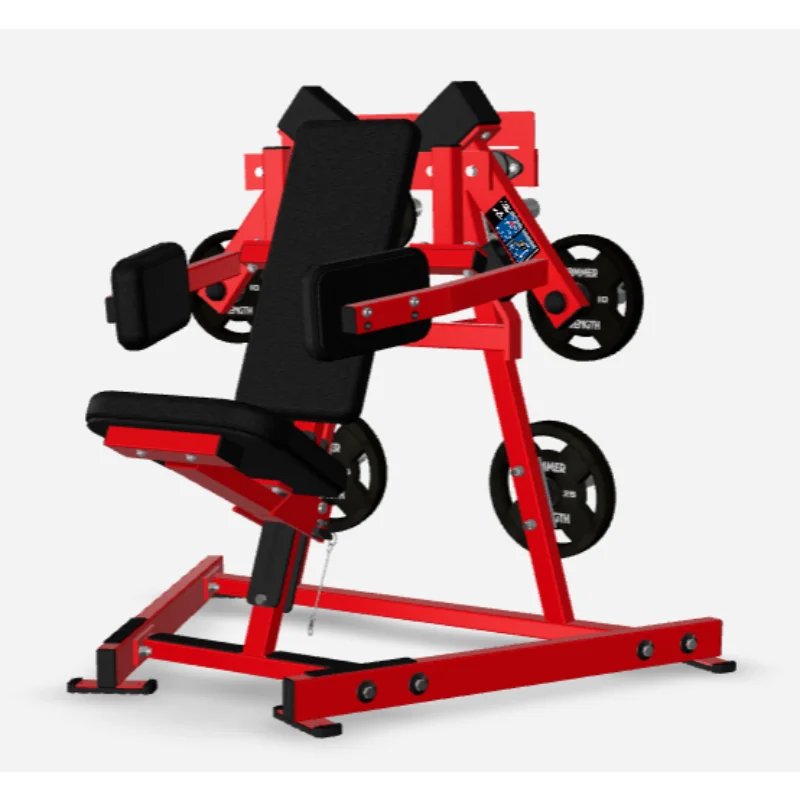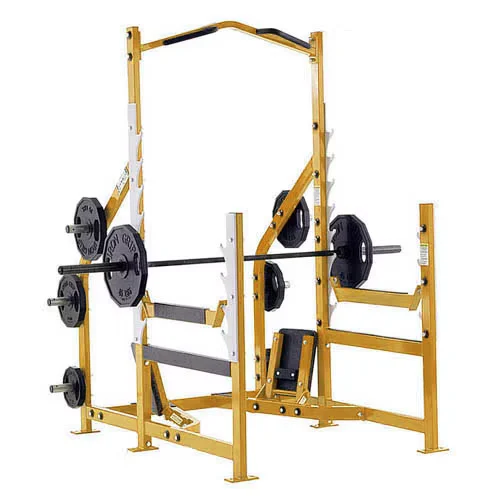
Commercial Durability — Steel frame and reinforced welding tested to withstand continuous public facility operation without structural fatigue or wobble.
Technical Specifications
| Parameter | Value |
|---|---|
| Product Type | Power Rack & Pull Up |
| Designation | 5057 |
| Material | Steel |
| Product Dimensions | 1830 1200 1876 mm |
| Net Weight | 98 kg |
| Exercise Part | Leg, Waist, Arm |
| Age Group | Adult |
| Gender | Unisex |
| OEM/ODM | Available |
| Production Capacity | 500 PCS/Month |
| Certification | ISO 9001, CE |
| Application | Professional Gym and Club, Community, Gymnasium |
Application Suitability
| Deployment Scenario | Typical Use |
|---|---|
| Chain gym free-weight zone | High-frequency squat, press, and pull-up circuits requiring structural rigidity and member safety during unsupervised hours. |
| Corporate wellness room | Compact full-body training station for time-efficient sessions in limited square footage. |
| Community fitness center | Shared-use station handling diverse user body weights and training styles throughout extended operating hours. |
| Sports performance training center | Athlete-level loading for compound lifts and bodyweight progressions with multi-grip pull-up integration. |
| High-end residential home gym | Durable personal training station with commercial-grade stability for daily use without structural wear. |
Why Light-Duty Frames Fail in Commercial Free-Weight Zones
A 98 kg commercial-grade steel frame anchors compound lifts and pull-up progressions under daily public load.
Walk into a chain gym at peak hour and listen. The clanking, the rattling, the slight wobble when a member un-racks a heavy bar — that is the sound of frames built for weekend home use buckling under continuous commercial stress. We have seen light-duty power racks develop micro-fractures at weld points within months of heavy public operation, forcing facility operators into costly replacements and creating liability concerns [NEED_CITE: structural fatigue testing for commercial strength equipment]. A commercial power rack pull up station must endure thousands of loading cycles where user body weight, barbell mass, and dynamic force converge on every joint. This unit is engineered for that exact reality, with reinforced welding and steel construction sized for professional gym and club environments rather than occasional personal use.
Where This Station Fits in a Professional Free-Weight Layout
This commercial power rack pull up station covers compound lower-body lifts, overhead presses, and multi-grip pull-up variations within a single 1830 * 1200 mm footprint. In a structured free-weight zone, it anchors the barbell training area while complementing cable machines and plate-loaded stations that handle isolation work. The pull-up bar integration supports varied grip widths for comprehensive upper-body development without requiring a separate dedicated pull-up tower. Deployment density should account for safe barbell clearance on all sides, typically placing this unit against a wall or in a bay configuration with adequate member flow space between stations.
Continuous Load Demands and Facility Infrastructure
Steel frame structures in 24/7 gym environments experience repetitive stress from loading and unloading cycles that accumulate over years of public access. Unlike motorized cardio equipment with defined duty cycles, a power rack must maintain dimensional stability through indefinite mechanical loading without electronic components to recalibrate [NEED_CITE: EN 957 requirements for commercial strength equipment]. Floor anchoring becomes critical — the 98 kg net weight provides substantial base stability, but concrete subfloors with proper bolt-down points eliminate lateral drift during heavy barbell racking. Adequate ceiling height clearance must exceed the 1876 mm frame height plus any overhead press range of motion, and rubber flooring around the perimeter absorbs dropped-plate shock transmission to adjacent equipment zones.
Steel Grade, Weld Integrity, and Finish Longevity
The 98 kg net weight signals substantial steel thickness throughout the uprights and cross-members, far exceeding the light-gauge tubing found in consumer-grade racks. Reinforced welding at every structural junction prevents the progressive loosening that causes sway under asymmetric loads — a common failure point when members perform single-arm pull-ups or offset barbell positions. The powder-coated finish resists chipping from barbell contact and corrosion from high-humidity environments like basement fitness centers or poolside gym spaces. Multi-grip pull-up bar geometry supports narrow, neutral, and wide hand placements without requiring attachment swaps, reducing maintenance touchpoints where bolts and quick-pins typically wear out in modular systems.
The Hidden Cost of Underspecified Steel
Facility operators who source racks based on price alone typically face replacement cycles that dwarf the initial savings. Light-gauge frames develop audible rattle within the first year of commercial use, prompting member complaints about equipment quality and perceived safety. Weld failures at high-stress junctions — particularly where uprights meet base cross-members — create liability exposure that no facility manager wants to navigate [NEED_CITE: commercial strength equipment load testing protocols]. Pull-up bars on underspecified racks loosen from repeated dynamic loading, requiring monthly tightening that maintenance teams inevitably fall behind on. The compounding effect is a free-weight zone that looks tired, sounds unstable, and drives members toward better-equipped competitors.
Why This Product Line Holds Up in Public Facilities
Every unit undergoes structural load verification matching the demands of continuous high-frequency commercial deployment. The steel frame and weld quality are inspected against specifications that account for dynamic force multipliers beyond static weight ratings. Full OEM/ODM capability covers custom color, logo placement, and attachment options so a gym chain can maintain brand consistency across locations. Our 3D layout service maps this rack’s footprint within your free-weight bay, accounting for barbell swing radius, member flow, and sightlines that keep the training area visually accessible from the entrance. Technical support covers installation guidance and spare parts sourcing throughout the equipment lifecycle.
Documentation & Test Records
- CE declaration of conformity for European commercial fitness market access
- EN 957 test report validating structural safety under commercial loading protocols
- ISO 9001 certificate covering manufacturing quality management systems
- Steel grade and thickness specification sheet for structural verification
- Weld quality inspection records documenting junction integrity
- OEM customization scope document covering color, logo, and attachment options
Installation, Commissioning & Maintenance
- Confirm ceiling clearance exceeds 1876 mm plus overhead press range before positioning
- Bolt frame to concrete subfloor using manufacturer-specified anchor points at base cross-members
- Level all four base contact points with shims if floor irregularity exceeds tolerance
- Inspect weld seams and bolt torque at all structural junctions after first 30 days of use
- Wipe powder-coated surfaces weekly with mild detergent to prevent sweat corrosion buildup
- Check pull-up bar mounting hardware monthly for loosening under dynamic repetitive loading
Planning Your Free-Weight Zone Deployment
Share your facility floor plan and target equipment count to receive a 3D layout mapping this rack’s clearance requirements alongside adjacent stations. Specify expected daily member throughput so we can recommend anchoring specifications and floor protection appropriate for your usage intensity. Identify your deployment floor type — concrete slab, suspended floor, or raised platform — to confirm the correct fastener kit and vibration isolation approach. State your target market so OEM branding, color, and attachment options align with your chain’s visual identity standards.
Frequently Asked Questions
Q: What steel specifications should I verify before purchasing a commercial power rack?
A: Request the steel grade and thickness specification sheet from the manufacturer. This document should list upright gauge, cross-member dimensions, and material grade for every structural component. Compare these values against your facility’s expected daily loading cycles. Commercial-grade racks use substantially thicker steel than consumer models to resist progressive deformation under continuous public use.
Q: How do multi-grip pull-up bar options affect training versatility?
A: The integrated pull-up bar supports narrow, neutral, and wide grip positions without requiring separate attachments. This allows members to target different muscle groups and progress through grip variations within a single station. Fewer attachment swaps also mean fewer loose components and reduced maintenance burden for facility staff managing high-traffic free-weight zones.
Q: What determines powder coating durability in a busy gym environment?
A: Coating thickness, curing temperature, and surface preparation before application all influence long-term finish performance. In high-traffic commercial environments, the finish must resist chipping from barbell contact, corrosion from constant humidity exposure, and wear from member handling. Request documentation on the coating specification to verify it matches commercial durability requirements.
Q: Can the frame accommodate additional attachments later?
A: Modular attachment compatibility depends on the upright hole pattern and mounting hardware interface. Confirm that the manufacturer supports expanding training capabilities with accessories like dip bars, landmine attachments, or cable pulley systems without requiring structural modification. This protects your initial investment as programming needs evolve over time.
![Commercial ISO-Lateral Front Lat Pulldown Machine for Gym Use [result]Commercial ISO-Lateral Front Lat Pulldown Machine for Gym Use[/result]](https://bicksport.com/wp-content/uploads/2026/08/commercial-iso-lateral-front-lat-pulldown-machine-for-gym-use-resultcommercial-iso-lateral-front-lat-pulldown-machine-for-gym-use-result-81571f.webp)