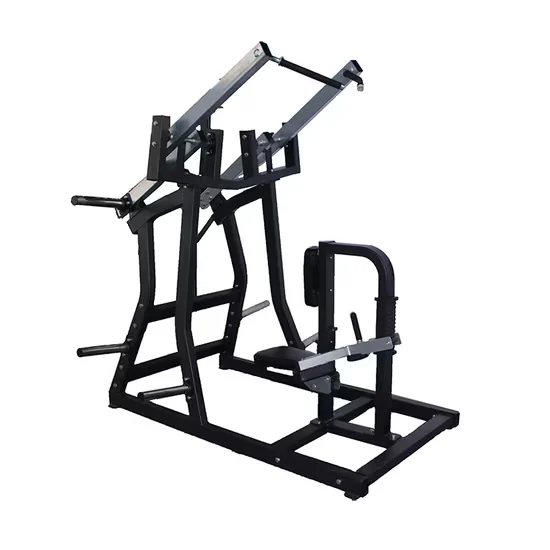
![Commercial ISO-Lateral Front Lat Pulldown Machine for Gym Use [result]Commercial ISO-Lateral Front Lat Pulldown Machine for Gym Use[/result]](https://bicksport.com/wp-content/uploads/2026/08/commercial-iso-lateral-front-lat-pulldown-machine-for-gym-use-resultcommercial-iso-lateral-front-lat-pulldown-machine-for-gym-use-result-81571f.webp)
Engineered Steel Stability — ISO-lateral independent motion paths deliver balanced back muscle engagement across high-frequency commercial deployments.
Technical Specifications
| Parameter | Value |
|---|---|
| Product Type | Strength Machine (Lat Pulldown) |
| Exercise Part | Back |
| Frame Material | Steel |
| Resistance Source | Manual (Plate-Loaded or Pin-Loaded) |
| Net Weight | 145kg |
| Product Dimensions | 1650 × 1100 × 2050 mm |
| Foldable | No |
| Max User Weight | 180kg |
| Age Group | Adult |
| Gender | Unisex |
| Customization | Available (Color, Upholstery, Logo) |
| Certification | ISO 9001, CE |
| HS Code | 950691190 |
Application Suitability
| Deployment Scenario | Typical Use |
|---|---|
| Chain gym strength and free-weight zone | High-frequency latissimus dorsi and upper back training across diverse member demographics |
| Corporate wellness fitness room | Compact footprint strength station for employee conditioning programs with minimal floor space allocation |
| Community fitness center | Durable, low-maintenance back training option accessible to adult users of varying experience levels |
| Sports performance training center | Bilateral and unilateral pull-down variations for athlete upper-body hypertrophy and rehabilitation protocols |
| High-end residential home gym | Commercial-grade build quality for private installations requiring long service intervals and quiet operation |
Why Structural Drift and Pulley Noise Undermine Member Confidence in Strength Zones
Rigid frame geometry and sealed bearing assemblies prevent the wobble and grinding sounds that signal premature wear.
When a lat pulldown station shifts laterally under load or its cable system produces metallic chatter, users instinctively reduce their working sets or avoid the equipment entirely. In chain gym environments running fourteen-hour days, these micro-failures accumulate into measurable drops in station utilization [NEED_CITE: equipment utilization correlation with structural rigidity in commercial strength zones]. A commercial ISO-lateral front lat pulldown machine built on a 145kg steel frame with reinforced weld joints resists torsional flex that lighter frames cannot contain, keeping cable travel smooth and silent through thousands of daily repetitions.
Positioning This Station Within a Commercial Strength Layout
This ISO-lateral front lat pulldown machine targets vertical pulling movements across the full resistance spectrum, complementing horizontal rowing stations and free-weight pull-up rigs within a balanced back training zone. The independent arm design allows users to perform bilateral and unilateral pulls without reconfiguring weight stacks, supporting rapid turnover in high-traffic periods. Its 1650 × 1100 mm footprint positions naturally against perimeter walls or as an anchor unit between cable crossover systems, accommodating user heights and arm spans without adjacent equipment interference.
Continuous Load Cycles and Facility Environment Requirements
In facilities operating sixteen or more hours daily, cable-driven strength equipment faces relentless friction cycles that expose shortcuts in pulley and guide rod specification. Sealed bearing pulleys maintain rotational smoothness far longer than open bushings, which attract dust and chalk residue until cable travel becomes gritty and uneven [NEED_CITE: sealed bearing lifecycle under continuous chalk-rich gym environments]. Floor leveling within the deployment area is essential; even minor slab irregularities transfer rocking forces into the frame that accelerate fastener loosening over months of heavy loading. Adequate overhead clearance must account for the 2050 mm frame height plus full cable extension during pull-down travel.
Manual Resistance Architecture and Load Transfer Mechanics
Plate-loaded and pin-loaded manual resistance systems eliminate motor controllers, circuit boards, and power cables from the failure chain entirely. The ISO-lateral mechanism uses independent lever arms on separate pivot axes, meaning each arm tracks its own arc without mechanical cross-talk — a design choice that prevents the stronger side from compensating for the weaker side during unilateral fatigue [NEED_CITE: independent lever arm biomechanics in ISO-lateral strength equipment]. Steel guide rods with linear bearing sleeves ensure the weight stack rises and descends without lateral sway, while aircraft-grade cable rated for loads well beyond maximum stack weight provides a substantial safety margin under explosive concentric phases.
The Accumulated Cost of Underspecified Strength Equipment
Gyms that deploy light-commercial frames rated for lower duty cycles encounter frame cracking at weld intersections within the first eighteen months, forcing warranty claims and member-facing downtime simultaneously. Pulley systems built on unsealed bushings require frequent lubrication and eventual replacement, generating maintenance labor costs that compound across every unit on the floor [NEED_CITE: comparative maintenance intervals between sealed and unsealed pulley assemblies]. Cable fraying from misaligned guide paths creates visible safety hazards that erode member trust and invite liability exposure in unsupervised community fitness settings.
Why This Product Line Earns Its Place on the Floor
Every frame in this range undergoes structural load testing that validates weld penetration depth and tube wall integrity under cyclic stress well beyond maximum rated user weight. The ISO-lateral front lat pulldown machine benefits from the same manufacturing discipline applied across all six cardio and strength series, meaning facility operators can source an entire equipment package from one production line with consistent build standards. Full OEM and ODM customization extends to frame color, upholstery material, and logo placement, allowing brand alignment without structural compromise. The in-house engineering team provides 3D strength zone layouts that account for this unit’s exact dimensions, safe approach clearances, and traffic flow patterns before a single anchor bolt is drilled. Technical support operates around the clock for installation queries and component sourcing across all export markets.
Documentation & Test Records
- CE declaration of conformity covering all structural and safety requirements
- EN 957 test report validating stationary strength training equipment standards
- ISO 9001 certificate confirming quality management system compliance
- Noise level test report documenting pulley and cable system acoustic performance
- Durability test record verifying frame and weld joint cyclic load endurance
- Spare parts list with exploded assembly diagrams for maintenance reference
Installation, Commissioning & Maintenance
- Maintain minimum 600 mm clearance on all sides for safe user approach and plate loading around the 1650 × 1100 mm footprint
- Verify floor levelness before anchoring; use shims if necessary to eliminate any frame rocking on the steel base plates
- Inspect cable tension and pulley alignment during initial commissioning and recalibrate before member handover
- Lubricate guide rods with manufacturer-specified dry-film lubricant at intervals determined by ambient dust and chalk concentration
- Wipe down upholstery and steel contact surfaces daily with pH-neutral cleaner to prevent sweat-induced corrosion on the powder-coated frame
Scoping the Right Equipment Mix for Your Strength Zone
Provide your strength area square footage and target station count to receive a 3D layout that positions this ISO-lateral front lat pulldown machine within optimized member traffic flow and safe clearance boundaries. Specify anticipated daily usage hours so duty-cycle expectations align with frame and pulley specifications. Confirm target market voltage standards if pairing with any electronically assisted stations in the same procurement. Indicate whether console data integration or facility management software connectivity is required for adjacent cardio equipment in the same deployment.
Frequently Asked Questions
Q: How does ISO-lateral independent arm design differ from a traditional single-bar lat pulldown?
A: Traditional lat pulldown machines link both hands to one cable and weight stack, forcing the stronger arm to compensate when fatigue asymmetry develops. The ISO-lateral design places each arm on its own pivot axis and cable path, so both sides move independently through their natural arcs. This reduces compensatory movement patterns and provides more accurate bilateral strength assessment during training sessions.
Q: What maintenance advantages do manual resistance systems offer over motorized equipment?
A: Manual resistance eliminates electric motors, control boards, and power supply components from the failure chain entirely. There are no firmware updates, no electrical safety inspections, and no voltage compatibility concerns when deploying across different regional markets. Maintenance concentrates on cable inspection, pulley bearing condition, and guide rod lubrication — tasks that facility technicians handle with standard tools and minimal specialized training.
Q: How does steel frame construction and welding quality affect long-term equipment durability?
A: Frame rigidity determines whether lateral forces during heavy pull-downs cause progressive loosening of bolted connections and weld micro-cracks over time. Thicker-walled steel tubing with full-penetration welds at high-stress junctions absorbs cyclic loading without deformation. This ISO-lateral front lat pulldown machine weighs 145kg, reflecting the material density necessary to maintain structural alignment through years of continuous commercial use.
Q: What layout considerations optimize traffic flow around lat pulldown stations?
A: Positioning lat pulldown machines against perimeter walls or as dividers between training zones preserves open floor space for free-weight movements while keeping cable stations accessible from multiple approach angles. Adequate overhead clearance for the 2050 mm frame height plus full cable travel must be verified before installation. Safe plate-loading clearance on both sides prevents member congestion during peak hours.
Q: What customization options are available through OEM or ODM arrangements?
A: Frame powder-coat color, upholstery material and stitching pattern, logo placement on shrouds and seat pads, and weight stack increment configuration can all be specified to match facility branding or regional market preferences. Minimum order quantities remain flexible for single-station trials or full-floor deployments. Custom console UI applies to electronically assisted companion equipment ordered within the same project.