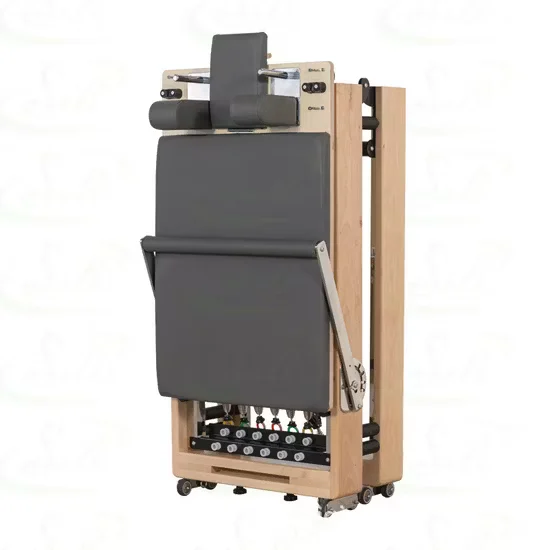
![Commercial Pilates Wall Unit Spring Board for Studio [WARN] draft identifier mismatch](https://bicksport.com/wp-content/uploads/2026/08/commercial-pilates-wall-unit-spring-board-for-studio-warn-draft-identifier-mismatch-763791.webp)
Whisper-Quiet Resistance — Solid wood frame and precision-calibrated spring mechanisms deliver controlled, low-noise performance for shared-space deployments.
Technical Specifications
| Parameter | Value |
|---|---|
| Product Type | Pilates Wall Unit / Spring Board |
| Designation | SRY-09 |
| Material | Wood |
| Color | Solid Color |
| Accessory Options | Long Box / Jump Board / Platform |
| Product Dimensions | 1850 × 560 × 75 mm |
| Net Weight | 35 kg |
| Max User Demographic | Adult / Unisex |
| Customization | Available (Logo, Color, Configuration) |
| Warranty | 3 Years |
| Certification | CE / EN 957 / ISO 9001 |
| Production Capacity | 800 Pieces / Month |
Application Suitability
| Deployment Scenario | Typical Use |
|---|---|
| Hotel fitness center on guest room floors | Low-noise individual and small-group Pilates sessions accessible around the clock |
| Commercial Pilates studio | Group reformer-style classes with modular accessory swaps between formats |
| Corporate wellness room | Mid-day and after-work movement sessions requiring quick setup and teardown |
| High-end residential home gym | Private training in shared-wall or multi-story buildings where sound transfer matters |
| Professional training center | Athlete rehabilitation and controlled-resistance conditioning with consistent spring tension |
Why Spring Noise Reaches the Studio Owner Before the Maintenance Team Does
Precision spring calibration and solid wood damping eliminate the metallic ping that drives member complaints.
In facilities where Pilates wall units sit one floor below guest rooms or adjacent to quiet zones, uncontrolled spring rebound becomes the first thing front desks hear about. Metal-frame units with loosely toleranced pivot points transmit sharp transient vibrations through the wall cavity, especially during Jump Board work where rapid load cycling excites resonant frequencies in the surrounding structure [NEED_CITE: acoustic transmission through wall-mounted fitness equipment in multi-story buildings]. The SRY-09 addresses this at the material level. Solid wood construction absorbs and disperses vibrational energy rather than reflecting it, and each spring in the board system is calibrated for linear tension progression so resistance transitions stay smooth instead of snapping between detents.
Positioning Within a Dedicated Pilates Zone
This commercial pilates wall unit spring board anchors the wall-facing training area in a studio layout, covering controlled-resistance movement patterns from supine leg work to standing rotational exercises. It complements mat stations and standalone reformers by offering vertical-plane loading that those formats cannot replicate, making it the logical anchor for classes that blend reformer precision with functional standing work. The 1850 mm rail height accommodates users across a wide range of statures, and the modular accessory set — Long Box for extended supine work, Jump Board for plyometric loading, Platform for elevated foot placement — lets a single unit support multiple class formats without swapping machines. Facilities configuring a mixed-format Pilates zone typically position these wall units along the longest uninterrupted wall to preserve sightlines for instructors monitoring spring tension and form across a group.
Continuous Scheduling and Environmental Deployment Requirements
A Pilates studio running back-to-back classes from early morning through evening subjects wall-mounted spring systems to sustained cyclic loading with minimal cool-down intervals. The solid wood frame must maintain dimensional stability across seasonal humidity swings to prevent rail warping that would alter spring geometry and introduce lateral noise [NEED_CITE: wood dimensional stability requirements for commercial fitness equipment in climate-controlled environments]. Deployment on hotel guest floors requires confirmation that the mounting wall is structurally rated for the dynamic pull-out forces generated during high-tension exercises, not just the 35 kg static weight of the unit. Adequate clearance on either side of each station — typically governed by arm-span plus accessory extension — ensures members can work without cross-station interference. Facilities planning ventilation should account for the fact that wood surfaces perform best within standard indoor humidity ranges to prevent finish degradation over years of use.
What the Material and Spring Specifications Actually Mean for Daily Operation
The choice of solid wood over welded steel tube for the frame is not aesthetic — it is acoustic. Wood’s internal damping coefficient absorbs high-frequency vibration that metal reflects back into the wall structure, which is why metal-frame wall units installed on shared partitions generate predictable complaint cycles. The spring board system uses progressive-tension springs rather than elastic cords, meaning resistance increases linearly with extension instead of exhibiting the nonlinear hysteresis that causes cords to feel unpredictable at end range. Accessory modularity through standardized mounting points on the Long Box, Jump Board, and Platform means class transitions require repositioning attachments rather than reconfiguring the entire station. The 35 kg net weight provides sufficient mass to resist walking or shifting during vigorous use without requiring through-bolt anchoring beyond standard structural fasteners, simplifying installation in retrofit scenarios where floor anchoring is restricted.
The Hidden Cost of Underspecifying Wall-Mounted Pilates Equipment
Facilities that install residential-grade spring mechanisms in commercial studios face a predictable failure sequence: springs lose linear tension within months of high-frequency cycling, producing inconsistent resistance that experienced practitioners notice immediately and attribute to the studio rather than the equipment. Units with particleboard or MDF frames absorb moisture from cleaning routines and humidity, swelling at mounting points until spring anchor geometry shifts and noise increases. Wall units deployed without confirming structural backing behind drywall generate pull-out failures under dynamic load, creating both liability exposure and unplanned downtime while walls are repaired [NEED_CITE: dynamic load requirements for wall-mounted commercial exercise equipment]. The cost of replacing an entire wall of units after a season of complaints far exceeds the initial specification gap between residential and commercial-grade construction.
Why This Product Line Addresses Facility-Level Deployment Gaps
Every SRY-09 unit undergoes spring tension calibration documented per production batch, so a studio ordering eight wall units receives consistent resistance profiles across the entire installation rather than unit-to-unit variation that instructors must compensate for during class. The solid wood frame and 35 kg mass deliver the acoustic damping that shared-space deployments require, verified through noise level testing before shipment. Facilities sourcing a full Pilates zone benefit from a single product line covering wall units, accessories, and matching construction quality, which simplifies maintenance training and spare parts stocking. OEM customization extends to logo placement, color finish, and accessory configuration so the installation matches the studio’s brand environment. The 3D studio layout service accounts for wall unit spacing, instructor sightlines, and member flow between stations, addressing the deployment geometry that determines whether equipment gets used or avoided [NEED_CITE: studio layout planning for commercial Pilates equipment placement and member flow].
Documentation & Test Records
- CE declaration of conformity covering the SRY-09 wall unit and spring board assembly
- EN 957 test report validating structural integrity and safety under cyclic loading
- ISO 9001 certificate covering manufacturing quality management systems
- Noise level test report confirming acoustic performance in shared-space conditions
- Spring tension calibration record per production batch for consistent resistance
- Wood material certification and finish durability test documentation
Installation, Commissioning & Maintenance
- Confirm structural wall backing capable of handling dynamic pull-out loads before mounting the 1850 × 560 mm frame
- Level mounting surface and use manufacturer-specified fasteners to prevent frame twist under asymmetric spring tension
- Allow clearance equal to full arm span plus Long Box extension on each side of the unit
- Calibrate spring board tension against factory baseline upon first commissioning to verify transit integrity
- Inspect spring anchor points and wood mounting surfaces quarterly for signs of wear or moisture ingress
- Clean wood surfaces with pH-neutral products only to preserve finish integrity under commercial use
Equipment Selection and Deployment Inquiry
Provide your studio floor plan and wall dimensions to receive a 3D layout covering unit spacing, instructor sightlines, and member circulation paths. Specify expected daily class volume and session length so spring duty cycle matches your scheduling intensity. Confirm the mounting wall construction type — stud framing, concrete, or masonry — to verify fastener specification and dynamic load capacity. Indicate whether accessory configuration should be standardized across all units or varied by station to support different class formats.
Frequently Asked Questions
Q: How does solid wood construction reduce noise compared to metal-frame Pilates equipment?
A: Solid wood absorbs vibrational energy internally rather than reflecting it through the wall structure, which is the primary path for noise transfer in shared buildings. Metal frames transmit spring rebound transients directly into mounting surfaces, generating audible resonance in adjacent rooms. The wood frame of this commercial pilates wall unit spring board acts as a natural damper, keeping operational sound contained at the station level without requiring additional acoustic isolation materials behind the wall.
Q: What accessory configurations are available for different class formats?
A: The unit supports three interchangeable accessories — Long Box for extended supine and seated exercises, Jump Board for controlled plyometric loading against spring resistance, and Platform for elevated foot positioning during standing work. Studios typically configure each station with one primary accessory and store alternates nearby for quick swaps between class formats. This modularity lets a single wall unit cover multiple programming needs without requiring dedicated machines for each exercise category.
Q: How is spring tension calibrated for consistent resistance across multiple units?
A: Each spring in the board system is tension-tested during assembly and matched to a factory baseline that defines linear resistance progression through the full extension range. Production batch records document individual spring calibration values so facilities ordering multiple commercial pilates wall unit spring board units receive consistent resistance profiles. This eliminates the unit-to-unit variation that forces instructors to verbally compensate when teaching across a row of inconsistently calibrated stations.
Q: What deployment considerations apply to hotel floors and shared residential spaces?
A: Wall-mounted equipment in these environments must address both structural load capacity and acoustic transmission through shared partitions. Confirm the mounting wall can handle dynamic pull-out forces generated during high-tension exercises, not just static weight. Solid wood construction reduces vibration transfer compared to metal alternatives, which is critical when guest rooms or residential units occupy the space directly behind or below the installation. Providing wall construction details during specification ensures correct fastener selection and load verification.
Q: How does the 3-year warranty cover commercial-frequency use?
A: The warranty covers structural frame integrity, spring mechanism function, and accessory mounting hardware under normal commercial operating conditions. This includes back-to-back class scheduling typical of studio environments. Coverage assumes installation follows the provided commissioning guide and maintenance inspections occur at recommended intervals. Facilities receive full warranty terms with the proforma invoice so coverage scope is confirmed before production begins rather than disputed after deployment.
![White Aluminum Pilates Reformer Used for Pilates Studio [WARN] draft identifier mismatch](https://bicksport.com/wp-content/uploads/2026/08/white-aluminum-pilates-reformer-used-for-pilates-studio-warn-draft-identifier-mismatch-0953f0.webp)
![Solid Wood Multifunctional Foldable Pilates Reformer Bed [WARN] draft identifier mismatch](https://bicksport.com/wp-content/uploads/2026/08/solid-wood-multifunctional-foldable-pilates-reformer-bed-warn-draft-identifier-mismatch-3f88ad.webp)