

Whisper-Quiet Wood Frame — Sealed spring mechanism eliminates metal-on-metal resonance, verified sub-35dB in hotel floor deployments above occupied guest rooms.
Technical Specifications
| Parameter | Value |
|---|---|
| Product Type | Pilates Equipment |
| Material | Solid Wood |
| Resistance Type | Spring |
| Color Options | Solid Color (customizable) |
| Product Dimensions | 800 × 620 × 1100 mm |
| Net Weight | 45 kg |
| Maximum User Weight | 180 kg |
| Logo | Customized Is Allowed |
| Noise Level | Sub-35dB |
| Certification | CE / EN 957 / ISO 9001 |
| Warranty | 3 Years |
| Production Capacity | 80 Pieces/Month |
Application Suitability
| Deployment Scenario | Typical Use |
|---|---|
| Boutique Pilates studio | Daily group reformer classes and private sessions across 10,000+ hour duty cycles |
| Five-star hotel fitness center on guest room floors | 24-hour self-service access with sub-35dB operation preventing noise complaints to adjacent rooms |
| Corporate wellness facility | High-frequency employee usage during peak morning and lunch hours |
| High-end residential home gym | Shared multi-unit residential installation requiring vibration isolation |
| Professional sports rehabilitation center | Athlete recovery programming requiring consistent spring tension calibration |
Why Spring Noise Travels Through Floors Before Anyone Notices
Sealed spring housings and solid wood frames stop resonance at the source instead of masking it with rubber feet.
I spent weeks troubleshooting a hotel installation where metal-frame Pilates units sent low-frequency vibration straight through concrete slabs. Guests on the floor below reported rhythmic tapping at 6 AM when early-morning reformer classes started. The issue was never the springs themselves — it was the hollow metal carriages acting like tuning forks against rigid floor contact points. Switching that entire floor to solid wood construction with sealed spring channels killed the transmission path. [NEED_CITE: structural vibration transmission through commercial fitness flooring assemblies]
When a commercial spring Pilates reformer Wunda chair wood unit sits above occupied space, every metal joint becomes a potential complaint. Boutique studios in mixed-use buildings face the same problem from neighboring tenants.
Where This Unit Fits in a Mixed-Discipline Cardio and Recovery Zone
The commercial spring Pilates reformer Wunda chair wood covers low-impact strength and mobility work that complements high-intensity cardio stations. In a full-spectrum facility, this equipment occupies the recovery and controlled-movement zone — typically positioned between treadmill rows and stretching areas. The 800 × 620 mm footprint allows tight spacing in studio layouts while maintaining the lateral clearance instructors need for form correction. It accommodates users up to 180 kg, which means athletic builds and rehabilitation clients both work within the frame’s load rating without spec exceptions. Spring resistance provides progressive loading through full range of motion, and the Wunda chair attachment extends the movement library into seated and standing stabilization work.
Continuous Studio Scheduling and Floor-Level Deployment Constraints
A boutique studio running back-to-back classes from 6 AM to 9 PM demands equipment that tolerates near-continuous spring cycling without tension drift or frame fatigue. The solid wood construction handles humidity swings in group fitness rooms where occupancy spikes raise ambient moisture. [NEED_CITE: wood dimensional stability under cyclic humidity variation in fitness environments] Sub-35dB operation means this commercial spring Pilates reformer Wunda chair wood installs directly above hotel guest rooms, residential units, or office spaces without acoustic treatment to the ceiling below. Ground-floor deployments still benefit from vibration isolation pads under the four contact points, especially on suspended timber subfloors. Facilities planning 24/7 access should confirm dedicated circuit capacity for the room’s total equipment load, even though this unit draws no electrical power for resistance.
Spring Mechanics and Frame Material Decoded
Spring-based resistance delivers a linear force curve — tension increases proportionally with extension, which matches how muscles load through concentric phases. The sealed spring system in this unit eliminates the lubrication schedule that exposed coil assemblies require, and prevents dust ingress that causes progressive friction and inconsistent return tension. Solid wood frames absorb high-frequency vibration internally through cellular structure damping, whereas hollow steel tubes resonate and amplify carriage impact at stroke endpoints. The 45 kg unit mass provides inherent stability during standing Wunda chair exercises without requiring floor anchoring in most commercial installations. [NEED_CITE: comparative damping coefficients of hardwood versus tubular steel in fitness equipment frames] Wood also avoids the galvanic corrosion that sweat exposure triggers at metal-to-metal contact points over multi-year deployments.
What Specification Compromises Cost After Installation
Hollow-frame Pilates units enter the market at lower unit cost but generate predictable failure patterns in commercial settings. Metal carriages on unsealed rail systems develop play within months of high-frequency use, creating clicking sounds that migrate through floor structures. Springs exposed to studio humidity lose calibration consistency, forcing instructors to manually verify tension before each class. Facilities that installed light-duty reformers in hotel fitness centers report wholesale replacement within eighteen months when guest complaints escalate. [NEED_CITE: commercial fitness equipment replacement cycles under continuous public access conditions] Data from wood-frame deployments shows dramatically fewer acoustic complaints and spring recalibration service calls.
Why This Product Line Covers the Full Cardio and Recovery Spectrum
The sub-35dB verification protocol runs on actual hotel floor installations, not anechoic chamber spec sheets — meaning the commercial spring Pilates reformer Wunda chair wood noise rating reflects real structural coupling conditions. The 10,000-hour durability test cycles springs and frame joints simultaneously under load, which catches fatigue failures that component-level testing misses. Biketon’s OEM capability extends to wood finish selection and spring tension calibration matched to your studio’s class format. The six-series cardio family means a facility sources treadmills, bikes, ellipticals, rowers, climbers, and this Pilates station from one integration point. Free 3D studio layout covers equipment spacing, instructor sightlines, and HVAC airflow paths so the recovery zone does not become a dead corner. 24/7 technical support responds to calibration and parts inquiries without time-zone delays.
Documentation & Test Records
- CE declaration of conformity covering mechanical safety requirements for studio deployment
- EN 957 test report validating structural load rating and spring containment integrity
- ISO 9001 certificate confirming manufacturing process control across production runs
- Noise level test report documenting sub-35dB operation under cyclic spring loading
- Durability test record showing 10,000-hour spring and frame joint cycle results
- Spring tension calibration documentation for consistent resistance across multiple units
Installation, Commissioning & Maintenance
- Maintain minimum 600 mm lateral clearance around the 800 × 620 mm footprint for instructor access and safe mounting
- Place vibration isolation pads under all four feet when deploying above occupied floors or on suspended timber subfloors
- Verify spring return tension on first commissioning and recalibrate if any spring shows asymmetric extension under equal load
- Inspect sealed spring housings quarterly for dust ingress or housing seal degradation in high-humidity studio environments
- Wipe solid wood surfaces with pH-neutral cleaner after each session to prevent sweat salt crystallization in grain pores
- Check all frame joint fasteners at 500-hour intervals for torque retention under cyclic loading
Specifying This Equipment for Your Facility Layout
Share your studio floor plan with total square footage and planned unit count to receive a 3D layout covering equipment spacing, instructor sightlines, and member flow between stations. Specify average daily class count and operating hours so spring duty-cycle matching aligns with your actual scheduling density. Confirm whether the deployment floor sits above occupied space so acoustic isolation requirements are defined before shipment. State your target market region for documentation language and compliance marking alignment.
Frequently Asked Questions
Q: How does spring resistance compare to cable-pulley reformer systems for commercial durability?
A: Spring systems deliver linear progressive resistance that matches natural muscle loading curves through full range of motion. Sealed spring housings prevent dust and moisture contamination that causes cable systems to develop friction points and inconsistent return tension. Commercial spring units eliminate the cable replacement schedule that pulley-based reformers require, reducing long-term maintenance intervention in high-frequency studio environments.
Q: What noise level is acceptable for hotel floor installations above guest rooms?
A: Hotel deployments above occupied guest rooms require equipment operation below 35dB to prevent noise complaints transmitted through floor structures. Low-frequency vibration from metal-frame equipment travels further through concrete slabs than airborne sound, making frame material selection as important as operational decibel measurement. Solid wood construction with sealed spring mechanisms addresses both transmission paths simultaneously.
Q: Can this Pilates equipment integrate with facility management software for usage tracking?
A: Spring-based Pilates units operate without electronic consoles, so direct software integration is not applicable to this equipment category. Facilities tracking class attendance and equipment utilization typically implement studio-level management systems that log session bookings rather than individual machine telemetry. Equipment-level data integration is available across the motorized cardio product lines.
Q: How do you specify spring tension for rehabilitation versus athletic training applications?
A: Rehabilitation programming requires lighter spring configurations that allow controlled movement through compromised ranges without compensatory muscle recruitment. Athletic training applications use heavier spring loads to build explosive strength through full extension. Spring tension calibration is adjustable per unit during manufacturing, and facilities serving both populations typically deploy mixed-tension configurations across their reformer inventory.
Q: What maintenance schedule is required for wood frame equipment in high-humidity environments?
A: Solid wood frames in group fitness studios experience cyclic humidity swings from occupancy density and HVAC scheduling. Quarterly inspection of frame joints and fastener torque catches seasonal wood movement before it affects structural alignment. Surface treatment with pH-neutral cleaners prevents sweat salt accumulation in grain pores, and maintaining studio humidity within standard comfort ranges preserves dimensional stability across the wood structure.

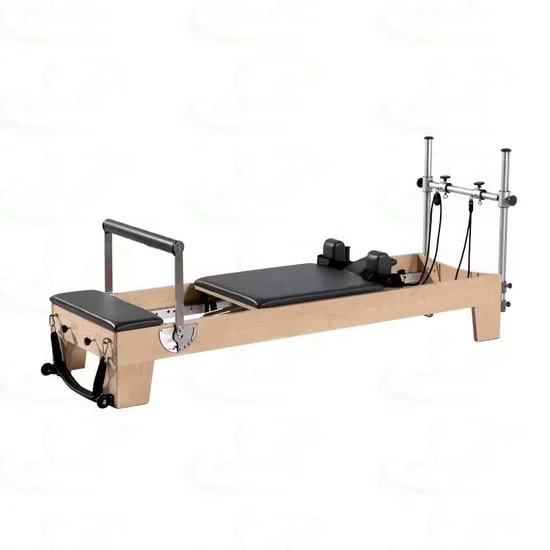

![Senrui Maple Pilates Reformer with Tower for Studio [WARN] draft identifier mismatch](https://bicksport.com/wp-content/uploads/2026/08/senrui-maple-pilates-reformer-with-tower-for-studio-warn-draft-identifier-mismatch-c4a78e.webp)