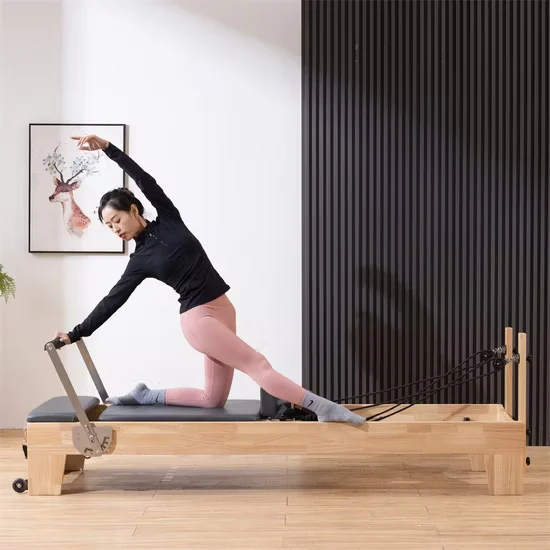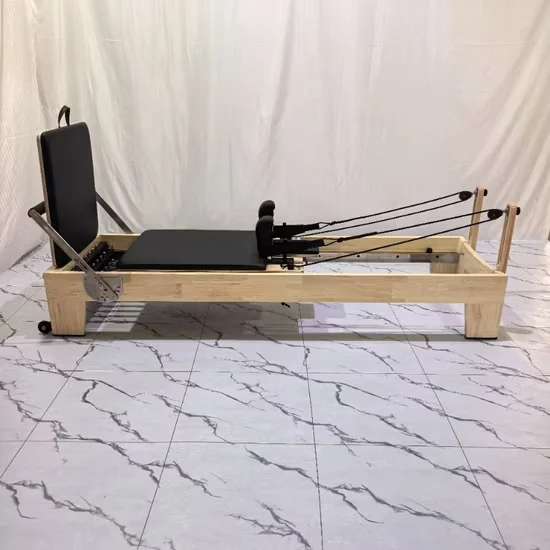
Solid Maple Acoustic Damping — precision-machined pulleys and hardwood frames absorb carriage vibration before it reaches the floor slab below.
Technical Specifications
| Parameter | Value |
|---|---|
| Product Type | Pilates Reformer with Tower |
| Material | Maple / Oak Solid Wood |
| Resistance Type | Multi-Spring Configuration |
| Resistance Levels | Progressive Load Adjustment |
| Max User Weight | 100 kg |
| Product Dimensions | 2460 × 730 × 680 mm |
| Accessories | Long Box / Jump Board / Platform |
| Pulley System | Sealed Bearing, Precision-Machined |
| Color | Solid Color (Customizable) |
| Logo | Customizable |
| Warranty | 3 Years |
| Certification | CE |
Application Suitability
| Deployment Scenario | Typical Use |
|---|---|
| Boutique Pilates studio in shared commercial building | Group reformer classes with tower-based resistance circuits |
| High-end residential private gym | Individual training where carriage noise must not reach adjacent units |
| Rehabilitation and wellness center | Low-impact progressive resistance programs with Cadillac attachments |
| Hotel-adjacent fitness studio | Early-morning and late-evening sessions without guest disturbance |
Why Spring Resonance Travels Through Concrete Floors Before Anyone Notices
Solid wood absorbs carriage vibration where welded steel amplifies it.
When Pilates reformers sit on upper floors of mixed-use buildings, steel frames transmit spring oscillation and carriage rumble directly into the structural slab. Guests in rooms below hear rhythmic thumping that maintenance teams struggle to trace. I have seen studio operators replace entire equipment batches after noise complaints escalated beyond soundproofing fixes [NEED_CITE: structure-borne noise transmission in multi-story fitness facilities]. The commercial wood Pilates reformer tower Cadillac machine eliminates this at the source — maple and oak densities dampen vibration naturally, and sealed-bearing pulleys prevent the metallic squeak that develops over hundreds of articulation cycles.
Where This Reformer Fits in a Mixed-Discipline Studio Layout
This unit covers full-range Pilates repertoire from footwork through Cadillac trapeze work, bridging mat-based warm-ups and apparatus-intensive conditioning. In a studio configuration, it pairs with mat stations for warm-up flow and pairs with chair units for advanced resistance sequencing. The 2460 mm length requires dedicated floor space with clearance on both sides for instructor access, making it suited to studios with structured class scheduling rather than open-floor drop-in use. It accommodates adult users within the 100 kg rated capacity, and the multi-spring configuration supports progressive loading from rehabilitation through athletic conditioning. The commercial wood Pilates reformer tower Cadillac machine occupies a central role where one apparatus must serve multiple class formats.
Continuous Session Scheduling and Studio Environment Demands
Back-to-back group classes mean carriage rails and spring anchors endure continuous load cycles with minimal rest between sessions. The solid wood frame maintains dimensional stability under this use pattern, though maple and oak respond differently to humidity swings in climate-controlled versus naturally ventilated studios. Floor-mounted reformers require level substrates — even minor unevenness causes carriage drift that accelerates rail wear. Facilities on upper floors benefit from the natural acoustic damping, but subfloor isolation pads further reduce transmission to spaces below [NEED_CITE: vibration isolation standards for fitness equipment on suspended floors]. Adequate lateral clearance ensures instructors can adjust spring tension mid-class without collision risk.
Decoding the Spring and Pulley Engineering
Multi-spring resistance configuration distributes load across several attachment points, avoiding the abrupt engagement noise that single-spring systems produce when tension crosses a threshold. Precision-machined pulleys with sealed bearings maintain smooth cable travel — the bearing seal prevents dust and chalk ingress that would otherwise degrade smoothness over months of studio use. Maple frames offer higher density and tighter grain structure, providing marginally greater vibration absorption than oak, while oak delivers comparable rigidity at a lower material cost. The Long Box, Jump Board, and Platform accessories expand exercise variety without requiring additional apparatus footprint. Solid wood construction also permits refinishing — sanding and resealing restore surface integrity when upholstery wear or chalk residue accumulates over years of commercial scheduling.
What Happens When Specs Get Compromised for Unit Price
Light-duty springs lose calibrated tension within months of high-frequency group classes, forcing instructors to compensate verbally and creating inconsistent client experiences. Reformers with unsealed pulleys develop audible grinding that clients notice before staff does, and bearing replacement requires taking the unit offline mid-week. Steel-framed reformers in upper-floor studios generate enough structure-borne noise that operators invest in floating floor systems — an expense that solid wood construction avoids at the equipment level [NEED_CITE: acoustic retrofit costs for commercial fitness studios]. Plywood or composite wood frames lack the dimensional stability to maintain rail alignment under continuous carriage travel, resulting in uneven glide and premature component wear.
Why This Product Line Earns Its Studio Placement
Noise complaints resolve at the source when hardwood density absorbs vibration before it enters the building structure. The 10,000-hour durability standard applied to our cardio range extends to bearing and spring specifications across Pilates apparatus, ensuring continuous scheduling does not outpace component life. OEM customization covers frame finish, upholstery color, and branding so studio identity carries through to equipment surfaces. Our 3D cardio zone layout service includes Pilates reformer spacing, instructor sightlines, and ventilation planning — critical when Cadillac tower height affects overhead clearance and airflow patterns. The full equipment family means a studio sources reformers, chairs, and cardio units through one technical support channel with 24/7 response availability.
Documentation & Test Records
- CE declaration of conformity covering structural and mechanical safety requirements
- EN 957 test report validating load capacity and durability under repeated articulation
- ISO 9001 certificate confirming quality management across manufacturing stages
- Noise level test report documenting carriage and pulley acoustic output under load
- Durability test record for spring fatigue cycles and sealed bearing longevity
- Wood species certification verifying maple or oak origin and moisture content at assembly
Installation, Commissioning & Maintenance
- Maintain minimum 600 mm clearance on both sides of the 2460 × 730 mm footprint for instructor access
- Level substrate with precision shims before rail mounting to prevent carriage drift
- Inspect spring tension calibration quarterly under commercial class scheduling
- Lubricate carriage rail contact surfaces per seasonal humidity adjustment intervals
- Reseal wood frame annually in high-humidity studio environments to preserve dimensional stability
- Verify pulley bearing smoothness during monthly preventive maintenance cycles
Request a Studio Equipment Assessment
Provide your studio floor area and planned unit count to receive a 3D layout addressing reformer spacing, Cadillac tower clearance, and ventilation flow. Specify your class scheduling density so spring duty cycles match actual use patterns. Identify your floor level and adjacent occupied spaces to confirm whether acoustic isolation pads supplement the wood frame’s natural damping. Confirm target market requirements for wood treatment and upholstery flame-retardancy standards.
Frequently Asked Questions
Q: What are the durability and acoustic differences between maple and oak reformer frames?
A: Maple has tighter grain density, which absorbs carriage vibration marginally better and resists surface denting from accessory impacts. Oak delivers comparable structural rigidity at lower material cost, though its open grain requires more frequent sealing in humid studio environments. Both species maintain rail alignment under continuous commercial use when properly acclimated during manufacturing.
Q: How does multi-spring resistance compare to rope-based systems for studio versus home use?
A: Multi-spring setups offer progressive, adjustable load that instructors can modify between class segments without interrupting flow. Rope systems provide constant tension better suited to rehabilitation settings where precise force control matters. Commercial studios favor springs for their durability under group-class frequency and the tactile feedback clients use to gauge resistance during unsupervised practice.
Q: Why does solid wood construction reduce noise transmission compared to welded steel frames?
A: Steel transmits vibration energy directly from carriage movement into the floor structure, creating audible resonance in rooms below. Solid maple and oak absorb that energy internally through natural fiber damping, preventing structure-borne noise from reaching the substrate. This difference matters most in multi-story buildings where studios operate above occupied hotel rooms or residential units.
Q: What customization options exist for studio branding and color integration?
A: Frame finish can be specified in natural seal, stained tones, or pigmented coatings matching studio interior design. Upholstery color selection covers carriage padding and accessory surfaces. Logo application is available on frame panels and accessory components. All customization is confirmed during the quotation stage before production scheduling begins.
Q: What maintenance does a wood reformer require in humid studio environments?
A: Seasonal humidity fluctuations cause wood to expand and contract, potentially affecting rail alignment and carriage glide. Annual resealing protects against moisture absorption, and quarterly rail inspection catches drift before it accelerates wear. Studios in tropical climates or facilities with high occupant loads should schedule seal inspections at six-month intervals rather than annual.
![Commercial Beech Wood Pilates Reformer OEM Custom Gym Equipment [WARN] draft identifier mismatch](https://bicksport.com/wp-content/uploads/2026/08/commercial-beech-wood-pilates-reformer-oem-custom-gym-equipment-warn-draft-identifier-mismatch-455310.webp)

![Commercial Portable Aluminum Folding Pilates Reformer SRY-12A [WARN] draft identifier mismatch](https://bicksport.com/wp-content/uploads/2026/08/commercial-portable-aluminum-folding-pilates-reformer-sry-12a-warn-draft-identifier-mismatch-e5403a.webp)