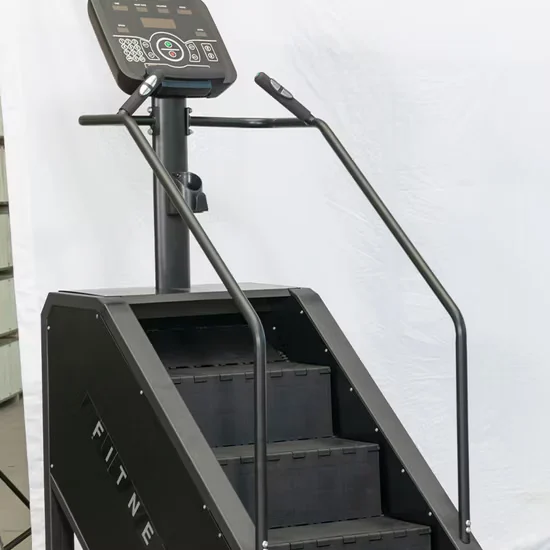
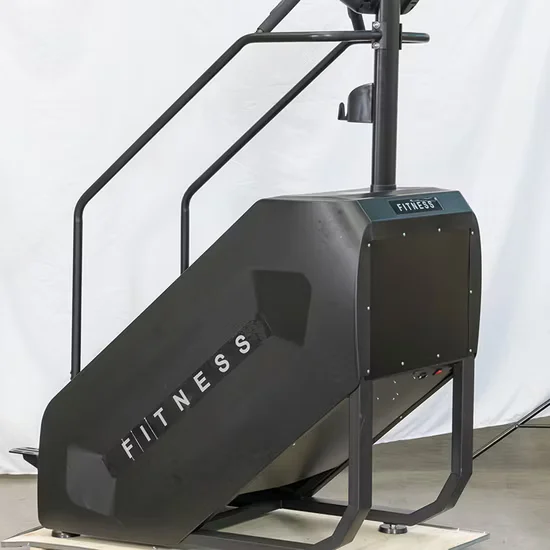
10,000-Hour Endurance Validated — Motor and sealed bearings tested for continuous high-frequency stepping across commercial duty cycles without thermal degradation.
Technical Specifications
| Parameter | Value |
|---|---|
| Designation | SQ1017 |
| Product Type | Stair Climber |
| Drive Type | Motor Drive |
| Running Velocity | 15 steps/min – 164 steps/min |
| Step Area | 560 x 235 x 220 mm |
| Max User Weight | 180 kg |
| Console Type | LED (Time, Climb, Calories, Steps, Heart Rate) |
| Heart Rate | Handgrip Sensors |
| Power Requirement | AC220V±10% / AC110V±10% |
| Product Dimensions | 1450 x 820 x 2080 mm |
| Net Weight | 148 kg |
| Material | Steel Pipe + PP Plastic |
| Foldable | Unfolded |
| Color | Black |
| Customization | Available (OEM/ODM) |
| Certification | CE, RoHS, ISO 9001 |
Application Suitability
| Deployment Scenario | Typical Use |
|---|---|
| Hotel fitness center on guest room floors | 24-hour self-service access with low-noise operation near occupied rooms |
| Chain gym cardio zone | High-frequency member turnover during peak hours across multiple units |
| Corporate wellness room | Employee use before and after shifts with moderate daily duty cycles |
| High-end residential home gym | Private daily training with commercial-grade frame longevity |
| Sports performance training center | Athlete conditioning with accurate heart rate feedback during intervals |
Why Motors Fail Before the First Quarter Ends
A motor rated only for peak output will overheat and shut down long before the warranty period expires under continuous commercial stepping loads.
Facility operators regularly replace stair climbers within months because the motor inside was specified for short residential sessions, not the eight-hour daily runtime a gym floor demands. The thermal protection trips repeatedly, members write complaints, and the unit sits cordoned off with an out-of-order sign. A commercial stair climber motor drive 180kg system must sustain its cadence range under repetitive loading without derating [NEED_CITE: motor duty cycle classification for continuous commercial operation]. When procurement focuses on upfront cost rather than continuous duty rating, the replacement cycle erases any initial savings well within the first year.
Where This Stepmill Fits in the Cardio Floor Mix
The SQ1017 occupies the vertical-loading niche in a cardio zone, complementing treadmills and ellipticals by engaging glute and quad dominance at adjustable cadence. It fits members from rehabilitation-paced stepping at 15 steps/min up to high-intensity intervals at 164 steps/min. Deployed along perimeter walls or between structural columns, its 1450 x 820 mm footprint leaves clear sightlines across the floor. The 180 kg user capacity covers the full commercial membership demographic, and the commercial stair climber motor drive 180kg rating ensures the frame and drive system handle repetitive loading across that entire range. The LED console records elapsed time, step count, climb distance, calorie estimates and handgrip heart rate so members can track session intensity without external devices.
Continuous Runtime and Deployment Environment Requirements
A stair climber in a 24-hour hotel gym may log six or more hours of active use daily, demanding a motor and bearing package that tolerates sustained thermal load without derating. Placement on guest room floors requires verified low-noise transmission through the subfloor; a vibration-damping mat beneath the 148 kg frame reduces structure-borne resonance [NEED_CITE: EN 957 requirements for commercial cardio equipment]. Dual-voltage input at AC220V or AC110V eliminates the transformer mismatch that stalls commissioning when containers arrive in markets with different grid standards. Adequate clearance around the unit—especially overhead given the 2080 mm height—ensures airflow reaches the motor housing and prevents heat accumulation during back-to-back sessions. Operators planning data integration should confirm whether the LED console firmware supports the facility management protocol in use before production.
Reading the Drive Train and Console Specifications
Motor-driven stepmills use an electric motor and gear reduction to set step cadence, unlike hydraulic or manual steppers where user effort alone dictates pace. This architecture holds a fixed cadence regardless of user weight, which matters for interval programming where the target is steps per minute, not perceived exertion. The 15–164 steps/min range spans warm-up walking to athletic sprint stepping, covering the intensity bands needed for both general fitness and sports conditioning. Steel pipe frame construction provides the lateral rigidity needed when a 180 kg user shifts weight rapidly between steps, preventing the side-to-side flex that degrades step alignment over thousands of cycles. Handgrip heart rate sensors offer adequate accuracy for steady-state monitoring, though members gripping the rails tightly during maximal efforts may see reading lag compared to chest-strap telemetry. The LED console displays five core metrics—time, climb distance, calories, steps and heart rate—giving operators a straightforward interface without the firmware complexity of touchscreen systems.
The Hidden Cost of Underspecified Components
A stair climber with a light-commercial motor deployed in a busy gym floor will enter thermal shutdown multiple times per day during peak hours, prompting members to abandon the machine mid-session. Noise from poorly balanced drive assemblies migrates through floor slabs, generating guest complaints that force hotels to relocate entire cardio zones to basement levels. Units specified for a single voltage standard arrive in markets with different grid supplies, requiring expensive step-down transformers or resulting in motor burnout on first power-up [NEED_CITE: voltage mismatch failure rates in exported fitness equipment]. Console systems that cannot export usage data leave operators blind to utilization patterns, making it impossible to justify equipment rotation or expansion decisions. Each of these failures traces back to specification choices made at procurement, not to operator error.
Why This Product Line for Your Facility
Every unit undergoes 10,000-hour continuous operation testing on motor, bearings and frame welds before leaving the production line. Sub-35 dB acoustic verification in hotel deployments confirms compatibility with occupied rooms directly above or beside the cardio zone. The six-series cardio family lets a facility source treadmills, bikes, ellipticals, rowers, climbers and spin bikes from one engineering platform, simplifying spare parts inventory and maintenance training. Full OEM and ODM capability extends to console UI customization, color matching and logo application at flexible minimum order quantities. Free 3D cardio-zone layout planning covers this unit’s 1450 x 820 mm footprint along with sightline corridors, member flow paths and HVAC airflow requirements so the commercial stair climber motor drive 180kg units integrate without dead zones. Round-the-clock technical support and parts dispatch minimize floor downtime when service events occur.
Documentation & Test Records
- CE declaration of conformity covering electrical safety and EMC requirements for this stepmill model
- EN 957 test report validating structural and mechanical safety under maximum user load
- ISO 9001 certificate for the manufacturing quality management system
- Noise level test report with measured values at operational cadence range
- Motor specification sheet detailing continuous duty rating, thermal class and insulation grade
- Durability test record documenting 10,000-hour motor and bearing run cycles
- Console technical documentation with wiring diagrams and LED display parameters
- Installation and commissioning guide with leveling procedures and power-up checklist
Installation, Commissioning & Maintenance
- Allow minimum clearance on all sides around the 1450 x 820 mm footprint for safe user entry and exit
- Install vibration-damping mat under the 148 kg frame to reduce structure-borne noise transmission
- Connect to a dedicated circuit matching AC220V or AC110V input requirement with correct plug type for market
- Verify LED console powers on and displays all five metrics before releasing unit to members
- Inspect motor drive belt tension and step alignment after the first 500 operating hours
- Wipe handgrip heart rate sensors and steel frame with non-corrosive cleaner daily to prevent sweat buildup
Before You Request a Quote
Provide the cardio zone floor area and planned unit count so we can generate a 3D layout with airflow and sightline analysis for this stepmill’s footprint. Specify average daily operating hours to confirm the motor duty cycle matches your facility’s usage pattern. Identify the deployment floor level and adjacent occupied spaces to validate acoustic requirements. Confirm target market voltage and plug standards to ensure the correct power configuration ships from the factory. Indicate whether console data export to your facility management system is required so the appropriate firmware can be pre-loaded before dispatch.
Frequently Asked Questions
Q: How does a motor-driven stepper differ from a manual hydraulic stepper in commercial durability?
A: Motor-driven systems use an electric motor and gear reduction to maintain consistent cadence regardless of user weight, distributing mechanical load across engineered components rather than relying on hydraulic cylinders that degrade under high-frequency use. This architecture sustains accurate step rates across thousands of daily cycles, making it the standard for commercial facilities where equipment runs continuously throughout operating hours.
Q: How can I verify whether the motor rating reflects continuous or peak output?
A: Request the motor specification sheet from the manufacturer, which should list both the continuous duty rating and the peak rating separately. A motor suitable for commercial deployment must show a continuous rating that covers the expected daily runtime without thermal derating. If the documentation only quotes a single horsepower figure without distinguishing duty classification, the value likely represents peak output unsuitable for sustained operation.
Q: Why does dual-voltage input matter for international deployment?
A: Facilities in different markets operate on either AC220V or AC110V grid standards, and shipping equipment configured for the wrong voltage results in motor burnout or non-operation upon arrival. Dual-voltage input eliminates this mismatch risk by accepting both standards at the factory, reducing the need for external transformers and ensuring the commercial stair climber motor drive 180kg system commissions without electrical rework on site.
Q: How reliable are handgrip heart rate sensors during intense climbing sessions?
A: Handgrip sensors provide adequate accuracy during steady-state climbing at moderate cadence, where grip contact remains consistent. During high-intensity intervals where users grip tightly or intermittently release the rails, readings may lag or drop temporarily. Facilities requiring continuous biometric accuracy for interval programming should evaluate whether chest-strap or optical telemetry integration is necessary for their training protocols.
Q: What floor space and layout factors affect stair climber placement?
A: The 1450 x 820 mm footprint and 2080 mm height require adequate overhead clearance and lateral spacing for safe user mounting. Placement near walls or columns should account for the step entry side and handgrip swing zone. Proper airflow planning around the motor housing prevents heat accumulation during back-to-back sessions, especially when multiple commercial stair climber motor drive 180kg units are grouped in a dedicated climbing zone.