
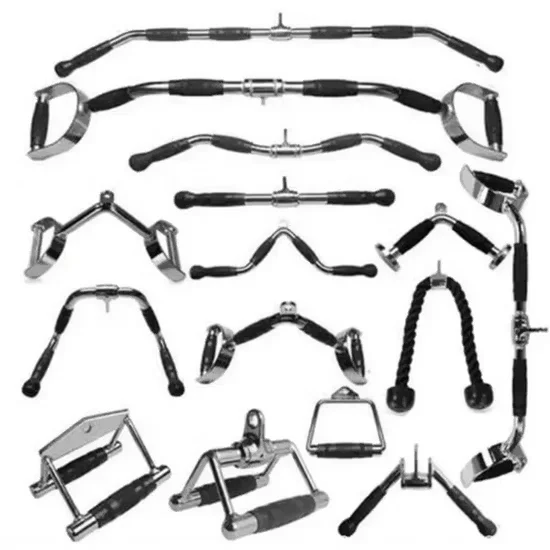
Precision-Forged Grip — Steel grip bars and press down handles engineered for 10,000+ hours of continuous high-frequency training across commercial strength zones.
Technical Specifications
| Parameter | Value |
|---|---|
| Product Type | Smith Machine Accessories |
| Material | Steel |
| Specification Range | 45–90 cm |
| Model NO. | FA-5555 |
| Available Colors | Silver / Black |
| Logo | Customized Logo Available |
| Application | Indoor |
| MOQ | 50 PCS |
| Customization | Available |
Application Suitability
| Deployment Scenario | Typical Use |
|---|---|
| Chain gym strength training zone | Press down bar attachments for group and individual resistance sessions |
| Corporate wellness fitness room | Multi-grip steel bars for compact strength stations |
| High-end residential home gym | Space-efficient press down bars paired with personal Smith machines |
| Hotel fitness center | Durable grip handles rated for unsupervised 24-hour guest access |
| Professional sports training facility | Steel grip accessories for athlete-grade Smith machine routines |
Why Grip Bars Fail Before the Frame Does
Steel thickness and weld integrity separate a three-year accessory from a three-month replacement.
Walk into any commercial gym after eighteen months of operation and check the Smith machine grip bars. You will find peeling knurling, hairline cracks at weld seams, and bars that no longer sit flush in the J-hooks. The frame survives; the accessories do not. Procurement teams focus on the main unit rating and treat grip bars as commodity items, yet these are the contact points members actually feel every rep [NEED_CITE: failure mode analysis for commercial gym accessory attachment points]. When a commercial smith machine accessories steel grip bar cracks under load, the entire station goes offline until a replacement ships.
Where Press Down Bars Fit in the Strength Zone Layout
A Smith machine without the right accessory set is a half-finished station. Press down bars and grip handles in the 45–90 cm range cover narrow-grip presses, wide-grip shoulder work, and tricep extensions across different user anthropometrics. In a commercial cardio and strength floor plan, these accessories pair with the Smith machine as the anchor and complement free-weight racks and cable systems nearby. The commercial smith machine accessories steel grip bar range accommodates users from lightweight rehabilitation clients to heavyweight athletes. Bars at 45 cm suit close-grip pressing and isolation work, while 90 cm bars handle wide-grip compound movements and partner-assisted drills.
Continuous Use Demands on Steel Grip Hardware
A commercial gym strength zone runs twelve to sixteen hours daily, sometimes twenty-four in hotel fitness centers. Each Smith machine station sees dozens of bar swaps per day. The steel must hold dimensional tolerance through thousands of insert-and-remove cycles without the ends wearing down and developing play in the J-hooks [NEED_CITE: commercial gym equipment duty cycle standards for attachment hardware]. Surface finish matters as much as raw material: sweat corrosion on untreated steel accelerates pitting in humid environments, particularly in tropical hotel gyms where air conditioning cycles create condensation. Facilities on upper floors also need to verify that accessory weight loads are within the floor’s rated capacity when multiple Smith stations run simultaneously.
Reading the Steel and Weld Specs That Matter
The material grade directly determines how the bar handles cyclic loading. Low-carbon steel bends before it breaks, giving a visible warning; high-carbon steel is harder and more wear-resistant but can fracture suddenly if a weld fails. Surface treatment—chrome plating, powder coating, or bare knurling—changes both grip feel and corrosion resistance. Chrome delivers a smooth finish that wipes clean easily but becomes slippery with sweat; powder coating adds texture but can chip at contact points over time. The weld pattern at the sleeve-to-bar junction deserves close inspection: full-penetration welds distribute stress across the joint, while spot welds concentrate it. Bars in the 45–90 cm specification range must also maintain straightness within tight tolerances, because even a slight bend causes uneven loading on the Smith machine guide rails.
The Hidden Cost of Specifying Accessories as Afterthoughts
Facilities that source Smith machines on engineering merit then buy grip bars on price alone create a predictable failure chain. Thin-walled bars deform under heavy press loads, transferring uneven force into the guide rail bearings. Bars with inconsistent sleeve diameters wobble in the J-hooks, generating noise and accelerating hook wear [NEED_CITE: tolerance stacking effects between Smith machine hooks and accessory bar sleeves]. In hotel fitness centers, a single snapped bar during guest use generates an incident report, liability review, and often a full accessory audit that pulls every station offline simultaneously. The replacement cost is minor; the operational disruption and reputation exposure are not.
Why This Product Line Holds Up in Deployment
These steel grip bars and press down handles are specified to match the durability expectations of commercial Smith machine systems tested for 10,000 hours of continuous operation. The material selection and weld protocols are verified through load testing records that document cyclic fatigue performance. Available in 45–90 cm lengths, the range lets a facility outfit every Smith station for the full movement catalogue without mixing suppliers. Color and logo customization keeps the visual identity consistent across a multi-site rollout, which matters for hotel groups and chain gyms that brand every touchpoint. The 50-piece MOQ supports a single large venue or a phased deployment across several locations. Documentation includes material certificates and weld inspection records so procurement teams can verify quality before the container ships, and 24/7 technical support covers fit issues or specification questions after commissioning.
Documentation & Test Records
- CE declaration of conformity covering accessory load ratings
- EN 957 test report for strength equipment attachment safety
- ISO 9001 certificate for manufacturing quality management
- Steel material grade certificate and chemical composition report
- Weld inspection and surface treatment quality records
- Dimensional tolerance and straightness verification logs
Installation, Commissioning & Maintenance
- Verify J-hook spacing matches bar sleeve length across the 45–90 cm range
- Confirm bar sleeves seat fully without lateral play before releasing to members
- Inspect weld seams and surface coating integrity upon delivery and quarterly thereafter
- Wipe down steel surfaces with pH-neutral cleaner after each use to prevent sweat corrosion
- Rotate bar inventory across stations to distribute wear evenly over time
- Replace any bar showing visible deformation, coating delamination, or hook-seat looseness immediately
Planning Your Strength Zone Accessory Specification
Share your Smith machine model and J-hook dimensions to confirm sleeve compatibility across the 45–90 cm range. Specify your daily operating hours and expected station throughput so we can match material grade and surface treatment to your duty cycle. Confirm the deployment environment—air-conditioned indoor gym, humid hotel fitness floor, or ventilated garage-style training space—to select the right corrosion protection. State your target market and branding requirements for color and logo customization scoping.
Frequently Asked Questions
Q: How does steel grade affect grip bar durability and user feel?
A: Higher carbon content increases hardness and wear resistance, meaning the bar surface and knurling hold up longer under repeated use. Lower carbon steel offers more ductility, bending visibly before failure rather than snapping. The surface treatment layered on top—chrome, powder coat, or bare knurl—then determines the tactile feel and how well the bar resists sweat corrosion in your specific environment.
Q: How do I choose the right bar length for different training movements?
A: Shorter bars around 45 cm suit close-grip presses, tricep work, and rehabilitation exercises where hand placement stays narrow. Mid-range lengths around 65 cm cover standard pressing and rowing grips for most users. The 90 cm bars accommodate wide-grip shoulder presses and partner-assisted drills. Most commercial facilities stock two or three lengths per station to cover the full movement range.
Q: What is the lead time for customized logo and color orders?
A: Custom logo engraving or printing and color-specific powder coating require a sampling approval step before full production runs. The 50-piece MOQ applies to customized batches. Once the sample is approved, production proceeds with the same quality checkpoints as standard finish bars, including weld inspection and dimensional verification before packing.
Q: What maintenance keeps steel grip bars in service longer?
A: Daily wipe-downs with a pH-neutral cleaner remove sweat salts that accelerate surface pitting, especially in humid environments. Quarterly inspections should check weld seams, sleeve roundness, and coating adhesion. Rotating bars across stations prevents any single bar from accumulating disproportionate wear. Bars showing surface pitting, coating flaking, or any visible bend should be pulled from rotation immediately.
Q: Are volume discounts available for multi-site chain deployments?
A: Bulk pricing applies to orders above the base MOQ and scales with total unit count and customization complexity. Facilities outfitting multiple locations benefit from consolidating orders to lock in consistent color, logo, and specification across all sites. Request a quotation with your total unit count, customization requirements, and delivery timeline for a project-specific proposal.


![Versatile PVC Soft Medicine Balls for Commercial Gym Indoor Fitness Training [WARN] draft identifier mismatch](https://bicksport.com/wp-content/uploads/2026/08/versatile-pvc-soft-medicine-balls-for-commercial-gym-indoor-fitness-training-warn-draft-identifier-mismatch-f48c00.webp)
![Ergonomic Squat Bar Shoulder Pads for Commercial Gym Comfort [WARN] draft identifier mismatch](https://bicksport.com/wp-content/uploads/2026/08/ergonomic-squat-bar-shoulder-pads-for-commercial-gym-comfort-warn-draft-identifier-mismatch-d13820.webp)