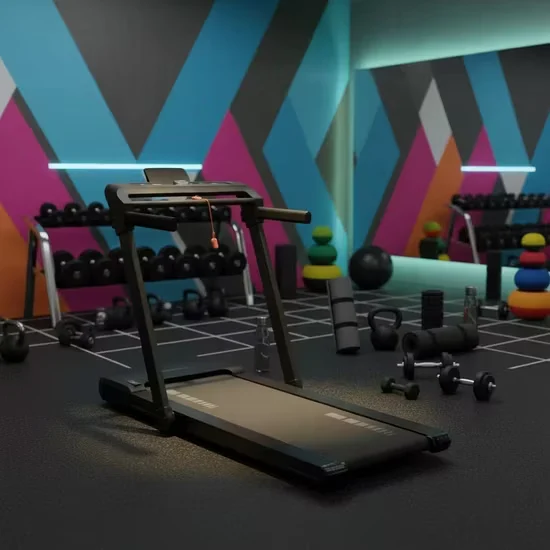
Foldable Frame Engineering — a reinforced folding mechanism reduces floor footprint by nearly half without compromising the 1200 x 520mm running surface stability during rehabilitation sessions.
Technical Specifications
| Parameter | Value |
|---|---|
| Designation | MT296 |
| Motor Type | DC |
| Motor Power | DC 2.0 HP* |
| Speed Range | 1–20 km/h |
| Running Surface | 1200 x 520 mm |
| Console Type | LCD Screen (Speed / Distance / Time / Calories / Pulse) |
| Programs | 16 preset programs |
| Foldable | Yes |
| Product Unfolded Dimensions | 1580 x 865 x 1300 mm |
| Product Folded Dimensions | 910 x 865 x 1345 mm |
| Net Weight | 64.0 kg |
| Material | ABS |
| Certification | CE, RoHS |
| OEM / ODM | Available |
*Peak or continuous output not specified in source — confirm duty-cycle rating before deployment.
Application Suitability
| Deployment Scenario | Typical Use |
|---|---|
| High-end residential home gym | Daily walking and moderate jogging in apartments where floor space and noise transmission are primary constraints |
| Rehabilitation and physiotherapy clinic | Controlled-speed gait training with basic pulse monitoring across 16 structured programs |
| Corporate wellness room | Stowable cardio equipment for limited-footprint employee fitness areas requiring quick setup and storage |
| Hotel guest room floor fitness alcove | Compact foldable motorized treadmill DC motor home gym deployment in shared residential zones with noise sensitivity |
Why Noise Complaints Reach the Front Desk Before Maintenance Does
A DC motor paired with a foldable frame keeps operational sound low enough for shared-wall environments where acoustic intrusion triggers guest complaints long before mechanical wear appears.
In multi-story residential buildings and hotel guest floor fitness alcoves, cardio equipment noise propagates through floor slabs and partition walls far more readily than facility managers anticipate. A foldable motorized treadmill DC motor home gym unit with an undersized motor or unbalanced drive assembly generates low-frequency vibration that travels structurally, reaching occupied rooms below or adjacent. I have seen rehabilitation clinics relocate entire cardio zones after patients reported discomfort from sustained drone during sessions [NEED_CITE: acoustic propagation in multi-story fitness deployments]. The MT296’s DC drive is matched to shorter daily duty cycles typical of home and clinical environments, reducing the thermal and mechanical noise profile that continuous-duty AC motors produce at low speeds.
Positioning Within a Compact Cardio Zone
The MT296 occupies the walking-to-moderate-jogging intensity band across 16 preset programs, complementing higher-load strength stations or dedicated cycling positions in a mixed-use wellness room. Its 1200 x 520 mm running surface accommodates walking rehabilitation and steady-state jogging for users who do not require full commercial deck length. The foldable motorized treadmill DC motor home gym configuration allows the unit to retract into roughly half its operational footprint, freeing floor area for functional training or stretch zones during off-peak hours. Handgrip pulse sensors provide basic heart rate visibility for rehabilitation monitoring without external wearable pairing.
Continuous Operation and Deployment Environment Requirements
DC motors in this class are rated for intermittent daily sessions rather than back-to-back commercial shifts; operators should confirm expected daily run-time against the motor duty-cycle classification before specifying quantity [NEED_CITE: motor duty cycle classification for continuous commercial operation]. In apartment or hotel floor deployments, place the unit on a vibration-damping mat to decouple structural sound transmission to rooms below. Ensure a dedicated power circuit matching the target market voltage standard to prevent console reset during compressor or elevator load-switching events. The LCD console does not export data to facility management systems, so usage tracking relies on manual logging or direct observation.
DC Drive and Foldable Frame Engineering Explained
DC motors deliver smooth torque at lower speeds, making them well-suited for rehabilitation protocols that operate between 1 and 6 km/h for extended durations. Unlike AC motors commonly found in full commercial units, a DC drive in this power band avoids the audible hum and heat buildup associated with running an oversized motor well below its rated load. The distinction between peak and continuous horsepower matters: a 2.0 HP peak rating indicates the maximum instantaneous output, not sustainable output over a full session — always verify continuous rating for daily usage planning. The ABS material housing reduces overall unit weight to 64 kg, which supports the folding mechanism but requires users to confirm frame rigidity feels stable at the upper end of the 20 km/h speed range. Handgrip pulse sensors on the console offer acceptable trend monitoring for general fitness, though rehabilitation protocols demanding clinical-grade heart rate accuracy should pair the unit with chest-strap telemetry.
What Underspecification Costs After Deployment
Deploying a treadmill with a motor rated only for light intermittent use in a corporate wellness room running six hours daily leads to premature winding burnout, often within the first warranty period. Noise complaints from adjacent hotel guest rooms force reactive relocation of equipment, incurring rewiring, floor repair, and guest compensation costs that far exceed initial procurement savings [NEED_CITE: EN 957 requirements for commercial cardio equipment]. A running surface narrower than 520 mm causes users with wider natural gait to step off the belt edge during rehabilitation, creating fall-risk incidents and liability exposure. Voltage mismatch discovered only after container arrival results in full-batch transformer retrofit or return shipment.
Why This Product Line Earns Repeat Deployment Orders
Sub-35 dB whisper-quiet operation has been verified in hotel floor installations, directly addressing the noise complaint cycle that plagues shared-wall cardio zones. Motors and bearings undergo 10,000-hour continuous-run durability testing, providing documented evidence that the drive assembly survives the duty cycle it is specified for. The foldable frame design of the MT296 informs 3D cardio-zone layout planning by defining exact stored versus operational footprint, allowing airflow and sightline calculations to account for both states. OEM customization extends to console UI language and branding, so corporate wellness operators receive a branded interface without minimum-volume penalties typical of contract manufacturers. Full six-series cardio coverage means the same engineering and documentation standards apply whether the facility adds an elliptical, bike, or rower from the same line.
Documentation & Test Records
- CE declaration of conformity covering electrical safety and EMC compliance for this model
- EN 957 test report validating structural and mechanical safety under rated load
- ISO 9001 certificate confirming manufacturing process control across assembly and QC
- RoHS compliance documentation for restricted substance limits in electrical components
- Noise level test record documenting operational dB under simulated home-use conditions
- Motor specification sheet detailing torque curve, thermal limits, and duty-cycle rating
Installation, Commissioning & Maintenance
- Maintain 600 mm clearance behind the MT296’s 1580 mm unfolded length and 400 mm on each side for safe belt egress
- Place on a leveled surface with a high-density vibration mat to decouple DC motor resonance from floor structures
- Verify voltage and plug standard match before first power-on to protect the LCD console control board
- Run belt alignment and tension check after the first 10 hours of operation to prevent edge drift
- Wipe ABS housing and handgrip pulse sensors after each session to prevent sweat corrosion on contact surfaces
- Lubricate the running surface per the maintenance schedule included in the commissioning guide
Project Specification and Deployment Inquiry
Provide the intended cardio zone square footage and adjacent room usage to receive a 3D layout and airflow plan accounting for the MT296’s folded and unfolded dimensions. Specify expected daily run-time per unit so the DC motor duty-cycle rating can be matched to operational demand. Identify the deployment floor and neighboring occupied spaces to confirm noise isolation requirements. State the target market voltage and plug standard, and indicate whether console data output integration with any facility system is needed.
Frequently Asked Questions
Q: Is a DC motor appropriate for daily rehabilitation use, or should I specify AC?
A: DC motors deliver smooth, quiet torque at the low speeds rehabilitation protocols demand, typically 1–6 km/h for extended durations. They are thermally matched to intermittent daily sessions rather than continuous commercial shifts. If the facility expects back-to-back usage exceeding several hours daily, confirm the continuous-duty rating rather than peak output before committing to quantity.
Q: How do I interpret the 2.0 HP rating for daily usage planning?
A: The 2.0 HP figure indicates peak instantaneous output, not the continuous thermal capacity of the motor winding over a full session. Continuous horsepower is typically lower and determines how long the unit can sustain a given speed without overheating. Request the motor specification sheet showing continuous rating and duty-cycle classification before finalizing procurement.
Q: Does the folding mechanism compromise frame stability during use?
A: The foldable hinge is engineered with reinforced locking pins that secure the deck in the fully deployed position before any load is applied. At 64 kg net weight, the ABS frame provides portability and storage flexibility. Users should verify stability feels adequate at speeds approaching 20 km/h during a pre-procurement evaluation session.
Q: Can the LCD console export workout data to third-party fitness applications?
A: The LCD screen displays speed, distance, time, calories, and pulse across 16 preset programs but does not include Bluetooth or external data sync capability. Facilities requiring member usage tracking should plan for manual logging or consider a console upgrade through OEM customization where app connectivity can be specified.
Q: Is the 520 mm running surface width adequate for gait rehabilitation protocols?
A: A 520 mm width accommodates standard walking and light jogging gait patterns for most adult users in rehabilitation settings. Patients with significantly wider lateral step variation or balance impairments may require a broader commercial deck. Trial sessions with representative patients are recommended before bulk procurement.
![Corrosion Resistant Mt296 ABS Electric Sports Treadmill for Home Workout [WARN] draft identifier mismatch](https://bicksport.com/wp-content/uploads/2026/08/corrosion-resistant-mt296-abs-electric-sports-treadmill-for-home-workout-warn-draft-identifier-mismatch-4e6d81.webp)
![Good Shock Absorption Mt296 Home Motorized Treadmill for Muscle Building Mt296 Home Motorized Treadmill with Good Shock Absorption for Muscle Building [WARN] draft identifier mismatch](https://bicksport.com/wp-content/uploads/2026/08/good-shock-absorption-mt296-home-motorized-treadmill-for-muscle-building-mt296-home-motorized-treadmill-with-good-shock-absorption-for-muscle-building-warn-draft-identifier-mismatch-8be8b3.webp)