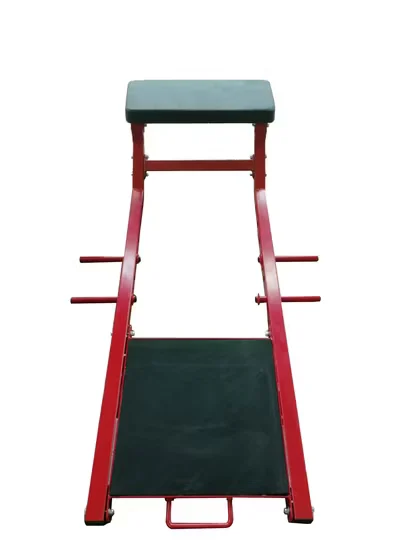
Zero-Noise Plate-Loaded Training — Manual resistance mechanics eliminate motor hum entirely, keeping the ISO-Lateral Bench Press Machine silent even during peak-hour gym traffic.
Technical Specifications
| Parameter | Value |
|---|---|
| Product Type | ISO-Lateral Bench Press Machine |
| Exercise Part | Chest |
| Material | Steel |
| Product Dimensions | 1323 × 1599 × 1746 mm |
| Net Weight | 140 kg |
| Power Source | Manual |
| Foldable | Unfolded |
| Resistance Type | Plate-loaded |
| Age Group | Adult |
| Gender | Unisex |
| Fit Area | Professional Gym and Club |
| Appliance | Community, Gymnasium |
| Production Capacity | 500 PCS/Month |
| OEM/ODM | Available |
| Certification | ISO 9001, CE |
Application Suitability
| Deployment Scenario | Typical Use |
|---|---|
| International gym chain networks | High-frequency chest training stations requiring minimal maintenance |
| Professional sports training centers | Athlete-grade load precision for periodized strength programs |
| Corporate wellness rooms | Durable plate-loaded option for mixed-ability employee users |
| Community fitness centers | Reliable daily-use bench press with low upkeep demands |
| High-end residential home gyms | Quiet, cable-free chest training without motorized components |
Why Pivot Wear Turns Members Away Before the First Set Is Complete
Precision-machined pivot points and sealed commercial-grade bearings keep the lateral motion path smooth across thousands of daily repetitions.
Plate-loaded chest machines in busy gym floors face relentless loading cycles. When pivot hardware is undersized or bearings lack proper sealing, lateral wobble develops within months. Members feel the friction through the handles, adjust their grip, and eventually skip the station altogether [NEED_CITE: bearing degradation patterns in high-traffic plate-loaded equipment]. I have walked chain gym floors where seat carriages on comparable machines rattled visibly during warm-up sets — the kind of feedback that spreads fast on social media and erodes membership retention.
Where This Press Fits Within a Commercial Strength Floor
The commercial ISO-lateral bench press machine targets horizontal pressing patterns at moderate to high intensity, filling the gap between barbell bench stations and selectorized chest press units. It complements fly machines and incline press stations in a dedicated chest-training cluster. Its plate-loaded manual resistance means it performs best in supervised or semi-supervised zones where users load their own weights. The reinforced steel frame supports adult users across a broad weight range without stability compromise.
Continuous Load Expectations and Floor Placement
A plate-loaded bench press does not draw electricity, so duty-cycle concerns shift entirely to mechanical wear — specifically pivot bearings, seat carriage rails, and frame weld joints. In a chain gym operating sixteen hours daily, this station will see dozens of loading cycles per hour during peak periods [NEED_CITE: average station usage frequency in commercial gym peak hours]. Deploy it on leveled flooring with vibration-dampening rubber mats to isolate impact from adjacent areas. No power circuit planning is required, which simplifies layout flexibility on upper hotel floors or multi-purpose wellness rooms where electrical capacity is limited.
Decoding the Steel Frame and Pivot Engineering
The 1323 × 1599 × 1746 mm steel frame provides a wide base footprint that resists lateral tipping even when loaded asymmetrically. Reinforced welding at stress concentration points — particularly the pivot axis and seat-mount junctions — prevents micro-fracture propagation under repeated heavy loading. The manual plate-loaded resistance system eliminates cable stretch, pulley wear, and weight-stack guide-rod friction entirely. Commercial-grade sealed bearings at the pivot axis maintain consistent rotational smoothness without scheduled lubrication intervals. The unfolded fixed configuration sacrifices portability but gains structural rigidity that folding frames cannot match under sustained commercial use.
What Cutting Corners on Frame Steel Actually Costs
Undersized frame tubing on chest press stations leads to flex under load, which users perceive as instability and quickly abandon. Bearing specifications below commercial grade result in grinding noises and uneven motion arcs within a few hundred hours of use. Machines that develop pivot play force maintenance teams into reactive repair cycles, pulling equipment offline during revenue-generating hours [NEED_CITE: downtime cost per station in commercial fitness facilities]. Entire batches of light-duty plate-loaded units have been replaced within two years by operators who initially saved on procurement but paid far more in member attrition and emergency service contracts.
Why This Lineup Earns Its Spot on the Purchase Order
Every frame in this series undergoes durability testing aligned with 10,000-hour continuous operation benchmarks — the same standard applied across our cardio range. The ISO-Lateral Bench Press Machine benefits from the same sealed-bearing specification philosophy that keeps our treadmills running sub-35 dB on hotel guest-room floors. OEM customization covers logo application, frame color, and upholstery material to match facility branding. Our team provides complimentary 3D strength-zone layout planning that accounts for this unit’s 1.3-meter width and the clearance needed for plate loading on both sides. Full documentation packages ship with every unit, and 24/7 technical support covers mechanical troubleshooting from day one.
Documentation & Test Records
- CE declaration of conformity covering structural and mechanical safety requirements
- EN 957 test report validating stationary training equipment performance standards
- ISO 9001 certificate confirming quality management across manufacturing processes
- Durability test records documenting frame and bearing endurance under cyclic loading
- Upholstery and contact surface material specification sheets for wear assessment
- Installation and commissioning guide with full spare parts list included
Installation, Commissioning & Maintenance
- Maintain minimum 800 mm clearance on both sides for safe plate loading and unloading
- Install on level flooring with rubber vibration mats beneath the 140 kg steel base frame
- Verify all pivot bolts and seat-mount fasteners at initial assembly and every 90 days thereafter
- Inspect sealed bearings for play or grinding and replace per maintenance schedule
- Wipe upholstery and steel contact surfaces daily with non-corrosive cleaner to prevent sweat damage
- Rotate plate-loading horn sleeves periodically to distribute wear evenly across the contact surface
Planning Your Strength Zone Procurement
Share your facility floor plan and target station count so our team can generate a 3D layout covering equipment spacing, member traffic flow, and plate-storage placement. Specify daily operating hours and expected peak-hour station usage to confirm that frame and bearing specifications match your throughput requirements. Indicate whether OEM branding, custom frame color, or upholstery material is needed for your facility identity. Note any adjacency constraints — such as group-class studios or recovery zones — so we can recommend placement that minimizes noise transfer from plate handling.
Frequently Asked Questions
Q: How does a plate-loaded ISO-lateral press compare to a selectorized chest press in long-term maintenance?
A: Plate-loaded units eliminate cables, weight-stack guide rods, and selector pins — the components that fail most often in selectorized machines. Maintenance focuses on pivot bearings and frame fasteners rather than cable tension adjustments or pin replacements. For high-traffic commercial floors, this translates to fewer service visits and simpler spare-parts inventory.
Q: What should I check to verify frame and bearing quality before placing a bulk order?
A: Request durability test records showing cyclic load testing on the pivot mechanism and frame welds. Inspect bearing specifications for sealed commercial-grade ratings rather than open bushings. Examine weld consistency at stress junctions and ask for material certificates on the steel tubing used in the main frame structure.
Q: How does the pivot mechanism design influence motion smoothness during pressing?
A: The ISO-lateral path relies on a fixed pivot axis with precision-machined bearings to guide the pressing arms through a natural convergence arc. Any play in the pivot hardware translates directly into handle wobble that users feel immediately. Sealed bearings maintain alignment and smoothness across thousands of repetitions without requiring field lubrication.
Q: What OEM customization options are available for commercial facilities?
A: Logo placement on the frame, custom powder-coat colors, and upholstery material or color selection are all available at flexible minimum order quantities. Console or branding panels can be adapted for facilities that want consistent visual identity across all strength and cardio stations in their equipment lineup.

![2019 Hammer Strength ISO-Lateral Leg Extension Commercial Gym Equipment [WARN] draft identifier mismatch](https://bicksport.com/wp-content/uploads/2026/08/2019-hammer-strength-iso-lateral-leg-extension-commercial-gym-equipment-warn-draft-identifier-mismatch-d05d8f.webp)
![2019 Hammer Strength Seated Calf Raise Commercial Gym Equipment [WARN] draft identifier mismatch](https://bicksport.com/wp-content/uploads/2026/08/2019-hammer-strength-seated-calf-raise-commercial-gym-equipment-warn-draft-identifier-mismatch-0cdfd7.webp)