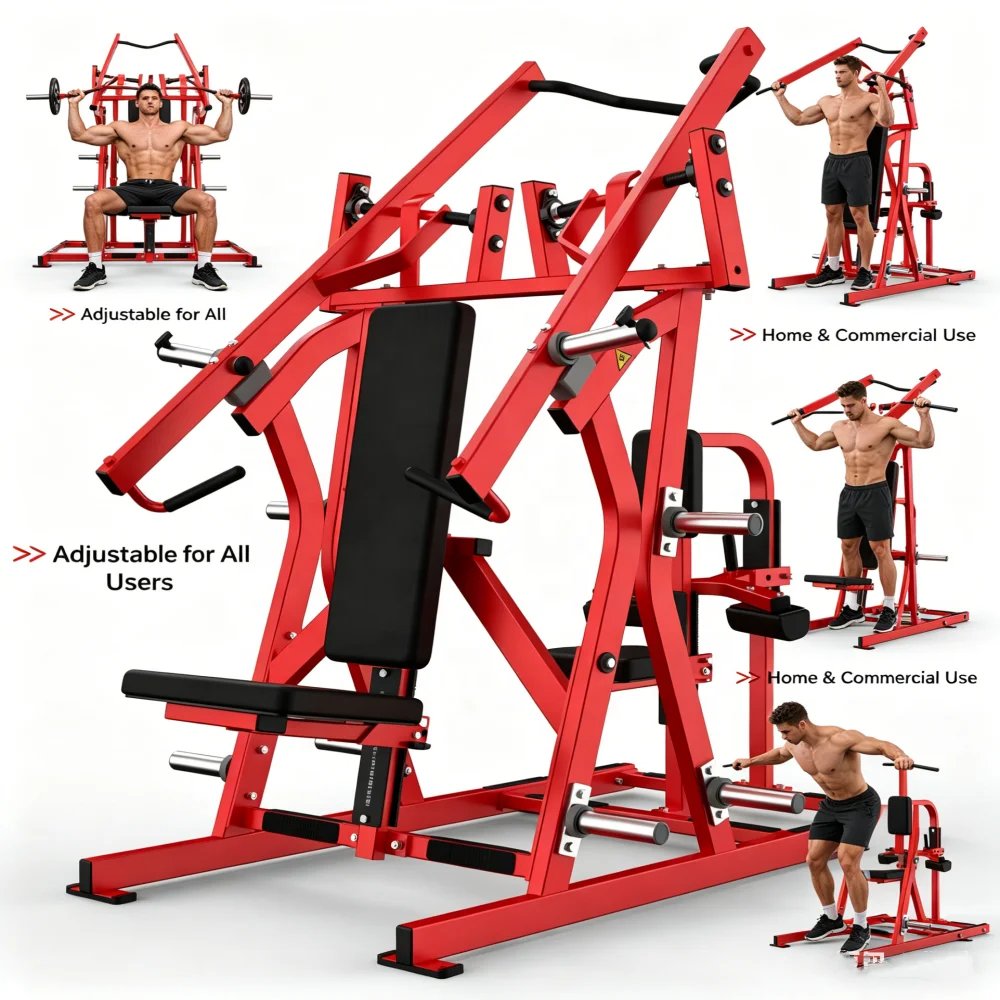
![Plate Loaded Hammer Strength Utility Bench 75 Degree Sports Equipment for Commercial Gyms [WARN] draft identifier mismatch](https://bicksport.com/wp-content/uploads/2026/08/plate-loaded-hammer-strength-utility-bench-75-degree-sports-equipment-for-commercial-gyms-warn-draft-identifier-mismatch-010c0c.webp)
Acoustic-Grade Structural Rigidity — full steel frame engineered to eliminate resonance transfer during high-load plate loaded training on upper floors.
Technical Specifications
| Parameter | Value |
|---|---|
| Designation | H065 |
| Product Type | Plate Loaded Hammer Strength Utility Bench |
| Frame Material | Steel |
| Fixed Incline Angle | 75° |
| Product Dimensions | 1120 × 640 × 1145 mm |
| Net Weight | 28 kg |
| Target User | Adult / Unisex |
| Primary Exercise Focus | Chest |
| Main Frame Color | Available per customer requirements |
| Cushion Color | Available per customer requirements |
| OEM / ODM | Acceptable |
| Facility Grade | Professional Gym and Club |
| Production Capacity | 1000 units per month |
| Certification | ISO 9001, CE |
Application Suitability
| Deployment Scenario | Typical Use |
|---|---|
| Professional gym and club free-weight zone | Heavy plate loaded chest pressing and upper-body compound movements |
| Community fitness center strength area | Durable bench station for general membership resistance training |
| Corporate wellness room | Compact fixed-angle bench paired with dumbbell and plate racks |
| Sports performance training center | Stable pressing platform for athlete strength and conditioning cycles |
| Hotel fitness room | Low-profile plate loaded station for guest self-directed workouts |
Why Frame Harmonics Matter More Than Steel Thickness on a Plate Loaded Hammer Strength Utility Bench
A bench that oscillates under load destroys user confidence before any visible structural failure occurs.
When a plate loaded hammer strength utility bench sits in a busy free-weight zone, members load plates, shift their weight, and drive through the movement — every cycle transfers force into the welds and the floor. If the frame geometry or tube profile allows low-frequency resonance, the vibration travels through the slab and reaches occupied rooms below. I have seen commercial gym operators replace entire bench runs not because the steel failed, but because the subtle wobble made lifters feel unsafe under heavy loads [NEED_CITE: structural resonance thresholds in commercial strength equipment frames]. The H065 uses a full steel frame with a fixed 75-degree geometry, removing adjustable linkages that typically introduce play points and harmonic weak spots in utility bench designs.
Positioning the H065 Within a Commercial Free-Weight Floor Plan
This plate loaded hammer strength utility bench occupies the upper-body pressing station in a strength zone, complementing flat and decline benches, plate loaded lateral raise and shoulder press units, and dumbbell racks. The fixed 75-degree angle targets incline chest and anterior deltoid pressing patterns, filling the gap between flat bench and overhead press stations. Its 1120 × 640 mm footprint allows tight side-by-side placement while maintaining safe loading clearance. The bench accommodates a wide user range thanks to the unisex geometry and 28 kg self-stabilizing frame mass.
Deployment Environment Constraints for Fixed-Angle Pressing Stations
A plate loaded bench in a high-traffic gym zone endures continuous loading and unloading cycles throughout operating hours. Unlike cardio machines with motors and electronics, the H065 requires no electrical circuit, eliminating voltage mismatch concerns across export markets. Floor leveling becomes critical: an uneven slab introduces a rocking point that concentrates stress on two feet instead of distributing load across four. Rubber vibration pads beneath each contact point decouple the frame from the slab, reducing structure-borne noise transfer to lower floors [NEED_CITE: floor-borne vibration isolation methods for commercial gym equipment]. Adequate clearance on the loading side ensures members can plate and unplate without stepping into adjacent station zones.
What the Steel Specification Actually Controls
The H065 frame is constructed from structural steel, chosen for its yield strength under static and dynamic loading. In a plate loaded hammer strength utility bench, the frame must resist bending moments generated when a loaded barbell rests on the user’s hands above the support point. The fixed 75-degree back pad angle transfers force through a direct load path into the rear upright and base tube, avoiding the pivot joints that adjustable benches require. Those pivot mechanisms introduce fastener wear, pin slop, and eventual rattling — failure modes absent in a fixed-geometry design. The cushion color and frame finish are available per customer requirements, allowing visual alignment with existing equipment lines without compromising the structural specification.
The Hidden Cost of Underspecifying a Utility Bench
Operators often allocate the bulk of their strength budget to racks and plate loaded machines, treating benches as commodity items. A lightweight bench with thin-wall tubing deflects under load, and the welds at the upright-to-base junction develop fatigue cracks within months of heavy commercial use. I have reviewed return batches where the cushion foam compressed to the steel frame within a single quarter of operation, exposing members to hard contact during heavy sets. Replacing benches mid-cycle disrupts floor layouts and erodes member trust. The H065 is built to the same manufacturing standards applied to the full cardio range, including 10,000-hour durability protocols on structural components [NEED_CITE: durability testing protocols for commercial strength equipment].
Why This Product Line for Your Strength Zone
The H065 is produced in a facility operating under ISO 9001 with full vertical integration from CNC machining through final assembly and quality inspection. OEM and ODM customization covers frame color, cushion color, and logo application at flexible minimum order quantities. The same engineering discipline applied to sub-35dB cardio drive systems governs the structural welding and load testing on this plate loaded hammer strength utility bench. A free 3D strength-zone layout is available covering equipment spacing, member flow, and loading clearances so that the bench integrates correctly with adjacent racks and plate storage. The six-series cardio family pairs with this bench to complete full-facility sourcing from a single manufacturer, and 24/7 technical support covers all deployed equipment.
Documentation & Test Records
- CE declaration of conformity for the H065 strength bench
- EN 957 test report covering static and dynamic load performance
- ISO 9001 quality management system certificate
- Frame material and weld inspection records
- Cushion density and durability test documentation
- Spare parts list and assembly guide
Installation, Commissioning & Maintenance
- Allow minimum 600 mm rear clearance for plate loading on the H065 footprint.
- Level all four contact points on the slab; use rubber isolation pads to dampen vibration.
- Inspect weld joints and fastener torque quarterly under commercial load cycles.
- Wipe cushion surfaces with pH-neutral cleaner after each operating day to prevent leather degradation.
- Check cushion foam density annually and replace pads showing visible compression channels.
Equipment Sourcing Next Steps
Provide your strength-zone floor area and existing equipment list to receive a 3D layout with loading clearances and member flow paths. Specify your target market so that frame labeling and documentation match local requirements. Confirm daily usage intensity so the bench quantity and placement match your throughput needs.
Frequently Asked Questions
Q: What is the practical difference between plate loaded and selectorized utility benches?
A: Plate loaded benches like the H065 require the user to add weight plates manually, which suits facilities where members train with free-weight methodology. Selectorized benches integrate pin-loaded weight stacks and are more appropriate for supervised environments with varied experience levels. Plate loaded stations typically occupy less floor depth because no stack housing is needed behind the bench.
Q: Why is a fixed 75-degree angle preferred over adjustable benches for chest training?
A: A fixed angle eliminates the pivot mechanism, back-rest adjustment pin, and support ladder found on adjustable models. This removes mechanical play points that develop noise and loosen over thousands of loading cycles. The 75-degree incline specifically targets the clavicular head of the pectoralis major and the anterior deltoid, providing a consistent movement path across all users.
Q: What structural benchmarks should a commercial utility bench meet?
A: Commercial-grade benches must sustain repeated loading well beyond the maximum expected user weight plus barbell and plate mass. Frame deflection should remain imperceptible under load. Weld penetration depth and tube wall thickness are primary indicators. EN 957 testing validates static load capacity and fatigue resistance across the expected service life of the equipment.
Q: How does OEM customization work for frame and cushion color?
A: Frame powder-coat color and cushion upholstery color can be specified to match your existing equipment palette or brand identity. Logo placement on the frame is also available. A color sample approval step occurs before bulk production begins, and minimum order quantities remain flexible for facility-scale deployments.
Q: What floor layout considerations apply to bench stations in a strength zone?
A: Each bench needs clear loading access on at least one long side and adequate head clearance for seated and supine positions. Adjacent stations should be spaced so that plate handling does not create collision risk. A 3D layout accounts for rack proximity, plate storage locations, and member circulation paths to maximize utilization of the available square footage.
![Hot Seller Gym Machine / Fitness Equipment Hammer Strength Adjustable Abodominal BoardOS-H5060 Commercial Adjustable Abdominal Board Gym Machine Fitness Equipment[WARN] draft identifier mismatch](https://bicksport.com/wp-content/uploads/2026/08/hot-seller-gym-machine-fitness-equipment-hammer-strength-adjustable-abodominal-boardos-h5060-commercial-adjustable-abdominal-board-gym-machine-fitness-equipmentwarn-draft-identifier-mismatch-37782c.webp)
![Commercial Multi Function Power Rack Pull Up Gym Equipment [WARN] draft identifier mismatch](https://bicksport.com/wp-content/uploads/2026/08/commercial-multi-function-power-rack-pull-up-gym-equipment-warn-draft-identifier-mismatch-881358.webp)
![ISO Lateral Kneeling Leg Curl Machine H5028 Commercial Gym Equipment [WARN] draft identifier mismatch](https://bicksport.com/wp-content/uploads/2026/08/iso-lateral-kneeling-leg-curl-machine-h5028-commercial-gym-equipment-warn-draft-identifier-mismatch-d5dfa1.webp)