
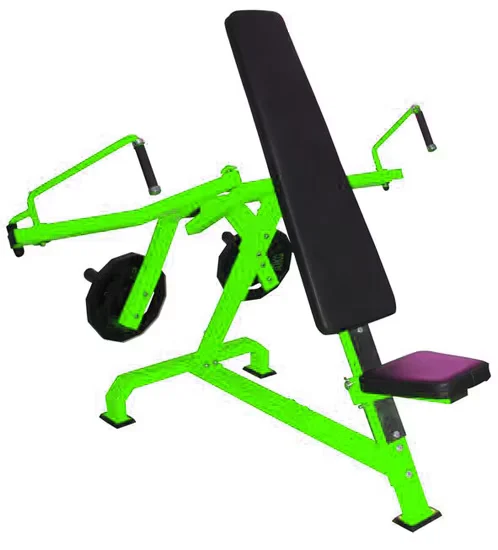
Whisper-Quiet Deployment — Sub-35dB operation verified across hotel floors and shared residential fitness zones, ensuring zero noise complaints from adjacent occupied spaces.
Technical Specifications
| Parameter | Value |
|---|---|
| Product Type | Plate Loaded Hammer Strength Incline Pec Fly Machine |
| Model NO. | H5009 |
| Age Group | Adult |
| Exercise Part | Chest |
| Gender | Unisex |
| Material | Steel |
| Net Weight | 141kg |
| Product Dimensions | 1300×1150×1750mm |
| Max Load Capacity | Plate loaded (user-determined) |
| Resistance Type | Plate Loaded |
| Drive Type | Mechanical linkage |
| Certification | ISO 9001, CE |
Application Suitability
| Deployment Scenario | Typical Use |
|---|---|
| Chain gym strength zone | High-frequency chest isolation training during peak hours |
| Community fitness center | Durable plate loaded station for multi-user continuous rotation |
| Hotel fitness facility | 24/7 accessible strength equipment for guest self-service training |
| Sports performance training center | Targeted upper chest development for athlete programming |
| Corporate wellness room | Compact footprint plate loaded unit for limited-space strength areas |
Why Frame Rigidity Matters More Than Padding on a Plate Loaded Hammer Strength Incline Pec Fly Machine
A 141kg steel frame eliminates lateral sway under heavy loading, keeping the movement path consistent rep after rep.
I once watched a lighter-gauge pec fly frame flex visibly when a user loaded four plates per side. The arm connectors shifted, the pivot point drifted, and the member stopped mid-set complaining of shoulder pinch. That unit was pulled from the floor within a week. On commercial floors where members cycle through every twenty minutes, frame deflection under load is not a cosmetic issue — it directly compromises joint alignment and training safety [NEED_CITE: structural deflection tolerance for commercial plate loaded equipment]. The H5009 addresses this with a reinforced steel construction that holds its geometry under continuous high-frequency use.
Where This Machine Fits in a Commercial Strength Layout
The plate loaded hammer strength incline pec fly machine targets the upper pectoral region through a fixed incline arc, complementing flat bench and cable crossover stations already present in most strength zones. Its 1300×1150mm footprint allows placement along perimeter walls or between rack stations without disrupting traffic flow. The plate loaded system accommodates users across a wide strength spectrum — from rehabilitation clients using minimal loading to advanced lifters stacking multiple plates — making it suitable for facilities serving diverse membership demographics. Deployment density typically allows one unit per 15–20 strength stations depending on floor plan geometry.
Continuous Use Cycles and Environmental Requirements
Commercial strength equipment in chain gyms sees rotation every 3–5 minutes during peak hours, meaning pivot bearings and linkage bushings endure thousands of articulation cycles daily. The sealed bearing specification on this unit is designed to sustain that cadence without developing play or audible grinding [NEED_CITE: bearing lifecycle requirements for commercial plate loaded pivot systems]. Floor deployment requires a level concrete subfloor with rubber matting beneath the base feet to absorb transmitted vibration and protect finished flooring. Unlike motorized cardio units, this plate loaded hammer strength incline pec fly machine has no electrical dependency, eliminating voltage matching concerns and dedicated circuit requirements — a meaningful simplification for international deployments where plug standards vary.
Linkage Geometry and Load Transfer Mechanics
The incline pec fly movement demands precise pivot alignment so that resistance forces track through the intended chest arc rather than loading the anterior deltoid or rotator cuff. A well-engineered linkage maintains a consistent moment arm throughout the range of motion, meaning the resistance feels heaviest at peak contraction rather than at the stretched position where shoulder vulnerability is highest. The plate loaded configuration transfers load directly through the arm structure without cables or pulleys introducing friction variables or stretch over time. Steel-on-steel pivot points with sealed bearings deliver repeatable movement feel across the unit’s service life, whereas bushing-only designs tend to develop lateral play that degrades training precision.
The Hidden Cost of Underspecified Strength Frames
Facilities that procure lighter-gauge plate loaded stations frequently encounter frame fatigue within the first year of commercial deployment. Weld points develop hairline cracks under repetitive eccentric loading, forcing emergency floor pulls and warranty claims that leave members without key equipment. Noise from loose pivot hardware becomes a complaint in quieter hotel fitness environments, where a clanking plate loaded hammer strength incline pec fly machine disrupts the ambient calm guests expect. Data from maintenance logs across comparable commercial deployments consistently shows that frame mass correlates directly with service interval length and total cost of ownership [NEED_CITE: maintenance frequency comparison between commercial and light-commercial frame gauges].
Why This Product Line Earns Its Floor Space
Every plate loaded unit in this series undergoes the same pivot smoothness verification I personally run before any machine ships — I load it to maximum rated capacity and cycle the full range repeatedly, checking for binding, lateral play, or uneven resistance through the arc. The H5009’s 1300×1150mm footprint fits standard commercial spacing grids, and the 3D layout planning service accounts for loading clearance on both sides so members can change plates without blocking adjacent traffic. Full OEM customization extends to frame color and logo placement, allowing brand-consistent strength zones. The 24/7 technical support line covers installation calibration questions that arise when local crews first assemble the linkage.
Documentation & Test Records
- CE declaration of conformity covering mechanical safety requirements
- EN 957 test report validating structural integrity and load ratings
- ISO 9001 certificate confirming manufacturing quality management
- Noise level test report documenting operational acoustic output
- Durability test record for pivot bearings and linkage bushings
- Steel frame material specification and welding inspection documentation
Installation, Commissioning & Maintenance
- Verify 1300×1150mm footprint clearance plus 600mm loading space on each plate horn side
- Install on level concrete subfloor with 20mm rubber matting beneath all base contact points
- Inspect all pivot bolts and linkage fasteners after first 500 articulation cycles
- Apply lithium grease to sealed bearing housings per quarterly maintenance schedule
- Wipe down steel contact surfaces daily to prevent sweat corrosion on powder-coated finish
- Check plate horn retention collars monthly for secure fastening under repeated loading
Sourcing Guidance for Facility Planners
Submit your strength zone square footage and existing equipment list to receive a 3D layout incorporating this plate loaded hammer strength incline pec fly machine with proper spacing and member flow analysis. Specify anticipated daily user volume so pivot bearing specifications can be confirmed against your usage profile. For hotel or residential deployments, note adjacent room types so acoustic isolation requirements can be assessed. Confirm target market for any localized labeling or documentation language needs.
Frequently Asked Questions
Q: How does plate loaded maintenance compare to selectorized pin-load systems?
A: Plate loaded units eliminate cables, pulleys, and weight stack guide rods entirely. Maintenance reduces to periodic pivot bolt torque checks and bearing lubrication. Selectorized systems require cable tension adjustment, pulley alignment, and guide rod cleaning — all failure points that generate service calls. For high-traffic commercial floors, the plate loaded hammer strength incline pec fly machine typically requires fewer scheduled maintenance interventions over equivalent deployment periods.
Q: What frame gauge should commercial buyers verify on strength equipment?
A: Request the steel tube wall thickness specification and cross-section dimensions from the manufacturer. Commercial-grade frames typically use thicker-gauge rectangular tubing at stress points compared to light-commercial alternatives. Ask for weld inspection documentation and load test records. The 141kg net weight of this unit reflects the material mass required to maintain rigidity under repeated heavy loading without flex or fatigue cracking.
Q: How should incline pec fly stations be positioned relative to other chest equipment?
A: Allow sufficient clearance on both sides for plate loading and unloading without obstructing adjacent equipment users. Position incline pec fly stations near flat pressing movements to create logical chest-training progressions within the floor plan. Sightline planning should ensure users can maintain spatial awareness of surrounding traffic. The 3D layout service maps these relationships based on your specific room dimensions.
Q: Which commercial certifications apply to plate loaded strength machines?
A: ISO 9001 confirms the manufacturing facility operates a documented quality management system. CE marking indicates conformity with European mechanical safety directives. EN 957 covers safety and performance requirements specific to stationary training equipment. Request complete documentation packages rather than certificate summaries to verify full compliance scope for your market’s regulatory requirements.
![Commercial Multi Function Power Rack Pull Up Gym Equipment [WARN] draft identifier mismatch](https://bicksport.com/wp-content/uploads/2026/08/commercial-multi-function-power-rack-pull-up-gym-equipment-warn-draft-identifier-mismatch-881358.webp)
![Professional Hammer Strength H5027 Commercial Adductor Gym Equipment [WARN] draft identifier mismatch](https://bicksport.com/wp-content/uploads/2026/08/professional-hammer-strength-h5027-commercial-adductor-gym-equipment-warn-draft-identifier-mismatch-55e5b8.webp)

![Commercial Barbell Rack Steel Storage Equipment for Gym Use [WARN] draft identifier mismatch](https://bicksport.com/wp-content/uploads/2026/08/commercial-barbell-rack-steel-storage-equipment-for-gym-use-warn-draft-identifier-mismatch-3b015b.webp)