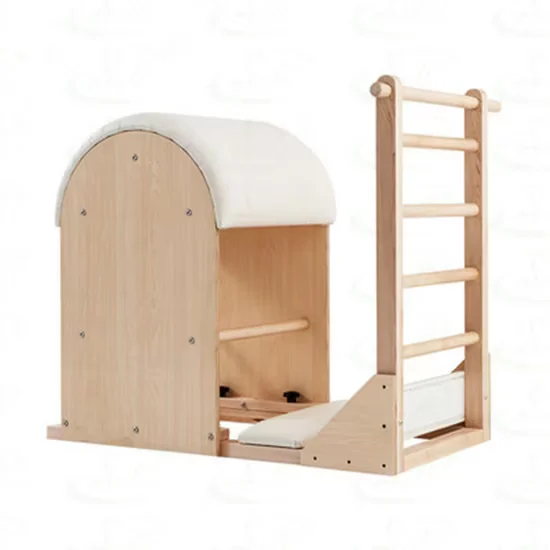
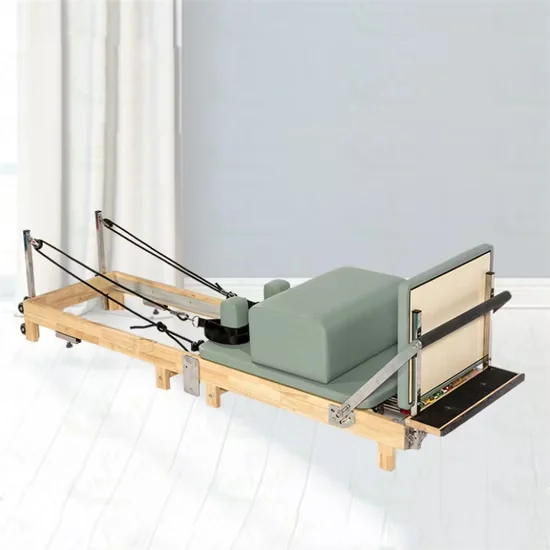
![Pilates Studio White Maple Wood Reformer Foldable Equipment [WARN] draft identifier mismatch](https://bicksport.com/wp-content/uploads/2026/08/pilates-studio-white-maple-wood-reformer-foldable-equipment-warn-draft-identifier-mismatch-2a8527.webp)
Solid Maple Vibration Damping — White maple wood frame absorbs structure-borne oscillation at the source, delivering quiet operation for shared-wall studios and noise-sensitive wellness spaces.
Technical Specifications
| Parameter | Value |
|---|---|
| Product Type | Pilates Reformer |
| Designation | SRY-20B |
| Frame Material | Solid White Maple Wood |
| Resistance Type | Spring |
| Product Dimensions | 2400 × 600 × 350 mm |
| Net Weight | 100 kg |
| Foldable | Yes |
| Accessories Included | Long Box / Jump Board / Platform |
| Customization | Available (logo, color) |
| Warranty | 3 Years |
Application Suitability
| Deployment Scenario | Typical Use |
|---|---|
| Boutique Pilates studio in shared commercial building | Group reformer classes requiring quiet carriage transitions between adjacent tenants |
| Five-star hotel wellness floor | Private and semi-private sessions with vibration isolation for guest rooms below |
| High-end residential home gym | Daily personal practice where wood aesthetics and acoustic signature align with interior standards |
| Corporate wellness center | Employee recovery and mobility sessions during work hours without disrupting nearby offices |
| Rehabilitation and physiotherapy clinic | Controlled spring-resistance therapy with stable carriage glide for post-injury programming |
Why Wood Frame Acoustics Matter More Than You Think in Multi-Story Studios
Maple absorbs vibration; steel transmits it straight through the floor slab.
Metal-frame reformers generate structure-borne noise every time the carriage reverses direction under spring load. In multi-story studio deployments, that vibration travels through floor slabs and shows up as complaints from tenants on the floor below — often before the studio owner even notices a pattern [NEED_CITE: structure-borne vibration transmission in multi-story fitness facilities]. The white maple wood pilates reformer commercial foldable frame addresses this at the material level: dense hardwood with natural cellular damping properties dissipates oscillation energy rather than conducting it downward. I have seen studios relocate entire reformer zones after noise complaints escalated within the first quarter of operation — a problem that traces back to frame material selection rather than maintenance failure.
Positioning Within a Studio Equipment Mix
This reformer covers the full spectrum of Pilates repertoire — footwork, long stretch, coordination, and advanced spring-loaded progressions — across beginner through athletic intensity ranges. Within a studio equipment layout, it pairs with Wunda chairs and Cadillac units to rotate members through apparatus circuits without bottlenecking on any single movement pattern. The 2400 mm rail length accommodates users across a wide height range, while the 100 kg net weight provides stable anchoring during dynamic Jump Board work. The foldable architecture allows studios to reconfigure floor space for mat classes or events without requiring a dedicated storage room. Studios targeting mixed-membership demographics benefit from the spring resistance system’s progressive tension curve, which scales load without requiring users to manually swap heavy components between sets. The white maple wood pilates reformer commercial foldable unit integrates into group class rotations where equipment must be reset quickly between sessions.
Continuous Studio Operation and Environmental Requirements
A boutique studio running four to six group classes daily places continuous fold-unfold and carriage cycle demands on hinge mechanisms and rail alignment. Wood frames respond to ambient humidity differently than steel: deployment in climates with seasonal moisture swings requires attention to indoor relative humidity stability to prevent frame warping that could introduce carriage drift [NEED_CITE: wood frame dimensional stability under fluctuating humidity conditions]. Floor surface preparation matters equally — an uneven subfloor transfers lateral load into the wood joinery over time, accelerating wear at stress points. Studios deploying on upper floors with occupied space below should pair the maple frame’s inherent damping with a dense rubber underlayment to further isolate residual spring recoil vibration. Spring housings benefit from periodic inspection for dust accumulation, which alters tension consistency across the resistance range when left unaddressed.
Spring Resistance and Carriage Engineering Decoded
Spring resistance on a Pilates reformer operates on a progressive tension curve — the further the carriage travels, the greater the load — which differs fundamentally from the linear resistance profiles of weight stacks or magnetic systems found on cardio machines. The spring count and individual spring stiffness determine the usable load range: lighter springs support rehabilitation and precision work, while heavier springs challenge athletic users during advanced footwork and pulling sequences. Carriage rail alignment is the single most critical tolerance specification: even minor deviation causes uneven glide, introducing lateral friction that members perceive as roughness and that accelerates wheel wear on one side. The foldable hinge mechanism must restore rail parallelism within tight tolerance after every fold-unfold cycle — a hinge that allows rail shift will generate inconsistent spring loading and premature carriage wheel degradation [NEED_CITE: reformer carriage rail alignment tolerance specifications]. Solid maple framing contributes rigidity that supports rail stability under the asymmetric loads generated during single-leg and unilateral exercises. Accessory mounting interfaces — for the Long Box, Jump Board, and Platform — must seat with zero play; loose-fit connections generate impact noise during dynamic movements and create safety risk under athletic loading.
The Hidden Cost of Spec Compromises on Studio Reformer Purchases
Studios that select reformers based on upfront price often absorb the real cost through maintenance downtime and member attrition. Hinge mechanisms that drift out of alignment after repeated folding cycles force the studio to pull units from rotation for recalibration — reducing available equipment during peak booking windows [NEED_CITE: Pilates studio equipment downtime impact on class scheduling]. Springs that lack sealed housings accumulate chalk dust and ambient particulates, shifting the tension curve unpredictably and forcing instructors to compensate verbally rather than relying on consistent resistance calibration. Wood frames sourced without documented moisture content specifications can develop surface checking or joint loosening in climates with humidity extremes, requiring refinishing or joinery repair within the first year of deployment. These failures do not appear in the showroom — they surface only after hundreds of class cycles reveal the gap between light-duty and studio-duty construction.
Why This Product Line Earns Its Place in Commercial Deployments
The solid maple frame on the SRY-20B has been selected specifically for its vibration damping contribution in noise-sensitive studio environments — not as an aesthetic afterthought. Spring resistance systems undergo tension consistency verification across the full range of motion after extended cycle simulation equivalent to years of studio class volume. The foldable mechanism is tested for hinge repeatability to confirm rail alignment holds through thousands of fold-unfold sequences without drift. Accessories — Long Box, Jump Board, Platform — ship with mounting interface tolerances specified and load-verified under dynamic movement conditions. OEM customization extends to logo application and frame color, allowing studio operators to maintain visual brand consistency across an equipment fleet. Biketon Sport’s engineering team provides 3D studio layout planning that accounts for reformer footprint, instructor sightlines, and member flow between apparatus stations — so the white maple wood pilates reformer commercial foldable deployment fits the room, not the other way around [NEED_CITE: Pilates studio layout planning for equipment spacing and airflow].
Documentation & Test Records
- CE declaration of conformity covering commercial Pilates apparatus safety requirements
- EN 957 test report validating structural integrity and load-bearing performance
- ISO 9001 certificate confirming quality management across manufacturing processes
- Spring tension consistency test record across full carriage travel range
- Foldable mechanism durability test log documenting hinge cycle count and rail alignment verification
- Accessory mounting interface load-bearing test report under dynamic exercise conditions
Installation, Commissioning & Maintenance
- Verify floor levelness within tolerance before placement; uneven subfloor induces lateral stress on maple joinery
- Maintain 1500 mm clearance on all sides for full-range carriage travel and instructor access during group classes
- Inspect carriage rail alignment and wheel condition monthly; recalibrate hinge mechanism if fold-unfold introduces drift
- Clean spring housings and carriage wheels quarterly to prevent particulate accumulation from altering tension consistency
- Monitor indoor relative humidity year-round; sustained extremes outside recommended range risk wood dimensional change
- Check accessory mounting interfaces for play before each class session; reseat Long Box and Jump Board if movement detected
Before You Request a Quote
Provide your studio floor dimensions and planned unit count so we can generate a 3D layout covering equipment spacing, instructor sightlines, and member circulation paths. Specify your average daily class schedule and session duration so we can confirm spring and hinge durability ratings match your operational volume. Identify the deployment floor and any occupied spaces directly below to determine whether supplemental floor underlayment is recommended alongside the maple frame’s inherent damping. Indicate your target market and whether logo or color customization applies to your order.
Frequently Asked Questions
Q: How does a solid maple wood frame compare to steel in terms of noise transmission in multi-story studio buildings?
A: Solid maple wood absorbs structure-borne vibration at the material level due to its natural cellular density, reducing the amount of spring recoil oscillation that transfers through the frame into the floor slab. Steel frames, by contrast, conduct vibration directly downward, which can trigger noise complaints from tenants on floors below. For studios operating above occupied spaces, the maple frame provides meaningful acoustic isolation without requiring supplemental damping modifications.
Q: What should I verify about the foldable mechanism before committing to a folding reformer for commercial class use?
A: Request the foldable mechanism durability test record showing cycle count before hinge wear or rail misalignment appears. The critical specification is whether the hinge restores rail parallelism within tolerance after every fold-unfold sequence — a hinge that allows drift will cause uneven carriage glide, inconsistent spring loading, and accelerated wheel wear. Studios running multiple daily classes will accumulate cycles quickly, making hinge repeatability the defining factor in long-term serviceability.
Q: How do I confirm that spring resistance remains consistent across the carriage range after extended use?
A: Ask the manufacturer for a spring tension consistency test report documenting progressive load measurements across full carriage travel after simulated high-cycle use. Springs in unsealed housings accumulate dust and chalk particulates over time, which alters the tension curve and forces instructors to compensate verbally. Sealed spring housings and documented tension verification give you a baseline to monitor against during routine maintenance intervals.
Q: What environmental factors affect wood frame longevity in studio deployments?
A: Ambient humidity stability is the primary factor — wood frames expand and contract with moisture fluctuation, and sustained extremes can cause surface checking, joint loosening, or rail alignment drift. Studios in tropical or heavily seasonal climates should maintain indoor relative humidity within a stable range and verify that the manufacturer documents wood moisture content at time of shipment. Floor surface levelness also matters, as uneven loading accelerates stress on joinery points.
Q: What are the accessory mounting requirements for safe Jump Board and Platform use under dynamic conditions?
A: Accessory mounting interfaces must seat with zero lateral play — any movement between the accessory and the frame generates impact noise during repetitive jumping or standing exercises and creates safety risk under athletic loading. Request the accessory load-bearing test report that documents performance under dynamic movement conditions. Before each class session, instructors should verify that the Long Box, Jump Board, and Platform remain securely seated with no detectable movement at the connection points.