
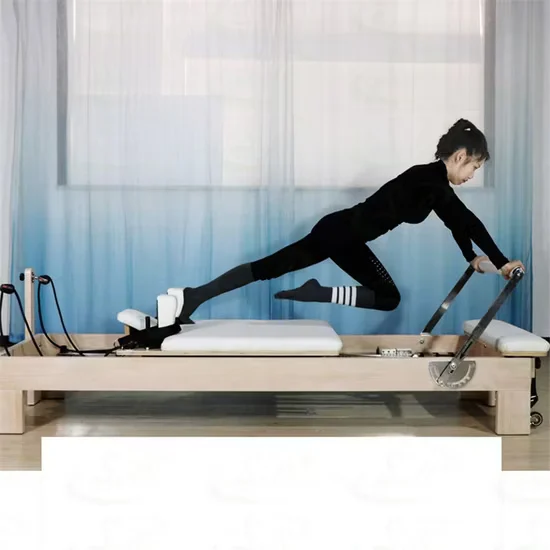
Acoustic Dampening Frame — Solid beech wood construction naturally absorbs carriage vibration, keeping studio noise away from adjacent rooms.
Technical Specifications
| Parameter | Value |
|---|---|
| Designation | SRY-02 |
| Product Type | Pilates Reformer |
| Frame Material | Solid Beech Wood |
| Color | Solid Color |
| Accessories Included | Long Box / Jump Board / Platform |
| Product Dimensions | 2460 × 730 × 680 mm |
| Net Weight | 100 kg |
| Warranty | 3 Years |
| Production Capacity | 80 Pieces / Month |
| HS Code | 9506911900 |
Application Suitability
| Deployment Scenario | Typical Use |
|---|---|
| Boutique Pilates studio | Full-spectrum reformer classes running 8+ hours daily with frequent accessory changes |
| Multi-disciplinary fitness center | Reformer-based rehabilitation and athletic conditioning alongside existing cardio zones |
| High-end residential wellness suite | Quiet carriage operation in shared buildings where noise travels through floor assemblies |
| Hotel guest floor fitness room | Durable wood frame equipment accessible to guests without dedicated instructor scheduling |
| Private home gym | Stable 100 kg base suitable for residential floors without structural bolting |
Why Carriage Noise Reaches the Studio Next Door Before the Owner Hears It
Metal-on-metal carriage systems transmit spring resonance directly into floor assemblies, turning every repetition into a structural vibration complaint.
In multi-tenant wellness buildings, the first signal of equipment failure rarely comes from the maintenance team. It comes from the tenant below. Pilates reformers with hollow aluminum frames and steel rail carriages generate low-frequency resonance that travels through concrete slabs and wooden joists with surprising efficiency. Over years of visiting studio build-outs across European and North American trade shows, I have seen entire reformer fleets pulled from upper-floor installations because the vibration complaints became unmanageable [NEED_CITE: vibration transmission standards for fitness equipment in multi-tenant buildings]. The issue is not the spring tension itself but the frame’s inability to absorb and dissipate the kinetic energy before it reaches the building structure. A solid beech wood frame addresses this at the material level, using the natural density and grain structure of hardwood to dampen oscillation before it couples with the floor.
Where This Reformer Fits Within a Studio Equipment Layout
This commercial Pilates reformer beech wood model occupies the conditioning and rehabilitation tier of a studio equipment plan. It pairs with mat-based programming for introductory sessions and transitions into advanced apparatus work as clients progress through resistance levels. The modular accessory system — long box for supine series, jump board for plyometric loading, platform for standing work — allows instructors to program full sessions without moving clients between machines. The 2460 mm length accommodates users across a wide height range, and the 100 kg net weight provides a stable base that stays put during dynamic jump board sequences. In a commercial cardio and conditioning zone, this unit complements treadmill and cycling stations by offering low-impact resistance work that balances high-intensity intervals with controlled eccentric loading.
Continuous Studio Scheduling and Floor Deployment Requirements
A reformer in a busy studio runs through eight to twelve sessions per day, with carriage bearings and spring sets cycling through thousands of repetitions weekly. The solid beech frame handles this density without the fatigue cracking that appears in laminated wood alternatives after sustained loading. Deployment on upper floors requires attention to subfloor rigidity — a flexible floor assembly amplifies carriage noise regardless of frame material [NEED_CITE: floor deflection limits for commercial fitness equipment placement]. Ground-level studios with concrete slabs present fewer vibration concerns but benefit from leveling pads to prevent frame twist on uneven surfaces. Ambient temperature and humidity control matter for beech wood: environments that swing between dry winter heating and humid summer conditions can cause gradual grain movement, so climate-controlled rooms maintain dimensional stability over the warranty period. Standard single-phase power is not required, as this is a purely mechanical apparatus with no motorized components.
Reading the Wood Grain and Rail Specification
The choice of solid beech over birch laminate or hollow steel is fundamentally an acoustic and structural decision. Beech has a tight, uniform grain pattern that distributes load evenly along the frame rails, reducing the localized stress points where carriage wheels generate noise under lateral load. The rail surface finish determines carriage smoothness — precision-machined rails with sealed bearings produce quiet, consistent travel through the full range of motion, while rough-cut rails develop wear grooves that amplify noise over time. Spring tension progression across the included set allows instructors to calibrate resistance incrementally, which matters for rehabilitation protocols where sudden load increases compromise joint safety. The accessory attachment points — long box rails, jump board brackets, platform mounts — must withstand repetitive insertion and removal without developing play that generates rattling during use.
The Hidden Cost of Underspecified Studio Equipment
Studios that purchase reformers based on price alone often discover the real cost six months later. Frames built from plywood composites or thin-walled steel develop carriage wobble as attachment points loosen under daily class turnover. Spring sets without calibrated tension progression force instructors to improvise resistance levels, creating inconsistent client experiences and increasing injury risk during unsupervised open studio hours [NEED_CITE: injury reporting trends in group reformer classes with variable equipment quality]. Noise complaints in multi-tenant buildings escalate from informal requests to lease enforcement actions when the source equipment cannot be silenced through maintenance alone. The expense of pulling an entire reformer fleet, storing it, and sourcing replacements far exceeds the initial price difference between underspecified and properly engineered units.
Why This Product Line Earns Studio Floor Space
The sub-35dB acoustic standard that defines our cardio engineering carries directly into this reformer’s design philosophy — every material choice targets vibration reduction at the source. The beech wood frame, sealed carriage bearings, and precision spring anchors work together to keep operational noise contained within the studio footprint. Our 10,000-hour durability testing protocols for motors and drive systems inform how we evaluate mechanical wear points on spring-loaded apparatus, ensuring carriage rails and attachment brackets perform through years of class scheduling. The complete six-series cardio family means facilities sourcing reformer conditioning can align equipment procurement, layout planning, and technical support under one production line. Free 3D layout and airflow planning covers reformer spacing requirements alongside treadmill and cycling clearances, ensuring member flow and ventilation work together across the full conditioning zone [NEED_CITE: equipment spacing requirements for commercial Pilates studios].
Documentation & Test Records
- CE declaration of conformity covering mechanical safety requirements for studio apparatus
- EN 957 test report validating structural load capacity and stability under dynamic use
- ISO 9001 certificate documenting quality management across production and assembly
- Noise level test record measuring carriage and spring resonance under loaded operation
- Durability test record tracking carriage bearing and spring fatigue through extended cycling
- Spring tension specification sheet with calibrated resistance values across the full set
Installation, Commissioning & Maintenance
- Maintain minimum 600 mm clearance on all sides for instructor access and accessory swaps around the 2460 × 730 mm footprint
- Install on level surfaces using adjustable leveling pads to prevent beech frame twist and carriage tracking drift
- Inspect carriage bearing smoothness and rail surface condition monthly under commercial scheduling loads
- Verify spring tension calibration quarterly and replace individual springs showing permanent elongation or corrosion
- Clean beech wood surfaces with pH-neutral solutions only; avoid petroleum-based products that degrade wood grain finish
- Check all accessory attachment brackets for fastener torque after every 500 hours of scheduled class use
Equipment Selection and Studio Planning Inquiry
Provide your studio floor plan with square footage and ceiling height to receive a 3D layout showing reformer spacing, instructor circulation paths, and accessory storage zones. Specify your daily class schedule and average sessions per unit so we can match spring set durability to your operational density. Confirm the deployment floor level and adjacent room usage so we can advise on vibration isolation requirements for the beech wood frame. Indicate your target market region so accessory documentation and warranty support align with local regulatory expectations.
Frequently Asked Questions
Q: How does a solid beech wood frame compare to metal for noise reduction in multi-tenant buildings?
A: Beech wood absorbs vibration through its natural grain density rather than transmitting it like hollow steel or aluminum frames. In upper-floor studio deployments, this material property reduces the low-frequency resonance that travels through floor assemblies and triggers noise complaints from tenants below. Metal frames can be isolated with aftermarket dampening pads, but solid wood addresses the issue at the structural level without adding separate isolation components.
Q: What is the spring tension maintenance schedule for commercial studio scheduling?
A: Springs under daily class use should be inspected for tension consistency and permanent elongation every quarter. Individual springs showing visible deformation, corrosion, or measurable loss of return force should be replaced rather than recalibrated. The spring attachment anchors on the beech frame should be checked for secure fastening at the same interval, as repetitive loading cycles can gradually loosen hardware over extended operation.
Q: Are the long box, jump board, and platform interchangeable between sessions?
A: Yes, all three accessories attach and detach through standardized mounting points designed for quick turnover between class formats. The attachment mechanism uses positive-lock brackets that secure without tools, allowing instructors to swap accessories during session transitions. Each accessory mounts to the same rail interface, maintaining alignment and preventing the lateral play that generates noise during dynamic movement sequences.
Q: What floor loading and vibration isolation requirements apply to upper-floor installation?
A: The 100 kg net weight distributes across the full frame footprint, producing floor loading well within standard commercial floor capacity ratings. Upper-floor installations benefit from rigid subfloor assemblies — flexible joist systems can amplify carriage vibration regardless of frame material. Rubber isolation pads beneath the frame feet decouple residual vibration from the floor surface and are recommended for any deployment above ground level.
Q: What does the 3-year warranty cover on frame, carriage, and spring components?
A: The warranty covers structural defects in the beech wood frame, carriage rail machining tolerances, and spring tension calibration under normal commercial use conditions. Consumable items such as spring sets and carriage bearing surfaces are covered against premature failure but are expected to show gradual wear proportional to usage volume. Warranty support includes replacement parts and technical guidance for on-site repair rather than full unit return.
![Commercial White Aluminum Pilates Reformer with Half Trapeze Tower [WARN] draft identifier mismatch](https://bicksport.com/wp-content/uploads/2026/08/commercial-white-aluminum-pilates-reformer-with-half-trapeze-tower-warn-draft-identifier-mismatch-390370.webp)


![Senrui SRY-20B Maple Oak Wood Folding Pilates Reformer for Studio Use [WARN] draft identifier mismatch](https://bicksport.com/wp-content/uploads/2026/08/senrui-sry-20b-maple-oak-wood-folding-pilates-reformer-for-studio-use-warn-draft-identifier-mismatch-4e68a8.webp)