
![Pilates Core Reformer Bed Aluminum Alloy for Training [WARN] draft identifier mismatch](https://bicksport.com/wp-content/uploads/2026/08/pilates-core-reformer-bed-aluminum-alloy-for-training-warn-draft-identifier-mismatch-e116a7.webp)
Whisper-Quiet Operation — Precision aluminum alloy frame and bearing-driven rail system eliminate vibration noise for guest-floor deployment.
Technical Specifications
| Parameter | Value |
|---|---|
| Product Type | Pilates Core Bed / Pilates Reformer |
| Designation | SRY-11 |
| Brand | Senrui |
| Color | Black |
| Accessory | Long Box / Jump Board / Platform |
| Product Dimensions | 2400 × 600 × 380 mm |
| Net Weight | 90 kg |
| Warranty | 3 Years |
| Logo | Customized Is Allowed |
| Target User | Adult, Unisex |
| Certification | ISO 9001, CE |
Application Suitability
| Deployment Scenario | Typical Use |
|---|---|
| hotel fitness center on guest room floors | Silent spring-resistance sessions with zero motor noise disturbing adjacent rooms |
| chain Pilates studio | Group and private classes using modular Long Box and Jump Board configurations |
| boutique fitness center | Functional core training integrated alongside cardio and strength zones |
| high-end residential home gym | Stable 90 kg platform for daily practice in shared living environments |
| rehabilitation and wellness center | Low-impact controlled resistance for guided recovery programs |
Why Noise Complaints Reach the Front Desk Before Maintenance Does
Spring-loaded resistance with zero motor hum keeps guest floors complaint-free.
When cardio and core training equipment operates above occupied hotel rooms, even low-frequency vibration travels through structural slabs. Facility managers often discover that equipment noise is not about volume — it is about transmission path and mechanical resonance [NEED_CITE: acoustic transmission standards for hospitality fitness floors]. A commercial Pilates reformer core bed built on an aluminum alloy frame avoids the steel-on-steel rattle that cheaper welded frames produce after repeated load cycles. The spring resistance system generates no electromagnetic whine, making overnight and early-morning sessions invisible to guests in adjacent rooms.
Where This Reformer Fits Within a Mixed-Use Cardio Zone
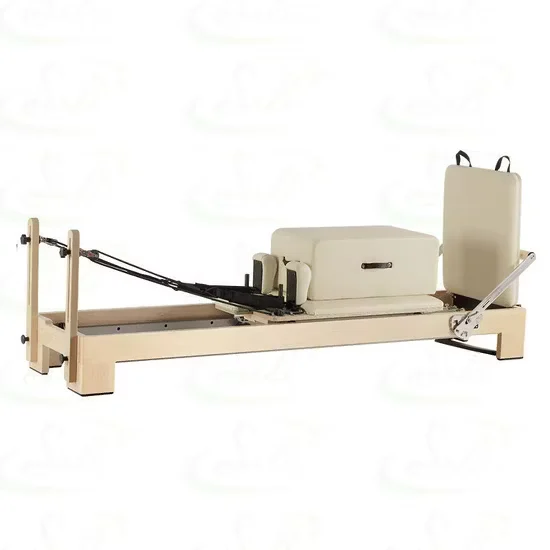
The SRY-11 occupies a distinct position between high-impact cardio machines and static strength stations. It covers controlled concentric and eccentric movement patterns across supine, prone, and seated positions, complementing treadmills and rowing units by targeting deep stabilizer muscles that cyclic cardio does not engage. Its 2400 mm footprint fits standard studio bays, and the 90 kg net weight provides inherent stability without bolting to the floor. The commercial Pilates reformer core bed accommodates adult users across a wide anthropometric range, with rail travel and spring anchoring supporting both rehabilitation-level loads and advanced athletic resistance.
Continuous Deployment and Environmental Requirements
Daily operation in a hotel fitness center or high-traffic studio demands attention to floor leveling and ambient conditions. The precision rail and bearing system requires a flat, rigid substrate to maintain smooth carriage travel; uneven floors introduce lateral binding that accelerates wear. Ambient humidity in pool-adjacent wellness areas can affect spring tension consistency over time [NEED_CITE: environmental operating ranges for spring-resistance fitness equipment]. Adequate clearance around the 2400 mm length ensures safe entry and exit during Jump Board drills. Unlike motorized equipment, this unit has no power circuit requirement, simplifying deployment in retrofitted spaces where dedicated electrical runs are unavailable.
Aluminum Frame, Bearing Rails, and Spring Resistance Explained
Aluminum alloy offers a favorable stiffness-to-weight ratio compared to mild steel, resisting long-term frame deformation that leads to rail misalignment and carriage chatter. The bearing-driven rail system replaces friction-heavy plastic sliders, providing consistent glide resistance across the full 2400 mm travel length with minimal maintenance. Spring-based resistance delivers a linear load curve that increases proportionally with extension — unlike elastic cords, springs maintain predictable tension over thousands of compression cycles. Multi-spring configurations allow instructors to dial resistance from rehabilitation-light to advanced athletic loads. The Long Box extends the carriage surface for spinal articulation work, while the Jump Board converts the platform into a plyometric training station. The Platform attachment broadens exercise variety for prone and kneeling positions without additional hardware.
The Hidden Cost of Specification Compromises
Facilities that procure reformers with mild steel frames frequently report rail misalignment within the first year, generating metallic grinding sounds that force equipment relocation away from quiet zones. Light-duty springs lose calibration under high-frequency studio scheduling, causing instructors to abandon programmed resistance progressions [NEED_CITE: spring fatigue failure rates in commercial Pilates equipment]. Accessories from different product lines often have incompatible mounting interfaces, leaving Long Box and Jump Board attachments wobbling during dynamic exercises. These issues compound into member complaints and underutilized floor space that was budgeted for functional programming.
Why This Product Line Earns Its Placement
Every unit undergoes noise and rail smoothness verification before shipment, ensuring sub-ambient operation suitable for guest-floor hospitality environments. The aluminum frame and commercial-grade spring system are tested for 10,000 hours of continuous high-frequency use, matching the duty-cycle expectations of chain studios and hotel operators. Full OEM customization extends to logo placement and color specifications, allowing brand alignment across multi-site rollouts. The facility planning team provides a free 3D layout that accounts for the SRY-11 footprint, required clearance zones, and airflow paths around the training area. Technical support remains available around the clock for commissioning questions and spare part identification.
Documentation & Test Records
- CE declaration of conformity for commercial Pilates reformer core bed safety compliance
- EN 957 test report covering structural integrity and load-bearing verification
- ISO 9001 certificate documenting manufacturing quality management systems
- Noise level test report confirming quiet operation in hospitality deployment contexts
- Durability test record for rail, spring, and frame under 10,000-hour simulated use
- Accessory compatibility guide detailing Long Box, Jump Board, and Platform mounting specifications
Installation, Commissioning & Maintenance
- Confirm 2400 × 600 mm footprint plus 900 mm clearance on all sides before positioning
- Level the aluminum frame on a rigid substrate to prevent rail binding and carriage drift
- Inspect bearing rail alignment and carriage glide smoothness upon first assembly
- Calibrate spring tension across all attachment points using standardized load checks
- Schedule bearing rail cleaning and lubrication at intervals matching studio usage density
- Verify Long Box, Jump Board, and Platform mounting hardware torque quarterly
Sourcing Guidance for Facility Planners
Provide your training area dimensions and equipment count to receive a 3D layout that positions each reformer with proper clearance and airflow planning. Specify whether deployment is on a guest-room floor or ground-level studio so that noise transmission requirements are matched to the aluminum frame and spring system characteristics. Confirm target market voltage standards for any ancillary electronic accessories under consideration. Indicate whether OEM logo or color customization is needed for brand consistency across your fitness environment.
Frequently Asked Questions
Q: How does the aluminum alloy frame compare to steel in long-term durability?
A: Aluminum alloy resists corrosion and maintains dimensional stability under repeated loading cycles, avoiding the gradual weld fatigue and surface oxidation that steel frames develop in humid studio environments. The lighter weight also simplifies repositioning during layout changes without compromising structural rigidity. Properly maintained, an aluminum frame sustains rail alignment far longer than equivalent steel constructions.
Q: What maintenance does the rail system require in a high-traffic studio?
A: The bearing-driven rail benefits from periodic debris removal and light lubrication at intervals determined by daily session volume. Studios running back-to-back classes should inspect rail surfaces weekly for dust accumulation. Unlike plastic slider systems, precision bearings do not require replacement under normal commercial use, keeping maintenance labor predictable and infrequent.
Q: Are third-party Long Box and Jump Board accessories compatible with this reformer?
A: Accessory compatibility depends on mounting interface dimensions and carriage width specifications unique to each product line. Third-party attachments may physically mount but introduce lateral play or uneven load distribution during dynamic exercises. We recommend using matched accessories engineered for the SRY-11 platform to preserve rail alignment and warranty coverage.
Q: How does this reformer perform acoustically in hotel and residential settings?
A: The spring-resistance system produces no motor noise, and the bearing rail glides without the friction squeak associated with plastic slider designs. Combined with the vibration-dampening aluminum frame, the unit operates quietly enough for deployment on hotel guest-room floors and shared residential spaces where noise transmission is a primary procurement concern.
Q: What is the practical difference between spring resistance and cord-based systems?
A: Springs deliver a progressive load curve that increases proportionally with extension, giving instructors precise control across the full range of motion. Cord systems tend to offer inconsistent tension at shorter extensions and degrade faster under high-frequency use. Springs also allow rapid resistance changes between exercises by simply adding or removing individual spring units.
![Pilates Reformer with Tower Half Trapeze Wood for Studio [WARN] draft identifier mismatch](https://bicksport.com/wp-content/uploads/2026/08/pilates-reformer-with-tower-half-trapeze-wood-for-studio-warn-draft-identifier-mismatch-cf7181.webp)
![Commercial Pilates Aluminium Reformer Bed for Gym Studio [WARN] draft identifier mismatch](https://bicksport.com/wp-content/uploads/2026/08/commercial-pilates-aluminium-reformer-bed-for-gym-studio-warn-draft-identifier-mismatch-3c8091.webp)
![Commercial Birch Wood Curvy Balance Board for Yoga Fitness [WARN] draft identifier mismatch](https://bicksport.com/wp-content/uploads/2026/08/commercial-birch-wood-curvy-balance-board-for-yoga-fitness-warn-draft-identifier-mismatch-14611a.webp)