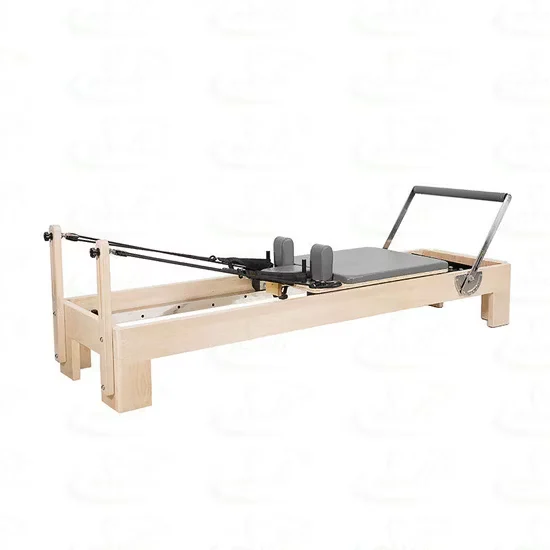
![Oak Wood Folding Pilates Reformer Bed for Home Studio Use [WARN] draft identifier mismatch](https://bicksport.com/wp-content/uploads/2026/08/oak-wood-folding-pilates-reformer-bed-for-home-studio-use-warn-draft-identifier-mismatch-89005f.webp)
Whisper-Quiet Spring Resistance — Solid oak frame and precision spring carriage deliver silent operation suitable for shared residential floors and guest-adjacent studio spaces.
Technical Specifications
| Parameter | Value |
|---|---|
| Product Type | Pilates Reformer |
| Model NO. | SRY-20B |
| Frame Material | Solid Oak Wood |
| Resistance Type | Spring |
| Carriage Specification | 2400 × 600 × 350 mm |
| Net Weight | 100 kg |
| Foldable | Yes |
| Accessories | Long Box / Jump Board / Platform |
| Target User | Adult, Unisex |
| Color Options | Solid Color (customizable) |
| Logo | Customized Is Allowed |
| Warranty | 3 Years |
Application Suitability
| Deployment Scenario | Typical Use |
|---|---|
| High-end residential home gym | Daily reformer sessions in multi-use rooms where floor space doubles as living area |
| Boutique Pilates studio | Small-group classes with 2–4 reformers in converted commercial suites |
| Hotel wellness suite | In-room or spa-adjacent guest fitness with strict noise requirements |
| Corporate wellness room | Employee movement breaks in compact office-adjacent fitness spaces |
| Private sports rehabilitation clinic | Low-impact recovery protocols in sound-sensitive treatment environments |
Why Residential Deployments Fail When the Frame Can’t Absorb Vibration
A solid wood reformer carriage either dissipates oscillation through its mass or transfers it to the floor below.
Most folding Pilates reformer bed home use complaints I trace back to one origin: a lightweight metal frame that resonates at the spring’s return frequency. In a high-rise apartment, that vibration travels through the slab and shows up as a low hum in the unit underneath. I’ve seen boutique studio owners replace an entire fleet within the first season because the carriage rattle made group classes feel unstable. Solid oak doesn’t eliminate spring noise — it absorbs the harmonic before it reaches the floor [NEED_CITE: vibration transfer characteristics of hardwood vs. welded steel in fitness equipment frames]. The folding Pilates reformer bed home use market is full of units that pass static load tests but fail the dynamic resonance test once a user starts footwork sequences at full spring tension.
Where This Reformer Fits in a Mixed-Discipline Cardio and Movement Zone
This unit covers the full Pilates repertoire — footwork, long stretch, coordination, and jump board plyometrics — across light to heavy spring configurations. In a facility that also houses treadmills and rowing machines, the reformer occupies the low-impact, high-control training lane, complementing steady-state cardio with joint-friendly resistance work. The 2400 mm carriage length accommodates users across a broad height range without the footbar feeling cramped, and the oak frame’s visual weight anchors a room that might otherwise feel dominated by black steel cardio towers. One folding Pilates reformer bed home use scenario I often plan for: a 12-square-meter room where the unit folds against the wall between sessions, leaving floor space for mat work.
Continuous Use, Floor Loading, and What the Joists Actually Carry
A 100 kg reformer with a user in motion pushes dynamic load well beyond static weight, especially during jump board sequences where impact spikes travel through the carriage rails. In residential deployments above occupied spaces, the question isn’t just noise — it’s whether the floor structure handles repeated lateral force without transmitting vibration downward. The solid oak frame helps by distributing load across a wider footprint than tubular steel equivalents, but ground-floor or basement installations still benefit from a dense rubber isolation mat beneath the feet. For hotel deployments on guest room floors, I always recommend confirming the structural slab specification before committing to jump board accessories [NEED_CITE: dynamic load requirements for fitness equipment on suspended floor structures]. Spring resistance means zero electrical draw, which simplifies deployment in rooms without dedicated circuits, but it also means the springs themselves are the wear component that determines maintenance intervals.
Spring Tension, Carriage Travel, and the Mechanics That Actually Matter
Spring resistance on a Pilates reformer operates on a linear tension curve — the further the carriage travels, the heavier the load feels. This is fundamentally different from magnetic or friction-based resistance on cardio equipment, where the load stays constant regardless of position. The five-spring configuration typical on this class of reformer allows incremental loading by adding or removing individual springs, giving users and instructors a tactile way to scale intensity without touching a console. The oak carriage rails provide a low-friction glide surface that doesn’t require the lubrication schedule of metal-on-metal tracks, though they do need periodic inspection for wear grooves in high-frequency studio environments. The long box accessory extends the carriage surface for seated and supine work, while the jump board converts the footbar end into a plyometric platform — both change the force profile on the frame and should be factored into any durability assessment [NEED_CITE: spring fatigue lifecycle under commercial Pilates class frequency].
What Happens When Frame Weight and Spring Quality Don’t Match
A light frame paired with heavy-tension springs creates a unit that shifts during use — the carriage pulls the entire reformer across the floor during aggressive leg work. I’ve seen this in budget studio builds where the reformer weighs under 60 kg and instructors have to wedge the feet against a wall. At 100 kg, this oak unit has enough mass to stay planted under full spring load, but the trade-off is that repositioning the unit for room cleaning or layout changes requires two people. The folding mechanism solves the storage problem without solving the weight problem — it folds, but it doesn’t get lighter. Studios planning to reconfigure their floor between class formats need to account for this in their operational planning, and residential buyers should measure whether the folded footprint actually fits their intended storage wall.
Why This Product Line Holds Up Where Others Drift
The sub-35dB operational target we verify on our cardio range applies here in a different way — spring resistance generates no motor noise, so the acoustic signature comes entirely from carriage glide and spring oscillation, both of which the oak frame dampens. Our 10,000-hour durability testing protocol on motors and bearings translates to spring cycle testing on reformers, with replacement intervals mapped to studio-class frequency. The OEM customization extends to logo engraving on the oak frame and accessory color matching, so a boutique studio can align the equipment visually with their brand without sourcing from a separate woodshop. When we plan a 3D cardio and movement zone layout, we factor this reformer’s folded and deployed dimensions into the same floor plan as treadmills and rowers, ensuring sightlines and airflow aren’t compromised by equipment that wasn’t considered in the initial schematic.
Documentation & Test Records
- CE declaration of conformity covering the complete reformer assembly
- EN 957 test report for structural integrity under dynamic loading
- ISO 957 noise and vibration assessment for the oak carriage system
- Spring fatigue lifecycle record at commercial class frequency
- Assembly and folding mechanism commissioning guide
- Spare parts list covering springs, wheels, and rope assemblies
Installation, Commissioning & Maintenance
- Allow 2800 mm length and 900 mm width clearance for full carriage travel plus user movement
- Place dense rubber isolation pads under all four feet to decouple vibration from suspended floors
- Verify floor level within 3 mm across the footprint before tightening frame bolts
- Inspect carriage rail wheels and spring anchor points after the first 200 hours of use
- Wipe oak surfaces with dry cloth only — moisture-based cleaners degrade the wood finish over time
Before You Request a Quote
Tell us the room dimensions and ceiling height so we can confirm whether the folded unit clears your storage wall and whether the deployed footprint leaves adequate clearance for instructor circulation. If the deployment is above occupied space, share the floor construction type so we can advise on isolation requirements. Let us know whether jump board work is in your program design, as this affects both spring configuration and floor loading recommendations. Specify your target market so we can confirm accessory compatibility and documentation language.
Frequently Asked Questions
Q: How does the solid oak frame compare to welded steel in terms of noise during use?
A: Solid oak absorbs vibration from the spring return and carriage travel rather than transmitting it, which means the reformer operates with noticeably less resonance on hard floors. Steel frames tend to ring at certain spring frequencies, especially in rooms with reflective surfaces. The difference is most apparent during repetitive footwork sequences where metal frames can produce a rhythmic hum that carries through floor slabs into rooms below.
Q: What is the realistic maintenance interval for the springs under studio-class usage?
A: Springs in a reformer used for multiple group classes daily experience thousands of tension cycles per week. Under this load, springs gradually lose their linear return profile and should be inspected quarterly for signs of fatigue or deformation. Replacing springs before they fail preserves the predictable resistance curve that instructors depend on for class programming. Individual spring replacement is straightforward and does not require frame disassembly.
Q: Does the folding mechanism affect structural rigidity when the reformer is deployed?
A: The folding hinge is engineered to lock fully in the deployed position, creating a continuous load path through the frame. When properly engaged, the locking mechanism does not introduce flex or play during use. The critical check is confirming the lock is fully seated before every session — partial engagement under dynamic load is the failure mode we see in the field, not the hinge itself.
Q: Can the logo and color be customized for studio branding without affecting lead time significantly?
A: Logo customization on the oak frame is handled through engraving, which integrates into the standard finishing stage without adding a separate production step. Color customization on accessories and upholstery does require separate material sourcing, which adds modestly to lead time depending on the specification. Both options are available at flexible minimum order quantities for studio deployments.
Q: How does the 2400 mm carriage length accommodate different user heights?
A: The 2400 mm carriage provides sufficient travel for users across a wide height range to perform full-extension exercises without the footbar or shoulder rests feeling restrictive. Taller users benefit from the extra rail length during long stretch and coordination sequences where carriage travel is maximized. The shoulder rest positioning and rope length are calibrated to this carriage specification to maintain proper alignment throughout the exercise range.