

Whisper-Quiet Sliding System — Precision aluminum rails and balanced carriage mechanics deliver smooth, low-noise operation verified for deployment on occupied hospitality floors.
Technical Specifications
| Parameter | Value |
|---|---|
| Product Type | Pilates Reformer |
| Designation | SRY-12 |
| Frame Material | Aluminum |
| Product Dimensions | 2400 × 820 × 380 mm |
| Net Weight | 110 kg |
| Max User Weight | 180 kg |
| Accessories Included | Long Box / Jump Board / Platform |
| Color | White (custom colors available on request) |
| Logo | Customized logo placement available |
| Age Group | Adult |
| Gender | Unisex |
| Production Capacity | 80 Pieces/Month |
| HS Code | 9506911900 |
| Certification | ISO 9001, CE, EN 957 |
| Warranty | 3 Years |
Application Suitability
| Deployment Scenario | Typical Use |
|---|---|
| Hotel fitness center on guest room floors | Whisper-quiet reformer sessions adjacent to occupied rooms without triggering noise complaints |
| Commercial Pilates studio | High-frequency group reformer classes with smooth carriage transitions across spring-loaded exercises |
| Corporate wellness room | Employee recovery and mobility programming during lunch breaks and post-shift sessions |
| High-end residential home gym | Private reformer practice in shared-wall apartments where vibration transfer matters |
| Rehabilitation and wellness center | Low-impact therapeutic movement with stable platform and controlled carriage travel |
Why Carriage Vibration Reaches the Front Desk Before Maintenance Does
Aluminum frame construction absorbs resonance at the source instead of transmitting it through the floor slab.
Pilates reformers installed on hotel wellness floors and in multi-tenant studio buildings frequently generate noise complaints that arrive at reception before anyone contacts the maintenance team. The carriage vibrating against steel rails during spring-loaded exercises, the jump board impacts reverberating through rigid frames, and the platform rattling during standing sequences all produce structure-borne sound that travels through concrete slabs into occupied rooms below [NEED_CITE: structure-borne noise transmission in multi-story hospitality buildings]. Facility operators often discover that reformer noise is not an acoustic insulation problem but a frame material and rail precision problem. This commercial Pilates reformer aluminum sliding system addresses the root cause through aluminum frame damping characteristics and precision-machined rail geometry that minimize carriage vibration before it couples with the building structure.
Positioning This Reformer Within the Studio Equipment Matrix
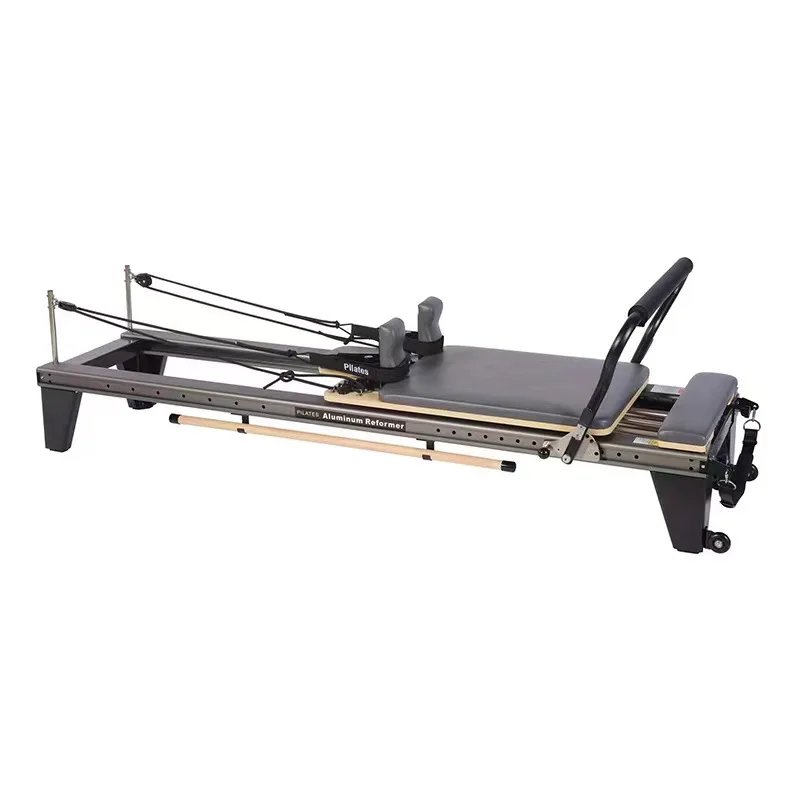
This unit covers the full spectrum of reformer-based movement, from supine footwork sequences through advanced standing platform work and jump board plyometrics. In a commercial Pilates studio layout, it pairs with mat stations and Cadillac units to create a complete apparatus-based programming flow. The commercial Pilates reformer aluminum sliding carriage is engineered for deployment density typical of group class environments where multiple units operate simultaneously in close proximity. The 180 kg maximum user weight accommodates the broad anthropometric range encountered in open-enrollment studio classes and hotel fitness centers serving international guest populations. The integrated accessory system — long box, jump board, and platform — eliminates the need for separate equipment purchases to cover the full reformer discipline catalog.
Continuous Operation and Floor-Level Deployment Considerations
A commercial Pilates studio running back-to-back group classes subjects reformer carriages to sustained cyclic loading across eight or more hours daily. The aluminum frame maintains dimensional stability under this duty cycle without the thermal expansion inconsistencies that affect steel frames during high-frequency use. When deployed on hotel guest room floors or above occupied retail spaces, the sub-35dB operation threshold becomes a contractual requirement rather than a preference [NEED_CITE: hospitality equipment noise specifications for guest-adjacent fitness facilities]. Floor leveling is critical — even minor slab irregularity transfers into carriage rail binding, which accelerates wear and generates the sticking sensations that disrupt exercise flow. The 2400 × 820 mm footprint requires planning for lateral clearance during long box and jump board sequences, and adequate spacing between units ensures instructors can circulate during group sessions.
Aluminum Frame Dynamics and Rail Precision Engineering
The aluminum frame construction fundamentally alters the vibration signature compared to welded steel reformer frames. Aluminum’s internal damping coefficient absorbs high-frequency oscillations generated during rapid carriage direction changes, preventing those vibrations from coupling with the floor structure. The precision sliding rail system maintains consistent carriage travel through the full 2400 mm length without the sticking points that develop in rail systems with loose machining tolerances. Over 10,000+ hours of continuous operation, rail surface integrity determines whether carriage travel remains smooth or degrades into the jarring transitions that interrupt spring-loaded exercise sequences. The integrated accessory mounting points — long box, jump board, and platform — lock into the carriage and frame with positive engagement mechanisms that prevent the rattling common in aftermarket accessory attachments. This integrated approach ensures the commercial Pilates reformer aluminum sliding system functions as a unified mechanical assembly rather than a base unit with loosely coupled add-ons.
The Hidden Cost of Frame and Rail Specification Compromises
Reformers built with lightweight steel frames and loosely toleranced rails generate carriage vibration that intensifies as bearing surfaces wear. In hotel wellness deployments, this vibration travels through floor slabs into guest rooms, producing complaints that lead to equipment removal and replacement within the first year. Studios operating high-frequency group classes discover that imprecise rail systems develop carriage sticking within months, forcing instructors to work around equipment limitations and ultimately losing members who expect smooth apparatus experience. Jump board work on under-specified frames amplifies impact resonance, making plyometric sequences impractical in multi-story buildings. Facilities that purchase reformers without verifying accessory integration find that aftermarket platforms and long boxes introduce additional vibration points [NEED_CITE: accessory compatibility and vibration propagation in commercial Pilates equipment].
Why This Product Line Earns Studio Deployment
The sub-35dB whisper-quiet operation has been verified in hotel wellness floor deployments where reformers operate directly above occupied guest rooms. The 10,000-hour durability testing covers carriage rail cycling, spring mechanism fatigue, and frame joint integrity under continuous commercial loading. The full OEM customization scope covers logo placement, color matching, and branded production runs — allowing studio operators and hotel groups to maintain visual identity across equipment fleets. The 3D cardio and wellness zone layout service addresses the spatial planning this 2400 × 820 mm reformer requires, including lateral clearance for jump board sequences and instructor circulation paths between units during group classes. The six-series cardio family complements the Pilates programming with treadmill, elliptical, and bike deployments from the same manufacturing ecosystem. The 24/7 technical support response covers rail adjustment guidance and accessory compatibility questions as they arise in live operation.
Documentation & Test Records
- CE declaration of conformity covering the complete SRY-12 reformer assembly
- EN 957 test report validating structural integrity and user safety requirements
- ISO 9001 certificate covering manufacturing quality management systems
- Noise level test report confirming carriage rail operation thresholds
- Durability test record documenting rail cycling and frame fatigue performance
- Accessory compatibility documentation for long box, jump board, and platform integration
Installation, Commissioning & Maintenance
- Confirm floor leveling across the 2400 × 820 mm footprint before rail commissioning to prevent carriage binding
- Allow lateral clearance on both sides for jump board and long box deployment during group class configurations
- Verify carriage rail alignment and smooth travel across full stroke length during first-day commissioning
- Inspect rail surfaces and carriage bearings at scheduled intervals based on studio class frequency
- Clean aluminum frame and rail surfaces with non-corrosive agents to prevent sweat residue accumulation
- Confirm accessory mounting point engagement for platform, jump board, and long box before each class session
Equipment Selection and Deployment Inquiry
Provide your studio floor area and target unit count to receive a 3D layout that accounts for the 2400 × 820 mm footprint, lateral jump board clearance, and instructor circulation paths. Specify whether deployment occurs on an upper floor adjacent to occupied spaces so noise threshold requirements can be confirmed against test records. Identify target market voltage standards for any electrically assisted accessory configurations under consideration. Indicate whether OEM branding — logo placement, custom color, or console UI — is required for fleet consistency across your facility network.
Frequently Asked Questions
Q: How does aluminum frame construction reduce noise compared to steel reformer frames?
A: Aluminum possesses higher internal damping characteristics than steel, meaning it absorbs vibrational energy within the frame material rather than transmitting it through the structure. When carriage movement generates oscillation during spring-loaded exercises, the aluminum frame dissipates that energy before it reaches the floor slab. This reduces structure-borne noise transmission into rooms below, which is critical for hotel wellness floors and multi-tenant studio buildings where vibration complaints originate from occupied adjacent spaces.
Q: What accessory configurations are supported and can components be used simultaneously?
A: The SRY-12 ships with a long box, jump board, and platform as integrated accessories. The long box mounts onto the carriage for seated and supine exercises. The jump board attaches at the foot end for plyometric rebounding sequences. The platform provides standing surface area for upright balance work. These accessories mount to dedicated engagement points on the frame and carriage, and while the long box and jump board typically serve different exercise positions and are swapped rather than used simultaneously, the platform can remain installed during certain carriage-based sequences.
Q: How does the sliding rail system maintain smooth carriage travel over extended commercial use?
A: The precision-machined aluminum rail and matched carriage bearing system maintains alignment through sustained cyclic loading. Rail surface finish and bearing tolerance are specified for 10,000+ hours of continuous carriage travel without developing the sticking points or lateral play that degrade exercise quality. Regular inspection intervals allow maintenance teams to verify rail surface condition and bearing engagement, ensuring consistent carriage behavior throughout the equipment service life in high-frequency studio environments.
Q: What OEM customization options are available for facility branding?
A: OEM customization covers logo placement on the frame, custom color matching for frame and upholstery, and branded production runs at flexible minimum order quantities. Facility operators can coordinate reformer appearance with existing equipment fleets and interior design specifications. Custom color and logo scoping is confirmed during the quotation phase with lead times adjusted for branded production scheduling.
![Commercial White Aluminium Pilates Reformer for Studio [WARN] draft identifier mismatch](https://bicksport.com/wp-content/uploads/2026/08/commercial-white-aluminium-pilates-reformer-for-studio-warn-draft-identifier-mismatch-3eeffd.webp)
![**产品标题 (H1):** Pilates Ladder Barrel Solid Wood Cardio Paint White for Studio [WARN] draft identifier mismatch](https://bicksport.com/wp-content/uploads/2026/08/e4baa7e59381e6a087e9a298-h1-pilates-ladder-barrel-solid-wood-cardio-paint-white-for-studio-warn-draft-identifier-mismatch-07f832.webp)
