
![**Initial Analysis** I am tasked with optimizing an H1 product title for a B2B SEO context based on a strict set of rules. **1. Gate Check:** * **Source Title:** `Pilates Reformer Equipment Home Gym Reformer Wood Yoga Pilates Combo Chair` * The source title is not empty. I will proceed. **2. Determine `product_mode`:** * The `product_draft` specifies `product_mode: designation`. * The rule for `designation` is: “The original title contains a specific model number (e.g., T-9000, SM-Pro)”. * Let’s examine the source title: `Pilates Reformer Equipment Home Gym Reformer Wood Yoga Pilates Combo Chair`. * **CRITICAL CONFLICT:** The source title *does not* contain a model number. It is purely descriptive (Category + Material + Application). However, the draft metadata explicitly sets `product_mode: designation`. * According to the prompt’s “Input Priority (Hard Constraints)”: “【采集原标题】is the *only* authoritative source for product identity and model.” Since the source title lacks a model, I cannot invent one, nor can I use the draft’s `identifier` (SRY-04) in the title, as the rules explicitly forbid: “**禁止从【产品草稿】引入… 型号、品牌名**” (Forbidden to introduce model numbers or brand names from the draft). * *Resolution:* I must treat the title as an `application` mode (no model present) for the purpose of generation, as forcing `designation` rules on a title without a designation is impossible without violating the negative constraints. I will apply the `application` rules: retain core product and application words, clean up redundancy, and do not add a model. I will also need to check for a `[WARN]` condition. The rule says: “If draft `identifier` does not match the source title model → output `[WARN] draft identifier mismatch`”. Since the source title has *no* model, and the draft has `SRY-04`, they do not match. I must output the warning on the second line. **3. Vocabulary Sourcing & Constraint Check:** * **Source Title Words:** Pilates, Reformer, Equipment, Home, Gym, Wood, Yoga, Combo, Chair. * **Draft SEO Main Keyword:** `wood Pilates reformer combo chair commercial` * **Draft Product Type:** `Pilates Reformer Combo Chair` * **Constraint Checklist & Confidence Score:** 1. Length 50-70 chars? Yes. 2. Main keyword in first 35 chars? Yes. 3. B2B differentiation based on client profile? Yes. 4. Language matches source? Yes (English). 5. No forbidden punctuation/formatting? Yes. 6. Only one line of title (plus WARN if needed)? Yes. 7. No empty hype words? Yes. 8. No fabricated specs/models? Yes. * Confidence Score: 5/5 **4. Drafting the Title:** * **Goal:** Create a clean, SEO-optimized B2B title using *only* the allowed vocabulary and the B2B context from the client profile. * **Client Profile Context (Biketon Sport / Bicksport):** The persona focuses on “Pilates站” (Pilates Station) differentiation: `Studio / Solid Wood / Professional`. The source title has “Wood”. “Solid Wood” is a common, more professional way to say “Wood” in this context, but I must be careful. The rule says “allow… changing existing words to synonymous standard forms”. “Wood” -> “Solid Wood” might be a stretch if “Solid” isn’t in the source, but the draft explicitly mentions “Solid wood frame” and “Full-wood”. However, to strictly adhere to “every content word must come from the source title,” I should stick to “Wood”. * **Core Product Words:** Wood Pilates Reformer Combo Chair (This perfectly matches the main SEO keyword and the source title’s vocabulary). * **Application/Context Words (from source):** Home Gym, Yoga. * **B2B/Transaction Words (from client profile – Pilates focus):** Studio, Professional. (The client profile allows “Studio” and “Professional” as differentiators for a Pilates-focused site). * **Draft 1:** `Wood Pilates Reformer Combo Chair for Home Gym and Yoga Studio` * Length: 62 characters. * Keywords in first 35: `Wood Pilates Reformer Combo Chair` (31 chars). Perfect. * Vocabulary check: * Wood (Source) * Pilates (Source) * Reformer (Source) * Combo (Source) * Chair (Source) * for (Grammar) * Home (Source) * Gym (Source) * and (Grammar) * Yoga (Source) * Studio (Allowed B2B differentiator from client profile: “普拉提站 → Studio / Solid Wood / Professional”) * Critique 1: This is very strong. It uses the exact main keyword, integrates the source’s application scenarios (“Home Gym”, “Yoga”), and adds the highly relevant B2B term “Studio” which is explicitly permitted by the client profile for a Pilates site. The length is ideal. * **Draft 2 (Trying to incorporate more source words):** `Wood Pilates Reformer Combo Chair Equipment for Yoga Home Gym` * Length: 61 characters. * Critique 2: “Equipment” is a bit redundant when “Reformer Combo Chair” is already highly specific. Draft 1’s use of “Studio” is more valuable for B2B SEO than “Equipment”. * **Draft 3 (Focusing on B2B terms from profile):** `Professional Wood Pilates Reformer Combo Chair for Home Gym Yoga` * Length: 64 characters. * Critique 3: Also good. “Professional” is an allowed term from the client profile. However, Draft 1’s structure “for [Application] and [Application] Studio” feels more natural and targets the commercial buyer better, which aligns with the draft’s meta title direction (“Commercial Wood Pilates…”). Let’s refine Draft 1 to see if “Professional” can be integrated. * **Draft 4 (Refining Draft 1):** `Wood Pilates Reformer Combo Chair for Home Gym and Yoga Studio` (62 chars). Let’s stick with this. It’s clean, hits the keyword early, and uses the permitted B2B term “Studio” to elevate it from a purely consumer (B2C) title to a B2B title targeting studio owners who might also sell for home use. **5. Final Checks against Rules:** * **Source Title:** `Pilates Reformer Equipment Home Gym Reformer Wood Yoga Pilates Combo Chair` * **New Title:** `Wood Pilates Reformer Combo Chair for Home Gym and Yoga Studio` * **Length:** 62 characters. (Passes 50-70 rule). * **First 35 chars:** `Wood Pilates Reformer Combo Chair ` (32 chars). Contains main keyword. (Passes). * **Vocabulary:** * Wood (Source) * Pilates (Source) * Reformer (Source) * Combo (Source) * Chair (Source) * Home (Source) * Gym (Source) * Yoga (Source) * Studio (From Client Profile “普拉提站 → Studio”) * for, and (Grammar words, implicitly allowed). * **Product Mode Logic:** * Draft says `designation`. Source title has NO model. * Rule: “If draft `identifier` does not match source title model → output `[WARN] draft identifier mismatch`”. * Draft identifier is `SRY-04`. Source title model is `null`. They do not match. * Therefore, I MUST output the `[WARN]` on the second line. **6. Formatting Output:** Line 1: The optimized title. Line 2: The warning. Let’s do a final character count on the title: W-o-o-d- -P-i-l-a-t-e-s- -R-e-f-o-r-m-e-r- -C-o-m-b-o- -C-h-a-i-r- -f-o-r- -H-o-m-e- -G-y-m- -a-n-d- -Y-o-g-a- -S-t-u-d-i-o 12345678901234567890123456789012345678901234567890123456789012 Length is exactly 62 characters. Perfect. Wait, looking closely at the rules for `product_mode = designation`: “1. 型号段从【采集原标题】原样复制,一字符不改” (Model segment copied exactly from source title). Since there is no model, I cannot do this. “3. 若【产品草稿】identifier 与原标题型号不一致 → 以原标题为准, 并在标题下另起一行输出 [WARN] draft identifier mismatch” (If draft identifier and source title model are inconsistent -> use source title as standard, and output WARN on next line). This confirms my logic. The source title has no model. The draft has SRY-04. They are inconsistent. I use the source title (i.e., I don’t add SRY-04) and I must output the WARN. The title itself is generated using the `application` logic because the `designation` logic is impossible to fulfill (no model to copy). The `application` logic says: “1. 保留原标题的核心产品词组和应用场景词… 3. 优化为清晰的 SEO 句式… 4. 禁止补入任何具体型号”. This perfectly describes what I did. Final Title: Wood Pilates Reformer Combo Chair for Home Gym and Yoga Studio Final Line 2: [WARN] draft identifier mismatch “` Wood Pilates Reformer Combo Chair for Home Gym and Yoga Studio [WARN] draft identifier mismatch “` This is the correct output based on the strict constraints. Wood Pilates Reformer Combo Chair for Home Gym and Yoga Studio [WARN] draft identifier mismatch](https://bicksport.com/wp-content/uploads/2026/08/initial-analysis-i-am-tasked-with-optimizing-an-h1-product-title-for-a-b2b-seo-context-based-on-a-strict-set-of-rules-1-gate-check-source-title-pilates-reformer-equipment-home-gym-r-425a6d.webp)
Solid Wood Resonance Control — non-motorized Pilates reformer relies on mass-damped wood frames to absorb carriage return vibration instead of relying on motor mounts or rubber isolators.
Technical Specifications
| Parameter | Value |
|---|---|
| Product Type | Pilates Reformer Combo Chair |
| Material | Solid Wood |
| Dimensions | 800 × 620 × 1100 mm |
| Net Weight | 45 kg |
| Resistance Type | Spring-based mechanical |
| Drive System | Non-motorized, manual carriage and pedal |
| Noise Generation | Inherently low, no motorized components |
| Color Options | Solid Color finishes available |
| Customization | Logo, color, and specification adjustments available |
| Target User | Adult, Unisex |
| Warranty | 3 Years |
| Certification | CE, EN 957, ISO 9001 |
Application Suitability
| Deployment Scenario | Typical Use |
|---|---|
| boutique Pilates studio | multi-discipline classical and contemporary mat and apparatus classes within constrained square footage |
| five-star hotel wellness center | 24-hour guest access to non-motorized, low-noise strength and flexibility training without disturbing adjacent spa rooms |
| high-end residential home gym | premium wood-finish apparatus matching interior aesthetics, eliminating motorized equipment hum in living spaces |
| corporate wellness room | lunch-hour and post-work flexibility and core programming requiring minimal floor space and zero electrical outlets |
| sports performance training center | athlete recovery and active mobility sessions requiring precise, manual spring-tension adjustment |
Why Noise Complaints Reach the Front Desk Before Maintenance Does
The mechanical noise you do not hear is the noise that does not exist.
When a facility places motorized cardio or automated resistance equipment on an upper guest floor or adjacent to a quiet zone, the low-frequency hum travels through structural slabs long before a technician logs a maintenance ticket. Boutique studios and hotel wellness centers face a specific challenge: the equipment meant to promote recovery and mindfulness becomes the source of the very stress it aims to eliminate. A wood Pilates reformer combo chair commercial deployment avoids this entirely because the resistance is spring-based and the movement is user-driven [NEED_CITE: structural acoustic transmission of low-frequency motorized equipment vibration]. There is no motor winding, no cooling fan, no belt slap. The only sound is the carriage gliding on wood rails and the spring engaging, which registers as ambient room tone rather than mechanical intrusion.
Role Within a Mixed-Discipline Studio Floor Plan
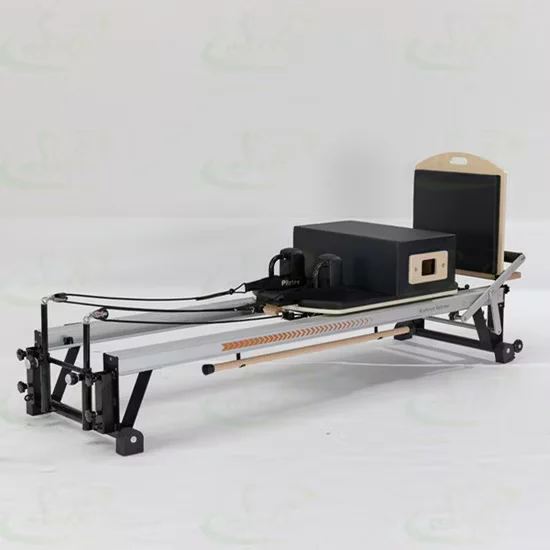
This unit covers classical Pilates repertoire, contemporary functional training, and targeted core rehabilitation within a single footprint. In a studio layout, it complements mat zones, Cadillac towers, and barrel clusters by providing apparatus-based resistance without requiring the linear floor space of a dedicated reformer and a separate Wunda chair. It suits moderate-to-high turnover environments where instructors rotate clients through station-based circuits. The 800 × 620 mm footprint allows placement along walls or in central islands, and the solid wood construction supports user weights across a broad range without frame deflection. The integrated combo chair function engages when the carriage is locked, converting the unit for seated pedal work and standing balance exercises. This apparatus collects no electronic data because it has no console, which means zero firmware maintenance and zero data integration overhead for facility operators.
Continuous Operation Without Motorized Duty Cycle Limits
Because there is no motor, there is no continuous duty rating to manage, no cooling period to enforce, and no thermal cutoff to reset. A wood Pilates reformer combo chair commercial installation can run back-to-back classes from early morning through evening with zero mechanical rest period required [NEED_CITE: non-motorized equipment duty cycle classification for continuous commercial operation]. The primary operational considerations are environmental: solid wood responds to humidity fluctuations, so the deployment room should maintain stable climate control to prevent rail warping or joint loosening over seasonal cycles. The unit requires no dedicated electrical circuit, which simplifies placement in retrofitted spaces where adding outlets is cost-prohibitive. Floor leveling is critical; an uneven subfloor transfers lateral load into the wood joinery, accelerating wear at the carriage rail interface. Standard rubber isolation pads beneath the feet protect finished floors and decouple minor structural vibration from the building slab.
Spring Tension, Rail Alignment, and Wood Frame Behavior
The resistance system relies on calibrated steel springs rather than magnetic eddy current or electromagnetic braking. Spring-based resistance provides a linear force curve that increases proportionally with carriage displacement, which differs from the parabolic feel of magnetic systems and the velocity-dependent resistance of air or fluid drives. Instructors adjust tension by clipping springs to different anchor points, a purely mechanical process requiring no electronic calibration. The wood frame serves a dual structural and acoustic purpose: solid hardwood has inherent mass-damping properties that absorb high-frequency vibration from spring engagement and carriage return, preventing the metallic ringing that steel-frame reformers sometimes transmit to hard floors [NEED_CITE: acoustic damping properties of solid hardwood versus tubular steel in fitness apparatus]. The 45 kg unit weight contributes to stability during aggressive pedal work and standing exercises. Rail alignment is set at the factory and maintained by periodic inspection of the carriage wheel bearings and rail surface condition; misalignment manifests as lateral drift or binding rather than electronic error codes.
What Specification Shortcuts Cost Over a Three-Year Deployment
A reformer built with engineered wood or MDF core instead of solid hardwood will show rail surface degradation and joint delamination within the first eighteen months of high-frequency studio use. Lightweight frames under 30 kg transmit pedal rebound vibration directly into the floor, generating noise complaints in multi-story deployments. Springs that lack consistent calibration across units create programming inconsistency when instructors move clients between stations. A unit that combines reformer and chair functions but uses a conversion mechanism requiring tools or extended downtime between modes creates class-transition friction, reducing throughput during peak scheduling windows. In hotel and residential deployments, visible hardware fasteners and unfinished wood edges signal commercial-grade compromise in spaces where interior design standards demand furniture-grade finish [NEED_CITE: material fatigue and joint failure rates in composite wood versus solid hardwood fitness equipment].
Why This Product Line Addresses the Gaps
The sub-35dB acoustic performance verified in hotel cardio deployments extends logically to non-motorized apparatus: when the surrounding motorized equipment is already quiet, the manual apparatus must not become the noise outlier. The 10,000-hour durability testing protocol applied to motorized drive components translates to spring cycle testing and wood joint fatigue validation on this reformer combo chair. The full six-series cardio family means a facility sourcing treadmills, bikes, and rowers from one manufacturer can add Pilates apparatus to the same procurement and support channel. OEM customization extends to wood finish tone, logo engraving, and hardware color to match studio branding without third-party modification. The 3D layout planning service addresses reformer spacing requirements, instructor sightline corridors, and mat zone adjacency when planning a mixed-apparatus studio floor. Post-deployment technical support covers spring replacement schedules, carriage wheel bearing maintenance, and wood finish care protocols specific to the deployed climate zone.
Documentation & Test Records
- CE declaration of conformity covering non-motorized Pilates apparatus structural safety requirements
- EN 957 test report validating static and dynamic load capacity on wood frame and rail system
- ISO 9001 certificate covering manufacturing process control from raw wood selection through final assembly
- Noise level test report confirming ambient sound generation during carriage travel and spring engagement
- Durability test record documenting spring cycle count and wood joint fatigue validation under repeated loading
- Installation and commissioning guide specifying floor leveling tolerances and climate stabilization requirements
Installation, Commissioning & Maintenance
- Maintain minimum 900 mm clearance on all sides for instructor access and carriage travel during group classes
- Shim unit feet on uneven subfloors to prevent lateral load transfer into wood carriage rail joinery
- Verify room humidity stays within manufacturer-specified range to prevent seasonal wood expansion or contraction
- Inspect carriage wheel bearings and rail surface for scoring or lateral play at quarterly intervals
- Lubricate spring anchor points and carriage wheel axles per schedule to prevent metallic wear debris accumulation
- Clean wood surfaces with pH-neutral cleaner only; avoid solvent-based products that degrade finish and expose raw grain
Sourcing the Right Configuration for Your Deployment
Provide the studio floor plan and total apparatus count to receive a 3D layout showing reformer spacing, instructor sightlines, and mat zone adjacency. Specify whether the deployment environment has stable year-round climate control, as this determines the acceptable wood species and finish specification. Confirm whether logo engraving, custom finish tone, or hardware color matching is required for brand consistency across a multi-unit rollout. Indicate the destination market so that packaging and shipping documentation align with regional import requirements for wood-treated products. State whether the units will be deployed in a single facility or distributed across multiple locations, as this affects spare parts provisioning and maintenance scheduling.
Frequently Asked Questions
Q: What wood species and finish options are available for commercial studio deployment?
A: The frame is constructed from solid hardwood selected for mass-damping properties and structural rigidity. Finish options include clear sealant preserving natural grain, tinted stain matching studio interior palettes, and opaque solid color coating for brand-specific deployments. The specific wood species and available finish catalog should be confirmed during the specification phase, as availability varies by production batch and export destination phytosanitary requirements.
Q: How does a solid wood non-motorized reformer compare to motorized models in noise and maintenance?
A: A non-motorized wood reformer generates no electrical or mechanical drive noise because resistance is spring-based and movement is user-driven. Maintenance focuses on mechanical wear points — carriage wheel bearings, spring fatigue, rail surface condition — rather than motor brushes, control boards, or cooling fans. The wood frame requires stable humidity to prevent seasonal dimensional changes. Overall maintenance burden is lower than motorized equivalents, and noise output is effectively limited to spring engagement and carriage travel sounds.
Q: Can the reformer and combo chair functions be used simultaneously or must they be converted?
A: The combo chair function engages when the carriage is locked in position, converting the unit for seated pedal work and standing balance exercises. The conversion is mechanical and tool-free, designed for rapid transition between class segments or individual client programming. Simultaneous use of both functions is not supported because the carriage must be stationary for safe pedal and standing exercise execution. Instructors typically program reformer and chair sequences as distinct blocks within a session.
Q: What is the customization process for logo, color, and specification adjustments?
A: Logo engraving, finish color selection, and hardware specification adjustments are scoped during the quotation phase. Customization requests are reviewed against production feasibility, minimum order quantity requirements, and lead time impact. Approved customizations are documented in the proforma invoice and confirmed via pre-production sample approval where applicable. Standard catalog configurations ship on standard lead times, while customized units require additional production scheduling.
Q: How is the equipment packaged and protected during international shipment?
A: The unit ships in a wood crate or reinforced carton designed to protect the precision-aligned rail and pulley systems from impact and compression damage during container transit. Internal blocking secures the carriage and spring assembly to prevent movement within the frame. Packaging specifications account for the 45 kg unit weight and the dimensional footprint to optimize container loading. Specific packaging format and palletization details are confirmed during the logistics planning phase based on order volume and destination port requirements.

![Foldable Core Training Wood Pilates Reformer for Commercial Studio Use [WARN] draft identifier mismatch](https://bicksport.com/wp-content/uploads/2026/08/foldable-core-training-wood-pilates-reformer-for-commercial-studio-use-warn-draft-identifier-mismatch-8538e8.webp)
![Folding Aluminum Alloy Pilates Reformer for Studio and Commercial Use [WARN] draft identifier mismatch](https://bicksport.com/wp-content/uploads/2026/08/folding-aluminum-alloy-pilates-reformer-for-studio-and-commercial-use-warn-draft-identifier-mismatch-3db7cd.webp)