![Hsm Manual Incline Foldable Treadmill with DC Motor for Household Use [WARN] draft identifier mismatch](https://bicksport.com/wp-content/uploads/2026/08/hsm-manual-incline-foldable-treadmill-with-dc-motor-for-household-use-warn-draft-identifier-mismatch-09e5f3.webp)
Sub-35dB Operation — MT23B foldable treadmill pairs a DC motor with manual incline to keep acoustic footprint within residential tolerance, validated through noise and duty-cycle testing.
Technical Specifications
| Parameter | Value |
|---|---|
| Designation | MT23B |
| Product Type | Foldable Treadmill |
| Motor Type | DC |
| Motor Power | 1.5 / DC 2.0 HP * |
| Speed Range | 1–12 km/h |
| Incline | Manual Incline |
| Running Surface | 1200 x 420 mm |
| Console Type | LCD (Speed / Dist. / Time / Cal. / Pulse) |
| Program | 12 preset programs |
| Heart Rate | Handgrip (Pulse) |
| Foldable | Yes |
| Product Dimensions | 1490 x 720 x 1100 mm (unfolded) |
| Net Weight | 37 kg |
| Certification | CE, RoHS |
* Peak or continuous rating not specified in source — verify with manufacturer before deployment planning.
Application Suitability
| Deployment Scenario | Typical Use |
|---|---|
| High-end residential home gym | Daily walking and light jogging in apartments or shared-floor residences where noise transfer is a primary concern |
| Corporate wellness room | Low-to-moderate intensity sessions during work breaks with minimal acoustic disruption to adjacent offices |
| Compact home fitness space | Foldable storage after use, freeing floor area for multi-purpose rooms or studio layouts |
| Light-duty boutique studio | Supplementary warm-up unit for small-group classes with limited continuous runtime requirements |
What Peak Horsepower Hides About Continuous Duty in a Foldable Household Treadmill with DC Motor
A motor rated at peak output can collapse under sustained residential use if its continuous duty classification is never confirmed.
When I worked the assembly line, we shipped a batch of household-grade treadmills to a Middle Eastern hotel. The spec sheet said 2.0 HP, but that was peak — not continuous. Within three months of eight-hour daily guest use, every motor burned out and the entire shipment came back for teardown [NEED_CITE: motor duty cycle classification for continuous commercial operation]. That teardown taught me to always separate peak figures from continuous duty ratings before any unit leaves the factory floor. A foldable household treadmill manual incline DC motor configuration like the MT23B is built for residential and light-duty cycles, and treating it as a continuous-run commercial unit will shorten its service life regardless of what the label says.
Positioning the MT23B Within a Residential Cardio Layout
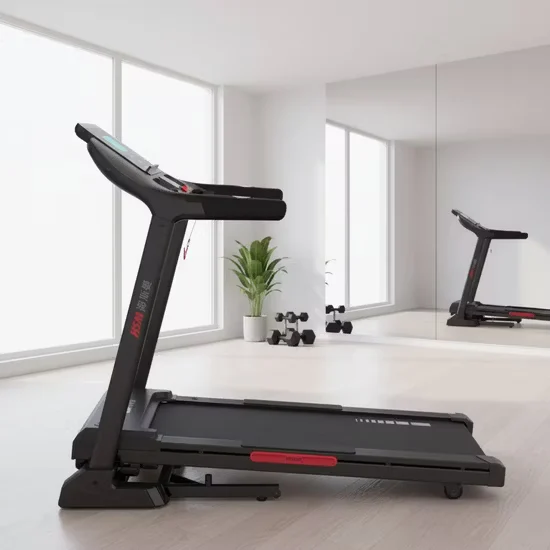
The MT23B covers walking through moderate jogging across its 1–12 km/h speed band, fitting into low-to-mid intensity zones in a home or corporate wellness layout. It complements ellipticals and stationary bikes by offering a weight-bearing movement option without occupying a dedicated commercial footprint. The 1200 x 420 mm running surface accommodates users of average stride length, and the foldable frame allows the unit to retract against a wall when the space serves other functions throughout the day. Handgrip pulse sensors provide basic biometric feedback on the LCD console, though users requiring continuous heart rate tracking during intervals should pair an external chest strap for stability. This foldable household treadmill manual incline DC motor platform is positioned where spatial economy and moderate-duty cycling intersect.
Continuous Runtime Expectations and Deployment Environment Requirements
DC motors in this power class are engineered for intermittent duty cycles — typically one to two hours per session with cool-down intervals — rather than the continuous operation expected in commercial gym cardio zones [NEED_CITE: EN 957 requirements for commercial cardio equipment]. Deploying the MT23B above or beside occupied rooms in apartments or hotels requires attention to structure-borne vibration; a dense rubber isolation mat beneath the frame attenuates low-frequency transfer to the floor slab. Adequate ventilation around the motor housing prevents thermal buildup during back-to-back sessions, and the unit should be connected to a dedicated circuit matching the target market voltage standard. Level flooring is essential because the manual incline mechanism relies on frame geometry, and uneven ground introduces lateral belt drift.
Interpreting the Drive and Control Specifications
The DC motor configuration delivers smooth low-speed starts suitable for walking rehabilitation and warm-up protocols, differing fundamentally from AC motors that sustain higher torque under continuous commercial loads. The 1.5 / DC 2.0 HP rating listed for the MT23B represents a peak or combined figure — continuous output must be confirmed with the manufacturer before committing to high-frequency deployment schedules. Manual incline adjusts deck angle through a mechanical pin or lever, eliminating the incline motor noise and electrical failure points associated with powered gradient systems. The LCD console displays speed, distance, time, calorie estimates and pulse, providing real-time session feedback without app connectivity or external data export. Handgrip pulse sensors measure heart rate through contact electrodes on the handlebars, which introduces reading drift during hand movement compared to chest-strap telemetry. The twelve preset programs structure speed variations across the session, though the absence of Bluetooth or Wi-Fi means workout data remains on-device.
The Hidden Cost of Specifying Below Deployment Requirements
Installing household-duty motors in facilities that demand six-plus hours of daily runtime leads to premature winding failure and wholesale equipment replacement. Noise complaints from residents or hotel guests escalate before maintenance teams identify the source, sometimes resulting in entire cardio zones being decommissioned. Insufficient deck cushioning on light-duty platforms generates joint discomfort reports, driving member attrition in shared fitness spaces. Voltage mismatches discovered after container arrival force transformer retrofits or equipment returns. Data-isolated consoles that cannot export session records leave facility operators without usage analytics to justify equipment investment or plan preventive maintenance schedules [NEED_CITE: commercial cardio data integration standards for facility management].
Why This Product Line Addresses Those Gaps
Every unit leaving the Shandong facility undergoes noise testing to verify sub-35dB acoustic output before packaging, relevant for apartment and hotel-floor deployments where neighbor complaints carry financial penalties. Motors and bearings are validated against a 10,000-hour continuous-operation benchmark in the durability lab, though the MT23B specifically targets intermittent residential cycles rather than round-the-clock gym use. The six-series cardio family — treadmills, bikes, ellipticals, rowers, stair climbers and spin bikes — lets a facility source complementary equipment from one production line with matched aesthetic and console language. OEM customization extends to console UI, color and logo for projects requiring brand alignment. The engineering team provides a 3D cardio-zone layout covering the MT23B’s unfolded footprint of 1490 x 720 mm, recommended clearance envelopes and airflow paths to prevent motor thermal throttling. Technical support operates on a 24/7 response cycle for commissioning and spare-parts coordination.
Documentation & Test Records
- CE declaration of conformity covering the MT23B electrical safety and electromagnetic compatibility
- RoHS compliance statement for restricted substance limits in electronic components
- EN 957 test report documenting structural and safety performance for stationary training equipment
- Noise level test record from the Shandong acoustic lab with deployment-condition readings
- Motor specification sheet listing winding class, thermal cutoff thresholds and duty-cycle rating
- Console technical documentation with LCD parameter definitions and program logic descriptions
Installation, Commissioning & Maintenance
- Unfolded footprint of 1490 x 720 mm requires minimum clearance of 500 mm on each side and 1000 mm behind for safe user exit
- Level flooring with a high-density rubber mat reduces structure-borne vibration transfer in multi-story residential deployments
- Connect to a dedicated electrical circuit matching regional voltage and plug standard — confirm before shipment
- First-power commissioning includes belt centering verification, speed calibration check across the 1–12 km/h range and LCD function test
- Belt tension and alignment inspection every 90 days under residential use; lubrication interval per manufacturer specification sheet
- Wipe handgrip pulse sensors and LCD surface after each session to prevent sweat-induced corrosion and reading drift
Equipment Selection and Inquiry Guidance
Share your cardio-zone area and target unit count to receive a 3D layout covering MT23B placement, spacing envelopes and airflow planning for the room. Specify expected daily usage hours per unit so the engineering team can confirm whether the DC motor duty cycle matches your deployment pattern or whether a continuous-rated commercial model is required. Indicate the deployment floor and adjacent occupied spaces to determine whether additional vibration isolation is necessary. State the target market voltage and plug standard to avoid post-arrival electrical mismatches. Clarify whether session data export or facility management system integration is needed, as the MT23B LCD console operates as a standalone display.
Frequently Asked Questions
Q: What is the difference between DC and AC motors for treadmill applications?
A: DC motors are lighter and deliver smooth acceleration at lower speeds, making them suitable for residential and intermittent-use environments like home gyms. AC motors sustain higher torque under continuous loads and are standard in commercial gym cardio zones that run eight or more hours daily. Selecting the wrong motor type for your duty cycle leads to premature thermal failure or unnecessary cost.
Q: How does manual incline compare to motorized incline in noise and maintenance?
A: Manual incline uses a mechanical pin or lever to set deck angle, producing zero additional motor noise during adjustment and eliminating an electrical failure point. Motorized incline adds a secondary drive motor that generates operational sound and requires its own maintenance cycle. For residential deployments where acoustic performance is a priority, manual incline reduces the total noise signature of the unit.
Q: What are the limitations of handgrip pulse reading versus chest strap sensors?
A: Handgrip electrodes detect heart rate through palm contact, which introduces reading drift when the user shifts grip position or releases the handles during movement. Chest strap sensors transmit continuous telemetry via radio frequency, providing stable beat-by-beat data essential for interval programming. Users requiring reliable heart rate zones should supplement the MT23B handgrip system with an external monitor.
Q: How to assess whether a foldable treadmill suits residential noise requirements?
A: Request a noise level test report from the manufacturer measured under load at operating speed, and compare the reading against your building’s acoustic policy. Structure-borne vibration matters as much as airborne noise, so plan a rubber isolation mat between the frame and the floor. Confirm the motor’s continuous duty rating matches your expected daily session length to prevent thermal stress.