![Hsm Fashion Design Durable Hydraulic Cylinder Treadmill MT23B [WARN] draft identifier mismatch](https://bicksport.com/wp-content/uploads/2026/08/hsm-fashion-design-durable-hydraulic-cylinder-treadmill-mt23b-warn-draft-identifier-mismatch-71f749.webp)
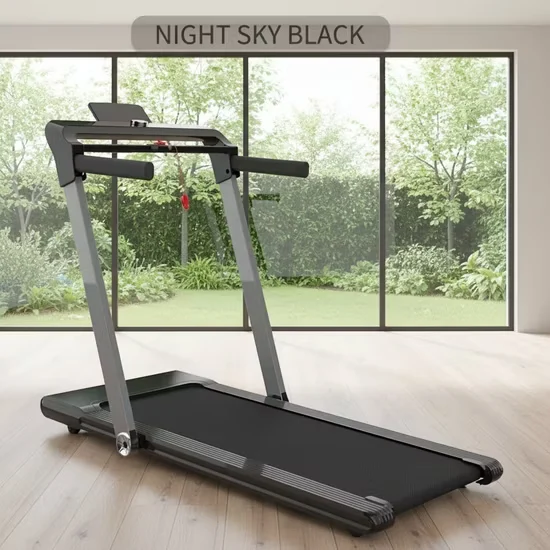
Hydraulic Folding Engineering — MT23B uses a DC motor paired with hydraulic cylinder deployment to reduce storage footprint while maintaining frame rigidity during repeated folding cycles.
Technical Specifications
| Parameter | Value |
|---|---|
| Designation | MT23B |
| Product Type | Foldable Treadmill |
| Motor Type | DC |
| Motor Power | 1.5 / DC 2.0 HP * |
| Speed Range | 1–12 km/h |
| Running Surface | 1200 x 420 mm |
| Console Type | LCD (Speed / Distance / Time / Calories / Pulse) |
| Program | 12 preset programs |
| Heart Rate | Handgrip pulse sensors |
| Foldable | Yes (hydraulic cylinder folding) |
| Product Dimensions (Unfolded) | 1490 x 720 x 1100 mm |
| Net Weight | 37 kg |
| Gross Weight | 42 kg |
| Certification | CE, RoHS |
*Peak or continuous rating not specified in source; verify duty cycle before procurement.
Application Suitability
| Deployment Scenario | Typical Use |
|---|---|
| High-end residential home gym | Daily personal cardio in space-constrained apartments |
| Corporate wellness room | Intermittent use during employee breaks |
| Boutique studio recovery zone | Light warm-up or cool-down sessions between classes |
What Peak Horsepower Hides About Continuous Duty in a Foldable Treadmill DC Motor Hydraulic Folding Setup
Motor labeling conventions routinely obscure the difference between peak output and sustained operational capacity.
When facility managers see a treadmill rated at 2.0 HP, the assumption is continuous delivery. In reality, DC motors in this class frequently achieve that figure only at peak load for short bursts. I have inspected units where the nameplate promised adequate power, yet thermal cutouts tripped after forty minutes of back-to-back use in a corporate wellness room. The MT23B lists 1.5 / DC 2.0 HP without clarifying which figure represents continuous duty. This ambiguity matters because a foldable treadmill DC motor hydraulic folding configuration already operates under structural constraints — the frame must handle repeated folding cycles while the motor manages heat dissipation in a compact housing. Procurement teams should request the continuous duty rating explicitly before committing to volume orders [NEED_CITE: motor duty cycle classification for continuous commercial operation].
Positioning the MT23B Within a Compact Cardio Layout
The MT23B covers steady-state walking through moderate jogging at speeds up to 12 km/h, fitting users who prioritize convenience over high-intensity sprint intervals. In a mixed cardio zone, it complements heavier commercial treadmills by serving lighter-traffic areas where floor space is limited. The 1200 x 420 mm running surface accommodates users of average height performing walking and jogging gaits, though taller users may notice the shorter belt during extended strides. Hydraulic cylinder folding allows the unit to stand vertically between sessions, making it viable for corporate wellness rooms or apartment gyms where a foldable treadmill DC motor hydraulic folding design must share floor space with other equipment. Handgrip pulse sensors provide basic heart rate feedback without requiring external chest strap pairing.
Continuous Operation Limits and Deployment Environment Factors
This unit is engineered for intermittent personal use cycles rather than the all-day occupancy typical of chain gym cardio zones. The DC motor generates less heat than an AC equivalent at comparable loads, but compact housing reduces airflow around the motor compartment. Deploying the MT23B on upper residential floors requires attention to vibration transmission — the 37 kg net weight means less mass to dampen footfall vibration through the deck. Facilities should ensure the floor surface is level and consider a rubber isolation mat beneath the unit. Voltage compatibility must be confirmed with the target market before shipment, as plug standards and frequency requirements differ across regions [NEED_CITE: voltage and plug standard requirements for fitness equipment export markets]. The LCD console operates independently without facility management system integration, so usage data remains on-device.
Interpreting the Drive and Control Specifications
DC motors in the 1.5–2.0 HP range deliver adequate torque for walking and jogging but operate outside their optimal efficiency band when pushed to sustained running speeds near 12 km/h. The hydraulic cylinder folding mechanism replaces manual lifting or gas-strut systems, offering controlled descent when deploying the deck and reducing physical strain on the user. LCD consoles displaying speed, distance, time, calories, and pulse represent a straightforward feedback loop — no touchscreen interface, no app connectivity, no entertainment streaming. This simplicity reduces electronic failure points but limits the unit to self-guided workouts using the 12 preset programs. Handgrip pulse sensors are subject to motion artifact during active running, so heart rate readings are most stable during walking or stationary recovery periods. The absence of incline specification indicates a flat-deck configuration, which simplifies the mechanical structure but eliminates gradient training variety.
The Hidden Costs of Specification Compromises
Units deployed beyond their intended duty cycle fail predictably — thermal cutouts trip, motor brushes wear prematurely, and control boards overheat in confined housings. I have seen batch replacements ordered after residential-grade treadmills were installed in hotel fitness centers where guests ran units for hours consecutively. Noise from inadequate deck cushioning transmits through floor slabs, generating guest complaints that surface at the front desk long before maintenance logs the issue [NEED_CITE: noise transmission standards for fitness equipment on occupied floors]. When procurement decisions rely solely on peak horsepower without verifying continuous duty ratings, facilities absorb replacement costs and member dissatisfaction. Data gaps from standalone consoles leave operators unable to track equipment utilization or justify expansion investments.
Why This Product Line Addresses Those Gaps
Our commercial cardio range includes sub-35dB whisper-quiet operation verified across hotel deployments — a benchmark the MT23B should be measured against when considering noise-sensitive installations. Motors and bearings across the full line undergo 10,000-hour continuous durability testing, establishing a baseline that clarifies where intermittent-use equipment fits within a mixed fleet. IoT-enabled consoles on our commercial series provide app sync and facility management integration, contrasting with the MT23B standalone LCD approach and helping buyers understand the data capability spectrum. The six-series cardio family allows facilities to source every discipline from one manufacturing line, so the MT23B can slot into a broader order that includes heavier-duty treadmills, ellipticals, and rowers. OEM customization covers console UI, color, and logo, and our team provides free 3D cardio-zone layout and airflow planning that accounts for the MT23B 1490 x 720 mm unfolded footprint and required clearance zones.
Documentation & Test Records
- CE declaration of conformity for the MT23B foldable treadmill unit
- EN 957 test report covering structural and safety requirements
- ISO 9001 certificate for manufacturing quality management
- RoHS compliance documentation for restricted substances
- Motor specification sheet clarifying peak and continuous duty ratings
- LCD console technical documentation with preset program parameters
Installation, Commissioning & Maintenance
- Position the MT23B with clearance behind and above for hydraulic cylinder folding arc
- Place on a level surface with a rubber isolation mat to reduce vibration transmission
- Confirm voltage and plug standard match local supply before connecting the DC motor
- Run the unit unloaded through all 12 preset programs to verify LCD console output
- Inspect running belt alignment and tension on the 1200 x 420 mm deck periodically
- Wipe handgrip pulse sensors after each use to maintain conductivity and prevent corrosion
Scoping Your Equipment Selection
Provide your cardio zone square footage and intended equipment count so our team can generate a 3D layout addressing the MT23B footprint alongside complementary units. Specify expected daily usage hours per treadmill to confirm whether DC motor duty cycles match your operational pattern. Indicate deployment floor level and adjacent occupied spaces to assess noise and vibration requirements. State your target market voltage and plug standard to ensure electrical compatibility upon arrival. Clarify whether console data integration with facility management software is required, as the MT23B LCD operates as a standalone system.
Frequently Asked Questions
Q: What is the difference between peak and continuous motor power for treadmills?
A: Peak power represents the maximum output a motor can deliver for brief intervals, while continuous power reflects sustained operational capacity under load. Manufacturers sometimes list only peak figures, which can mislead procurement decisions. For a foldable treadmill in intermittent use, peak ratings may suffice, but any shared or commercial deployment should verify continuous duty ratings to prevent thermal cutouts and premature motor failure.
Q: How does hydraulic cylinder folding compare to manual or gas-strut folding mechanisms?
A: Hydraulic cylinders provide controlled, assisted movement when raising or lowering the deck, reducing the physical effort required from the user. Manual folding relies entirely on user strength, while gas struts offer partial assistance but may lose pressure over time. The MT23B hydraulic system maintains consistent resistance throughout the folding arc, though operators should inspect the cylinder seals periodically for fluid leaks or pressure loss.
Q: Can the LCD console connect to external fitness apps or facility management systems?
A: The MT23B LCD console operates as a standalone display showing speed, distance, time, calories, and pulse across 12 preset programs. It does not include Bluetooth, Wi-Fi, or data export interfaces for external app synchronization or facility management software integration. Facilities requiring usage analytics or member tracking should consider units with IoT-enabled consoles that support app sync and network connectivity.
Q: What maintenance does a DC motor treadmill require compared to AC motor models?
A: DC motors typically require periodic brush inspection and replacement as wear components, while AC motors operate brushless with fewer consumable parts. Both types need belt tension checks, deck lubrication, and bearing inspection. The MT23B DC motor is sized for intermittent personal use, so thermal management and brush wear progress slower than in continuous commercial operation. Operators should schedule motor compartment cleaning to prevent dust accumulation around ventilation openings.

![Gym Machine Manual Treadmill Gym Equipment Unpowered Curved Treadmill [WARN] draft identifier mismatch](https://bicksport.com/wp-content/uploads/2026/08/gym-machine-manual-treadmill-gym-equipment-unpowered-curved-treadmill-warn-draft-identifier-mismatch-66d3b4.webp)